Summer water sports availability: varied difficulty options with required safety equipment 2026
Summer water sports availability for 2026 reflects a broad and growing landscape of options, with operators across North America and Europe offering experiences calibrated to every skill level. From beginner-friendly kayak rentals on protected lakes to multi-day whitewater expeditions through canyon rapids, the range of difficulty options is wider than in any previous season. Critically, each category carries specific required safety equipment standards governed by federal agencies, state regulators, and certified outfitters, making pre-trip awareness essential for all participants.
How the 2026 Season Is Structured Across Skill Levels
The 2026 season has seen a consistent pattern across operators: activities are explicitly tiered by difficulty, and each tier carries non-negotiable equipment requirements. At the entry level, venues such as the Natick Boathouse on Lake Cochituate in Massachusetts, which opened May 23, 2026, offer kayak, canoe, and stand-up paddleboard rentals suitable for first-time participants on calm, protected water. 1 At the advanced end, multi-day river expeditions such as the 4-day Gates of Lodore trip on the Green River in Dinosaur National Monument run Class III-IV rapids with a minimum age requirement of 6 and departure dates capped by National Park Service permit allocations. 2
The American Canoe Association classifies river difficulty from Class I through Class VI, a framework that operators and rental companies use to communicate genuine risk levels to participants before they commit to a trip. 3 Operators including WOKA Rentals, which offers solo kayaks, tandem kayaks, paddleboards, river surfboards, and body boards with age and weight restrictions per vessel category, structure their rental fleets around these classifications to match equipment to participant capability. 4
Flatwater and Calm-Condition Activity Availability
Flatwater options represent the most widely accessible tier of 2026 summer water sports. Strawberry Bay Marina in Utah, operating on over 19,000 acres of pristine reservoir, offers boat, paddle, and kayak rentals with seasonal hours running from Memorial Day weekend through November. 5 Similarly, Tamarack Resort Marina on Lake Cascade in Idaho offers kayaks, stand-up paddleboards, pontoon boats, wake boats, jet skis, and e-foils from May 22 through September 7, 2026, operating daily from 8 AM to 8 PM. 6
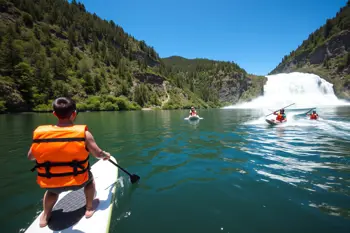
Stand-up paddleboarding continues to grow in popularity but carries regulatory weight that many participants overlook. Transport Canada classifies paddleboards as human-powered watercraft when used for navigation, requiring a Canadian-approved lifejacket or PFD for each person. 7 In the United States, the U.S. Coast Guard similarly designates SUPs as vessels, mandating a PFD and a sound-producing device such as a whistle. 8 These requirements apply regardless of perceived difficulty or water conditions.
Tow Sports: Wakeboarding, Wakesurfing, and Slalom Skiing
Tow sports in 2026 are accessible across a wide range of lakes, with commercial operators offering both captained sessions and self-captained rentals for qualified boaters. North Tahoe Watersports, operating from three locations on the North Shore of Lake Tahoe and running its season from May 7 through September 22, 2026, offers Cobalt bowrider vessels for water skiing, MasterCraft surf boats for wake surfing and wakeboarding, and single and double-decker tritoons for larger groups. 9 At Lake Norman in North Carolina, self-captained MasterCraft NXT24 rentals are available exclusively to guests with documented inboard wake boat operating experience, with the vessel featuring a 3,300-pound ballast system and a 6.0L 380HP Ilmor engine. 10
Lake Sidney Lanier in Georgia, with 38,000 acres of water and nearly 700 miles of shoreline, has developed into one of the Southeast's most active hubs for wakeboarding, wakesurfing, and hydrofoiling. 11 At Lake Powell in the Southwest, federal regulations require a dedicated observer watching the surfer or a Coast Guard-approved wide-angle mirror on the boat, and all riders must wear Coast Guard-approved life jackets at all times. Water temperatures at Lake Powell reach 70 to 80 degrees Fahrenheit from July through August, enabling extended sessions. 12 Slalom water skiing involves a single ski, boat speeds up to 36 mph for men and 34 mph for women in tournament configurations, and a tow rope and handle rated to marine-grade standards. 13
Whitewater Rafting: Difficulty Tiers and Mandatory Guide Requirements
Commercial whitewater rafting in 2026 spans a clearly defined difficulty range, and outfitters universally mandate certified professional guides for Class III and above. On Maine's Kennebec River, Crab Apple Whitewater runs trips through Class III-IV rapids including Big Mama and Magic Falls across a seven-mile gorge, with check-in at 8:30 AM, mandatory life jacket and helmet fitting for all guests, and a safety briefing and paddling instruction session before departure. Raft capacity is 8-9 paddlers, and adult weekday pricing for the summer and fall season runs May 23 through October 4. 14
In Tyrol, Austria, AREA 47 offers a beginner-rated rafting trip through the Imst Gorge lasting up to three hours including safety talk, gear fitting, and transfer. Equipment provided includes a wetsuit, shoes, helmet, and life jacket. Minimum age is 14, maximum weight is 130 kg, and all tours are exclusively guided by certified professionals with a practice session conducted in a calm section at the start. 15 In Argentina, Potrerillos operators combine 12 kilometers of Mendoza River rafting with a 1,400-meter canopy circuit, with full safety gear and a professional guide included for each component. 16
Youth-Oriented Programs and Structured Camp Formats
Structured camp programs in 2026 offer youth-specific pathways into water sports with embedded safety frameworks. Muskoka Wake Camp in Ontario, Canada, now in its 15th season, operates across 8 locations with a maximum of 8 campers per session, 35 certified and insured instructors, Bronze Cross and CPR certification among staff, and over 30 hours of coaching per week. The program accepts ages 6 to 16 across all skill levels, with safety gear included and daily progress feedback provided. 17
PGL Adventure Holidays' Aqua Explorer camp at Osmington Bay in Dorset, UK, running July 25 through August 1, 2026, provides ages 13 to 16 with access to coasteering, sailing, wakeboarding, aqua parks, kayaking, dragon boating, raft building, giant stand-up paddleboarding, keelboat sailing, and river canoeing, all led by experienced instructors with 24-hour supervision. 18 Charleston Aqua Park in South Carolina operates a floating inflatable obstacle course with certified lifeguards on duty and life jackets provided for every guest, running 45-minute sessions from May through September for ages 6 and up. 19
Required Safety Equipment: A Cross-Activity Overview
Across all difficulty levels and activity types, required safety equipment follows a consistent regulatory logic. The U.S. Coast Guard mandates that personal watercraft operators wear a USCG-approved life jacket at all times, and most states enforce this independently through boating law statutes administered by the National Association of State Boating Law Administrators. 20 Water sports rental providers in the U.S. are legally required to provide a USCG-approved PFD for every passenger on a rented vessel, and waivers combined with safety briefings are a standard pre-participation requirement at regulated commercial operations. 21
The following table summarizes required safety equipment by activity category for the 2026 season:
| Activity | Minimum Required Equipment | Difficulty Range | Additional Notes |
|---|---|---|---|
| Stand-Up Paddleboarding | PFD, whistle/sound device, leash | Beginner to Intermediate | Classified as a vessel under USCG and Transport Canada rules |
| Kayaking / Canoeing | PFD, paddle float, whistle | Class I to Class IV | ACA introductory course recommended for open water |
| Wakeboarding / Wake Surfing | USCG-approved life jacket, dedicated spotter or mirror | Beginner to Advanced | Specific boat ballast and speed requirements apply |
| Whitewater Rafting | Helmet, specialized PFD, wetsuit (conditions-dependent) | Class III to Class IV | Certified professional guide mandatory at commercial operators |
| Tubing | Life jacket, Type IV throwable cushion, spotter | Family / Low | Marine-grade tow ropes rated to rider weight required |
| Jet Ski / PWC | USCG-approved life jacket for all operators | Beginner to Intermediate | Tow rope 50 to 75 feet for wake setups; trim and ballast must be configured correctly |
Participants planning to join programs across any of these categories should verify local regulatory requirements before booking, as state-level rules frequently layer additional mandates on top of federal minimums. The CDC and American Red Cross both provide supplementary drowning prevention and swim readiness guidance that operators increasingly incorporate into pre-activity safety briefings, particularly for youth participants. 22
Sources
- Adventures Unbound Commonwealth Collection - Natick Boathouse (commonwealth.adventuresunbound.com)
- Dinosaur River Expeditions - Gates of Lodore 2026 Green River Rafting (dinosaurriverexpeditions.com)
- American Canoe Association - Safety Standards and Skill Classifications (americancanoe.org)
- WOKA Rentals - visitwoka.com
- Strawberry Bay Marina - Summer Rentals (strawberrybay.com)
- Tamarack Resort Marina - The Marina on Lake Cascade (tamarackidaho.com)
- Kelowna Capital News / Canadian Board Company - Paddleboard Safety on Canadian Lakes 2026 (smb.kelownacapnews.com)
- U.S. Coast Guard Boating Safety - PFD and Life Jacket Requirements (uscgboating.org)
- EIN Presswire / Travel and Tour World - North Tahoe Watersports Summer 2026 Fleet Announcement (einnews.com)
- RideLKN - MasterCraft Experience Center Lake Norman Wake Boat Rentals (ridelkn.com)
- Pull Pro Shop - Lake Lanier Watersports Guide (pullproshop.com)
- Boatsetter - Wakesurfing at Lake Powell: Complete 2026 Guide (boatsetter.com)
- Airkayaks - Slalom Skiing on Water: Equipment, Brands, and Buying Guide (airkayaks.com)
- Crab Apple Whitewater - Kennebec River Whitewater Rafting (crabapplewhitewater.com)
- AREA 47 - Rafting Imst Gorge in Tyrol (area47.at)
- Vempra - Adventure Day in Potrerillos: Rafting and Canopy (vempra.tur.ar)
- Muskoka Wake Camp (muskokawake.ca)
- PGL Adventure Holidays - Aqua Explorer, Osmington Bay, Jul 25, 2026 (adventureholidays.pgl.co.uk)
- Charleston Aqua Park - Johns Island SC (charlestonaquapark.com)
- National Association of State Boating Law Administrators (nasbla.org)
- America Outdoors - Safety Guidelines for Commercial River Operators (americaoutdoors.org)
- CDC - Drowning Prevention Guidance (cdc.gov)