All In One Functional Trainers for Weight Loss in the United States: A Data-Driven Consumer Guide
How Functional Trainers Support Weight Loss Through Resistance Training
All-in-one functional trainers support weight loss primarily by enabling compound movements that engage multiple large muscle groups simultaneously, which increases caloric expenditure during and after each session. According to the American Council on Exercise, resistance training with functional equipment raises metabolic rate, contributing to the energy deficit necessary for fat reduction. 1 National Institutes of Health research further confirms that consistent resistance training with functional equipment increases overall energy expenditure and supports sustainable weight loss outcomes over time. 2
Fitness guidelines broadly suggest that incorporating functional trainer workouts three to four times per week, combined with adequate nutritional management, can contribute to a sustainable reduction of approximately one to two pounds per week. 3 Unlike isolated single-joint machines, functional trainers also activate stabilizer and core muscles throughout compound movements, which meaningfully increases total caloric output per session. The adjustable cable angles allow users to replicate real-world movement patterns, making the training stimulus more comprehensive than most fixed-path alternatives.
Core Specifications That Determine Fat-Loss Effectiveness
Weight stack capacity is one of the most consequential specifications when evaluating functional trainers for a weight-loss context. Most residential all-in-one models in the United States feature dual independent weight stacks ranging from approximately 150 to 220 pounds per side. 4 Pulley ratio matters equally: machines operating at a 2:1 ratio effectively deliver roughly half the loaded stack weight as cable resistance, while 1:1 systems like the GMWD SM12 2.0 deliver the full loaded weight as resistance, making them more demanding per increment and better suited to users who want progressive overload at higher intensities. 5
Pulley height adjustability across the full vertical column determines which movement patterns are accessible. A wider adjustment range, from a low position near the floor to a high point at or above shoulder height, allows lat pulldowns, cable rows, cable flys, standing presses, and rotational core exercises to be performed without repositioning or compromising form. Machines offering 16 or more height positions, such as the EonfitOmni E5 2.0 with its 16 adjustable height positions, provide the exercise variety that keeps training metabolically demanding over time. 6
Price Tiers and What Each Range Delivers in the U.S. Market
The United States all-in-one functional trainer market spans a wide price spectrum, with meaningful differences in build quality, weight stack capacity, and included stations at each level. The following table summarizes typical characteristics across price tiers based on current market data:
| Price Range | Representative Models | Key Characteristics |
|---|---|---|
| Under $1,500 | Megastar P107, GMWD SM12 2.0, Major Fitness B52 | Plate-loaded or lightweight stacks, 5-in-1 stations, 14-gauge steel, basic pulley systems |
| $1,500 to $2,500 | REP Fitness Arcadia ($2,199), Force USA G3 ($1,199), Bowflex Xtreme SE | Selectorized stacks, broader exercise variety, engineered in USA, dual independent cables |
| $2,500 to $4,500 | Major Fitness B17 ($3,999), ATX MXL-700 ($3,999), Force USA FTR (~$3,400-$3,500), Vesta Pioneer ($4,674) | Smith machine integration, 200+ lb stacks, 11-gauge steel, commercial-style build, 1,000+ lb safety ratings |
| Above $4,500 | BodyKore MX1162 ($6,999), Force USA C10, Inspire FT2 PRO ($5,999), Gronk CFT ($5,999) | Commercial-grade frames, dual 220 lb stacks, swivel pulleys, leg press stations, professional installation options |
The Body-Solid GFT100/160 Functional Trainer at approximately $2,315 is cited by industry guides as a strong balance of price, footprint, and exercise variety for most home buyers. 7 At the commercial end, the BodyKore MX1162 Universal Trainer features a rolled-steel oval tube frame, dual 220-pound stacks, 15 height adjustment positions, and a weight capacity supported by six weight pegs, targeting intermediate to advanced users who require durability matching light commercial standards. 8
Key Models With Smith Machine Integration for Total-Body Training
A significant subcategory within all-in-one functional trainers combines a Smith machine with dual cable stations and a power rack, allowing users to perform barbell movements, guided lifts, and cable exercises without purchasing separate equipment. The Major Fitness Heritage Series B17 integrates a Smith machine with interchangeable 1:1 and 2:1 pulley ratios, a built-in weight stack expandable to 260 pounds per side, reinforced safety arms rated to a 1,000-pound drop test, and a linear-bearing Smith system designed for smooth controlled movement. 9 The ATX All-In-One Trainer MXL-700 takes a similar approach, combining a squat rack, Smith machine, and cable crossover into one unit with dual 242-pound weight stack blocks and a total machine weight of 1,190 pounds built from 11-gauge steel tubing. 10
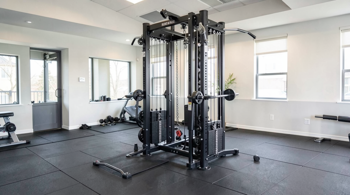
The Force USA C10 represents a more advanced configuration, featuring a world-first center cable system with six total pulley connection points driven by dual 220-pound weight stacks, plus 200-degree swivel pulley trolleys operating at a 2:1 ratio. 11 The XPT All-In-One Trainer integrates dual 209-pound weight stacks, adjustable pulleys, free-bar spotter arms, a lat pulldown station, and dumbbell storage, positioning itself as a full commercial strength experience for home installation. 12 These multi-function systems are particularly relevant for weight loss because they support high-volume, varied training sessions within a single footprint, sustaining workout density without transitions between separate machines.
Space Footprint and Practical Installation Realities
Floor space is a consistent constraint in U.S. home gym planning. All-in-one functional trainers generally occupy approximately 7 to 10 feet of floor space in their standard configurations. 3 The Force USA X15 Pro, for instance, has a footprint of 70 inches wide by 57 inches deep by 91 inches tall, which is notably more compact than purchasing a standalone power rack, cable crossover, and lat pulldown machine separately. 13 The Force USA G6 occupies 72 inches wide by 64 inches deep by 91 inches tall, reflecting typical mid-range dimensions for this category. 14
Assembly complexity is a frequently underreported friction point. Multiple independent reviewers note that tools beyond standard household kits are often required, and some models involve multi-hour assembly sessions. The Quantum Free Trainer 2, for example, was noted to require oversized tools not typically owned by home gym buyers, plus a learning curve for dialing in trolley and safety arm positions across different lifts. 15 Buyers should also account for ceiling height: most all-in-one functional trainers stand between 87 and 91 inches tall, which requires a minimum ceiling clearance of 8 feet and often more when overhead pulley movements are involved.
Risks, Limitations, and Factors That Affect Long-Term Weight Loss Results
All-in-one functional trainers carry legitimate limitations that prospective buyers should weigh carefully. Plate-loaded systems, while affordable, require the user to own sufficient weight plates to generate progressive overload as fitness improves, adding ongoing cost and logistics. Selectorized stack machines eliminate this issue but introduce mechanical components, including cables, pulleys, and selector pins, that require periodic inspection and maintenance to remain safe. Power rods used in Bowflex-style systems may wear out over extended use, reducing resistance consistency. 16
From a weight-loss physiology standpoint, resistance training alone is generally not sufficient without addressing caloric intake. The machines enable the training stimulus but do not independently produce fat loss without the nutritional component. Beginners often achieve faster initial results because the novelty stimulus generates significant early metabolic adaptation, but intermediate and advanced users must ensure progressive overload is consistently applied to avoid plateaus. The functional trainer format provides guided trajectories that reduce injury risk compared to free weights, making it safer for solo training, but that same guided path can limit the full range of stabilizer muscle recruitment that free-weight compound lifts produce. Budget models using lighter gauge steel, such as 14-gauge frames, may also introduce wobble or frame flex under heavy loading, which affects both safety and training confidence over time.
Sources
- American Council on Exercise - acefitness.org
- National Institutes of Health - nih.gov
- LLM General Research - Functional Trainer Weight Loss Guidelines
- EverythingGyms - everythingyms.com/blogs/guides/how-to-choose-functional-trainer-2026
- GMWD Fitness - gmwdfitness.com/products/smith-machine-with-cable-crossover
- EonfitOmni E5 2.0 - eonfitfitness.com/products/eonfit-e5-multi-function-smith-machine
- EverythingGyms Buyer Guide - everythingyms.com
- BodyKore MX1162 via GymsHQ - gymshq.com/products/bodykore-universal-trainer-mx1162
- Major Fitness B17 - majorfitness.com/products/heritage-series-b17-all-in-one-functional-trainer-with-smith-machine
- ATX Fitness MXL-700 - atxfitness.com/atx-all-in-one-trainer-mxl-700
- Force USA C10 via Premier Fitness Source - premierfitnesssource.com/product/force-usa-c10-all-in-one-trainer
- XPT All-In-One Trainer - thexpt.com/product/xpt-all-in-one-trainer-ultimate-home-gym-solution
- Force USA X15 Pro Review - garagegympro.com/force-usa-x15-pro-review
- Force USA G6 Review - garagegympro.com/force-usa-g6-review
- Quantum Free Trainer 2 Review - ironclinicgym.com/reviews/quantum-free-trainer
- Bowflex Xtreme SE Review - v9fitness.fit/post/bowflex-ultimate-home-gym-review