Tactical transport military equipment stocks: A guide to logistical documentation and payload weight specifications
The Documentation Architecture Behind Military Equipment Movement
Military cargo does not move on trust or verbal instruction. Every shipment of tactical equipment operates within a layered architecture of formal documentation that begins before freight is booked and continues through post-delivery inspection. The U.S. Department of Defense mandates standardized logistics processes that support transportation and movement documentation across all service branches. 1 At the center of this architecture is MIL-STD-129, a formal U.S. military standard that defines uniform marking requirements for all military equipment, supplies, and assets being shipped or stored for the DoD and other federal government agencies. First published in 1953 to address inconsistent marking on sea-transported military cargo during the Korean War, MIL-STD-129 has been updated regularly, with the latest revision, MIL-STD-129R, released in 2019. 2
A second critical packaging standard, MIL-STD-2073, governs how military cargo is physically prepared for movement. This standard is a contractual requirement on virtually every defense supply contract because military cargo moves through environments and handling chains that commercial packaging is not designed for, including depot storage, airlift in military aircraft, and forward operating environments. 3 Parallel to these packaging rules, DD Form 1750 provides a standardized packing list format for documenting cargo contents and tracking serialized military equipment across shipment events. 4 Shipments that omit or incorrectly complete this documentation face rejection at receiving docks, potential contract violations, and carrier disputes that can compromise mission readiness timelines.
Payload Weight Specifications: Core Metrics and Calculation Logic
Payload weight is not an estimate in military logistics. It is a precisely derived figure governed by the relationship between gross vehicle weight, tare weight, and net payload capacity. For standard truck transport, the formula is direct: GVW minus tare weight equals legal payload. In the European Union, a 5-axle articulated combination operates at a maximum GVW of 40,000 kg, with a typical tare of approximately 16,000 kg, yielding a net payload of roughly 24,000 kg. The U.S. federal limit for the same configuration is 80,000 lbs, or approximately 36,287 kg. 5 These figures shift when intermodal legs are introduced, as EU intermodal movements involving a rail or short-sea segment allow GVW limits to rise to 44,000 kg.
Beyond the static formula, volumetric data functions as foundational operational intelligence in defense logistics. A modern defense force that lacks accurate item-level data on dimensions, cubic volume, weight, packaging profile, stackability, hazardous classification, handling requirements, load orientation constraints, and palletization configuration cannot fully capacity-plan its supply chain, model operational outload, or optimize transport. 6 Without this data, planners are effectively engineering supply chains while blind to the physical realities of the material being moved, a gap that historically led to omissions, inefficient warehousing, and unplanned transport overages.
Tactical Vehicle Platforms and Their Logistical Footprints
Two dominant platforms define medium and heavy land transport logistics for the U.S. Army. The Family of Medium Tactical Vehicles, or FMTV, covers the 2.5 to 5-ton payload class. Derived from the Austrian Steyr 12M18 design platform and fielded from 1996 onward following the AM General contract award, the FMTV replaced aging M35 and M809 series vehicles. It hauls ammunition pallets, carries troops, tows artillery, and runs convoys from distribution points to company trains. 7 At the heavier end, the Heavy Expanded Mobility Tactical Truck, HEMTT, operates in a separate payload class entirely. Common military truck configurations include 4x4, 6x6, and 8x8 axle layouts, with selection scope required to cover gross vehicle weight, payload rating, axle load, tire system, braking capacity, and maintainability. 8
Military cab chassis trucks that operate in deployed environments face conditions far beyond civilian specifications: sustained off-road travel at speeds up to 40 km/h over rocky, muddy, or sand-dune terrain; exposure to temperature extremes from minus 32 degrees Celsius to plus 55 degrees Celsius; and repeated shock loads exceeding 15g during rapid deceleration or artillery recoil events. These conditions demand a reinforced ladder frame with high-tensile steel of at least 800 MPa yield strength, now standard across NATO-compliant military cab chassis platforms. 9 Compatibility with trailers, containers, field equipment, communications modules, and spare parts systems is also a selection requirement, not an optional specification.
Airlift Payload Envelopes and Aircraft-Specific Loading Standards
Aerial transport of tactical equipment introduces a distinct set of constraints that ground-based payload calculations do not capture. The Boeing C-17 Globemaster III, which entered U.S. Air Force service in 1995, has a maximum takeoff weight of 265,000 kg and can carry up to 77.5 metric tons of payload. 10 Its cargo floor measures 88 feet in length and 18 feet in width, providing 1,584 square feet of usable space, sufficient to accommodate a single M1 Abrams main battle tank weighing 73 tons or equivalent outsized loads. The aircraft can land on short, unpaved runways, a capability that allows direct delivery to forward operating bases where infrastructure-dependent platforms such as the C-5 Galaxy cannot operate. 11
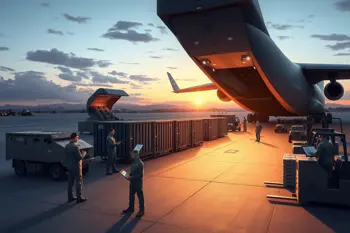
For tactical airlift comparisons, the C-130J limits cargo hold height to approximately 9 feet, a constraint that forces integrators to adopt collapsible or folded configurations for tall equipment. Conversely, C-17, C-5, and similar platforms accommodate standard ISO containers. All cargo consolidated for airlift must align with 463L Master Pallet dimensions of 88 inches by 108 inches to ensure compatibility across U.S. and NATO airlift fleets. 12 Load plans must also adhere to strict axle weight limits and floor load limits, which for standard air freight unit load devices are approximately 730 kilograms per square meter. 13 Items exceeding these floor load thresholds require shoring solutions, which increase deployment time and handling complexity.
Maritime and Intermodal Compliance for Military Cargo
Sea transport of military cargo introduces the International Maritime Dangerous Goods Code, developed by the International Maritime Organization, as the governing safety and compliance standard. Many items in the tactical transport category, including small arms ammunition, riot control agents, armored vehicles, and explosive ordnance, present hazards that require classification, packaging, and documentation far beyond those of ordinary commercial shipments. 14 The SOLAS Verified Gross Mass requirement adds another compliance layer: any packed container must have a confirmed gross mass on file with the carrier before a vessel's cut-off time, or the shipment is removed from the sailing. Failure at this documentation point can strand critical equipment and delay force deployment.
International military cargo movements are also subject to a complex web of export controls and sanctions screening. Many defense-related items fall under restrictions governed by UN Security Council resolutions, European Union regulations, and U.S. Office of Foreign Assets Control rules. Operators must screen shippers, consignees, and intermediaries against relevant sanctions lists, with non-compliance potentially resulting in cargo seizure, suspension of trading licenses, and loss of protection and indemnity insurance coverage. 15 Transportation Account Codes, or TACs, must also be validated and renewed each fiscal year through processes such as the Army's Army Vantage system before any movement under the Defense Transportation System can be authorized. 16
Risks, Compliance Failures, and Operational Friction Points
The consequences of documentation and payload miscalculation in tactical transport logistics are operationally significant and financially material. A shipment rejected at a receiving dock due to incorrect MIL-STD-129 markings, missing packing list data, or non-compliant packaging creates downstream delays that cascade through supply chains already operating under readiness pressure. Defense contractors who treat military freight procedures as equivalent to commercial freight processes consistently encounter compliance failures, delayed deliveries, and potential contract violations. 3 Moving an entire armored division, which deploys with approximately 15,000 vehicles and equipment pieces and roughly 50,000 short tons of cargo, illustrates the scale at which these errors compound. A single C-5M Super Galaxy can carry one M1 Abrams tank, meaning air movement of a 250-tank formation is logistically impractical without sealift and rail integration. 17
Payload weight violations at weigh stations or border crossings result in fines, immobilizations, maintenance overcosts, higher fuel consumption, and safety incidents. Weight and dimension control operates on two simultaneous planes: the physical dimension, which defines what a vehicle can do as an engineering problem, and the regulatory dimension, which defines what a vehicle can legally do depending on country, route, and load configuration. 18 Organizations that manage these variables manually or incompletely expose themselves to penalties and operational deviations. The Army's Logistics Information Warehouse provides real-time status and maintenance history for transportable military assets, and transportability engineering formally evaluates the constraints of equipment size and weight against the capabilities of available transport assets across rail, sealift, and airlift modes. 19
Sources
- Defense Logistics Agency (DLA) - dla.mil
- Marketopia.org - MIL-STD-129 Complete Guide
- LAX Freight - DOD Shipping Requirements Guide - laxfreight.com
- WHS.mil - DD Form 1750 Reference
- Hansatic - How to Calculate Truck Payload - hansatic.com
- Supply Chain Council UK - Item Volumetric Data in Defence Logistics - supplychaincouncil.org.uk
- Military Vehicles Vault - HEMTT vs FMTV - militaryvehiclesvault.com
- Sinotruckexp.com - Military Truck Selection: Terrain and Payload Risks
- Sinotruckexp.com - Cab Chassis Trucks for Military Use
- LNG in Northern BC - Boeing C-17 Globemaster Payload Analysis - lnginnorthernbc.ca
- C17Pilot.com - C-17 Cargo Capacity Guide
- MilitaryDronePro.com - Military Transport Aircraft Size Comparison
- Hansatic - Air Freight ULD Guide - hansatic.com
- Britannia P&I - Carriage of Military Cargo by Sea - britanniapandi.com
- Britannia P&I - Sanctions and Export Controls in Military Cargo - britanniapandi.com
- Army National Guard - ALARACT 090/2025 Transportation Account Code Guidance - armyng.com
- Military Machine - US Military Armored Division Sealift Deployment - militarymachine.com
- VEC Fleet - Cargo Transport Weights and Dimensions Guide - vecfleet.io
- Army Sustainment Command - Logistics Information Warehouse - asc.army.mil