Ex-military communication and radio equipment on sale
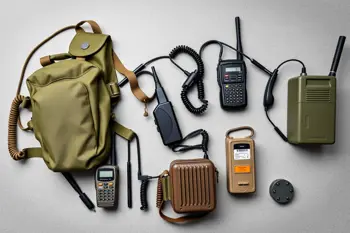
Anyone researching ex-military communication and radio equipment on sale will find a market that covers an unusually wide spectrum: from 1944-dated Signal Corps backpack transceivers to decommissioned tactical manpacks built to current MIL-STD standards. Units appear across specialized surplus retailers, auction platforms, and licensed military equipment resellers, with historical market averages ranging from roughly $50 to $200 for basic handhelds and $500 to $2,000 or more for advanced multi-band systems depending on model, condition, and operational completeness. 1
A Historical Overview of U.S. Signal Corps Radio Systems
The lineage of American military radios available in the surplus category stretches back to World War II. The SCR-536 (BC-611) was among the first true handheld radios issued for U.S. military use, earning the nickname Handie-Talkie among Signal Corps troops, and was manufactured by Galvin Manufacturing Corporation in Chicago, Illinois. 2 The BC-1000 backpack transceiver, also produced by Galvin MFG Co. under its earlier name, was the first radio to be informally called a walkie-talkie, seeing service across both World War II and the Korean War, and weighed approximately 35 pounds with batteries when configured as a complete BC-1000A set. 3
The SCR-284, manufactured by the Crosley Corporation of Cincinnati, Ohio, represented a different class of ground station and vehicle-mounted transceiver. More than 50,000 SCR-284 sets were produced in support of Operation Overlord, and the complete transmitter, receiver, power unit, and accessories weighed more than 100 pounds in aggregate. 4 Its 45-pound BC-654 transmitter was notably described at the time as roughly the weight, size, and shape of a modern window air conditioner, illustrating the physical demands placed on Signal Corps radiomen during the war.
Vietnam War Era Manpacks and Field Telephone Systems
The AN/PRC-25, operating across two FM bands from 30 to 75.95 MHz, achieved a particularly significant tactical reputation. In 1967, General Creighton Abrams, then deputy commander of the Military Assistance Command Vietnam, publicly called the PRC-25 the most important tactical item in Vietnam, and the system remained listed in FM 24-24 as late as 1994. 5 Its successor, the AN/PRC-77, entered service in 1968 as an upgrade and introduced solid-state components in the final power amplifier stage, replacing the vacuum tubes used in the PRC-25. The PRC-77 also added compatibility with voice encryption devices including the TSEC/KY-38 NESTOR equipment used in Vietnam and the later KY-57 VINSON family. 6
Complete Korean War and Vietnam War era field communications sets also circulate in the surplus market. The SB-22A/PT portable field telephone switchboard, for instance, handled up to 12 separate voice frequency circuits, supported interconnection with an additional unit for up to 29 VF circuits, and included provisions for conference calling and night alarm operation. 7 Companion units such as the TA-312/PT analog field telephone were designed to interoperate with the earlier World War II EE-8 field phone, extending the practical compatibility of these systems across multiple conflict eras.
Modern Surplus Tactical Radios: Current Generation Systems
At the more recent end of the surplus spectrum, decommissioned units from manufacturers such as L3Harris and Motorola Solutions appear in ex-military channels. The L3Harris RF-7800H MP is a wideband HF/VHF tactical manpack radio described as shock-resistant, water-resistant, and designed for multi-band, multi-mode communication across a wide frequency range, offering secure and encrypted voice and data transmission. 8 The Motorola APX 8000, a P25-compliant All-Band portable radio that covers four RF bands, has also appeared as a pre-owned trade-in unit in the surplus channel, with features including an Adaptive Audio Engine, Wi-Fi connectivity for firmware updates, and an AES-256 encryption suite. 9
Active U.S. Department of Defense procurement contracts provide context for what constitutes current-generation equipment. Little Rock Air Force Base has issued solicitations for six AN/PRC-167 radio systems with MIL GPS and RF-345M-MP003 components under NAICS code 334220. 10 The Collins Aerospace TruNet AN/PRC-162(V)1 represents another current platform, offering a two-channel software-defined radio spanning 30-88, 225-450, 1250-1450, and 1755-1850 MHz bands, with 20W peak output power per channel and 50W with a vehicular power amplifier. 11 Equipment at this tier rarely enters the civilian surplus market immediately upon decommission due to export and classification considerations.
Condition Standards, Completeness, and What Buyers Should Examine
Condition descriptions across the surplus market follow no universal standard, but several categories appear consistently. Units described as in working condition or very good condition typically retain original data plates, intact antennas, and major components. However, most surplus sellers explicitly note that functionality is not guaranteed, particularly when batteries are absent, as is commonly the case with older systems where original battery chemistry is no longer viable. 12 Units sold as-is with no returns accepted are the norm for historically significant pieces, while some retailers offer a limited inspection window, such as a three-day inspection and return policy observed on certain collectible lots.
Completeness is a key variable affecting both collectibility and practical utility. A fully documented set, such as a BC-611-F unit retaining its original Signal Corps data plate from a January 1945 manufacture date by Galvin MFG Corporation, carries considerably different interest to a collector or living history participant than a stripped chassis. 13 Accessories including handsets, antenna sets, carry harnesses, and jump cases for airborne-issued variants like the CS-156 parachute jump case for the BC-611 are described as exceptionally difficult to find separately and add material value to a complete configuration.
Regulatory Framework: FCC Licensing, ITAR, and Export Obligations
Operating ex-military radio equipment in the United States carries specific legal obligations. The Federal Communications Commission regulates all radio transmitters, and buyers must verify that any intentional radiator operates in compliance with FCC rules for the relevant frequency band and service type. FCC Part 90 licensing applies to many land-mobile frequency ranges used by military-specification radios. 14 Operating unlicensed or improperly configured ex-military transmitters on restricted frequency bands constitutes a violation regardless of the equipment's origin or historical status.
Export controls add another layer of legal complexity. The International Traffic in Arms Regulations (ITAR), administered by the U.S. Department of State's Directorate of Defense Trade Controls, and the Export Administration Regulations (EAR) can both apply to military communications equipment depending on its classification, technical parameters, and encryption capabilities. 15 Equipment incorporating advanced encryption modules or frequency-hopping waveforms may be subject to additional restrictions on resale, export, or transfer, even when the transaction is entirely domestic. Buyers should review applicable ITAR and EAR categories before acquiring systems with active encryption hardware or wideband frequency agility.
Market Channels, Authentication Risks, and Practical Considerations
Ex-military communication and radio equipment reaches the civilian market through several distinct channels. The Defense Logistics Agency (DLA) Disposition Services operates as the primary U.S. government channel for disposing of surplus Department of Defense property, including eligible electronics and communications equipment, through its formal disposition process. 16 Beyond the DLA, specialized surplus retailers, eBay militaria sections, dedicated military radio shops, and licensed military equipment resellers all maintain inventory of varying depth and provenance.
Authentication and provenance verification present persistent challenges in this market. The presence of original data plates, unit stenciling, contract numbers, and period-correct hardware such as WWII-style case latches versus post-war spring-loaded latches on BC-1000 series radios provides physical evidence of a unit's production era and service history. 17 Prospective buyers should also account for ongoing maintenance realities: vacuum tube equipment requires sourcing period-correct tubes, older battery compartments may show corrosion, and canvas harnesses deteriorate with age. Many units described as excellent candidates for full restoration are sold by sellers who acknowledge the equipment has not been tested, making independent assessment or purchasing from sellers with established return frameworks an important factor in the acquisition decision.
Sources
- General LLM Research Data: Price range benchmarks for ex-military radio equipment in the U.S. surplus market
- Kruschiki Supply Company - US Army SCR-536 (BC-611-F) Radio Set product listing (kruschiki.com)
- Ghost Gun Store - Original WWII U.S. Signal Corps BC-1000A Backpack Radio Receiver and Transmitter product listing (ghost-gunstore.com)
- Tactical Rifle Zone - Original U.S. WWII SCR-284 Signal Corps Radio Set by Crosley product listing (tacticalriflezone.com)
- Colt and Winchester Firearms Shop - Original Vietnam War U.S.M.C. Radio Set RT-505B / PRC-25 product listing (coltwinchestershop.com)
- Backcountry Hunt Shop - Original U.S. Vietnam War AN/PRC-77 Radio ManPack Set product listing (backcountryhuntshop.com)
- Backcountry Hunt Shop - Original U.S. Army Korean War and Vietnam War Field Communications Set: SB-22A/PT product listing (backcountryhuntshop.com)
- USA Drone Shop - L3Harris RF 7800H MP Man Pack Radio product listing (usadroneshop.com)
- North Georgia Communications - Motorola APX 8000 3.5 Pre-Owned product listing (northgeorgiacommunications.com)
- CLEATUS - 61 AS Tactical Radios, Department of Defense solicitation FA446026Q0387 (cleat.ai)
- RTX / Collins Aerospace - TruNet AN/PRC-162(V)1 Networked Communications Ground Radio (rtx.com)
- General LLM Research Data: Condition and as-is selling conventions in the military surplus radio market
- Tactical Rifle Zone - Original U.S. WWII Paratrooper Handie Talkie SCR-536 BC-611-F Radio with CS-156 Jump Case product listing (tacticalriflezone.com)
- Federal Communications Commission (FCC) - Land Mobile Radio Services and Part 90 licensing (fcc.gov)
- U.S. Department of State - Directorate of Defense Trade Controls (DDTC) - ITAR FAQs (pmddtc.state.gov)
- Defense Logistics Agency (DLA) Disposition Services - Surplus property disposition overview (dla.mil)
- Tactical Rifle Zone - Original U.S. Korean War US Signal Corps BC-1000 Backpack Radio product listing (tacticalriflezone.com)