Concrete Driveway Resurfacing Cost: A Data-Driven Pricing Guide for Homeowners
What Concrete Driveway Resurfacing Actually Costs in 2026
Concrete driveway resurfacing cost falls in the range of $3 to $12 per square foot in 2026, with most homeowners paying between $1,500 and $6,000 for a standard residential driveway. 1 A basic overlay on a 500 square foot driveway typically runs $1,500 to $3,000, while a decorative stamped overlay on the same surface can reach $4,000 to $6,000. 1 Broader project-level estimates from multiple cost tracking sources place total resurfacing budgets between $4,000 and $11,000 when accounting for surface preparation, sealant, labor mobilization, and edge work on driveways in the 600 to 900 square foot range. 2
Per-square-foot benchmarks vary by data source and project scope. Standard overlays on clean, well-prepped surfaces generally fall between $4 and $6 per square foot, while driveways requiring extensive crack repair, complex textures, or color treatments can push costs toward $7 to $9 per square foot or higher. 3 Concrete resurfacing consistently costs 30 to 50 percent less than tearing out and replacing an existing slab, making it the preferred option when the underlying concrete remains structurally sound. 4
Resurfacing Cost by Method and Finish Type
The resurfacing method chosen is the single largest variable in the final price. Basic concrete overlay resurfacing, which involves applying a polymer-modified cementitious layer one-eighth to three-eighths of an inch thick, costs $3 to $6 per square foot. 1 Spray-on textured resurfacing, sometimes called knockdown or cool deck, runs $3 to $7 per square foot and is the fastest method, with most driveways completed in a single day. 5 Stamped concrete overlay resurfacing applies a thicker layer of three-eighths to three-quarters of an inch and presses patterns mimicking brick, slate, cobblestone, or flagstone into the surface, costing $8 to $15 per square foot. 4
| Resurfacing Method | Cost Per Sq Ft | Typical 500 Sq Ft Total |
|---|---|---|
| Basic Concrete Overlay | $3 – $6 | $1,500 – $3,000 |
| Spray-On Textured Coating | $3 – $7 | $1,500 – $3,500 |
| Epoxy or Polyurea Coating | $4 – $10 | $2,000 – $5,000 |
| Stamped Concrete Overlay | $8 – $15 | $4,000 – $7,500 |
| Microtopping Finish | $4 – $8 | $2,000 – $4,000 |
Epoxy and polyurea systems, including polyaspartic clear coat installations, represent the most durable coating category and resist oil stains, tire marks, and chemical exposure. These systems cost $8 to $15 per square foot and are frequently backed by extended warranties from manufacturers. 6 Microtoppings, which are ultra-thin cementitious coatings one-sixteenth to one-eighth of an inch thick, cost $4 to $8 per square foot and accept stains and dyes well, making them a popular choice for covered patios and garage-adjacent surfaces. 4
Key Cost Components: Where the Budget Goes
A concrete driveway resurfacing project budget divides across several categories. For a standard residential driveway of 600 to 900 square feet, materials including resurfacing compound, polymer additives, primers, and colorants range from $1,200 to $4,000. 2 Labor, which covers surface preparation, mixing, application, and finishing, accounts for $2,500 to $5,500 depending on crew rates and the complexity of the job. 2 Professional labor typically represents 50 to 70 percent of the total project budget across most residential resurfacing contracts. 7
Additional cost components include equipment rental or use fees for scarifying tools, grinders, and compactors, which commonly add $300 to $1,500. 2 Permits, where required by local jurisdictions, range from zero to $1,000 depending on city rules and project scope. Delivery, material transport, and debris removal add $150 to $900 in most markets. A contingency allocation of $200 to $1,200 is standard practice to cover unforeseen surface preparation needs that are only identified after cleaning and inspection begin. 2 Surface preparation through shot blasting or diamond grinding alone adds $1 to $3 per square foot but is considered non-negotiable for achieving adequate bond strength between the overlay and the existing slab. 8
Factors That Move the Final Price Up or Down
Driveway size is the primary cost factor. A small patio of 200 to 400 square feet often keeps total costs in the $300 to $1,200 range for a basic overlay, while a two-car driveway of 800 to 1,000 square feet with a decorative finish can reach $4,000 to $8,000. 9 Surface condition is the most unpredictable cost variable. Minor surface crazing or discoloration needs minimal preparation, but a driveway with significant cracking, spalling, or oil contamination requires substantially more prep work before any coating can adhere correctly, adding $200 to $1,500 to the baseline estimate. 9
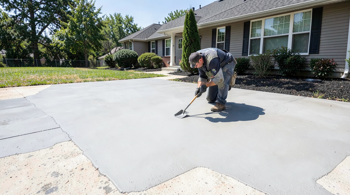
Regional labor rates introduce meaningful price variation. Urban markets and regions with higher construction labor costs typically command 20 to 40 percent premium rates compared to rural areas with the same project specifications. 7 The choice of finish also carries significant weight: a stained overlay costs $4 to $8 per square foot in most markets, a decorative knockdown or spray texture runs $7 to $12 per square foot, and a premium stamped overlay with multiple color treatments reaches $8 to $15 per square foot. 10 Accessibility modifiers, such as tight site access, hillside grading, or irregular driveway shapes requiring hand-finishing, add 10 to 15 percent to standard estimates.
Resurfacing vs. Full Replacement: The Financial Comparison
Full concrete driveway replacement costs $8 to $18 per square foot installed, making resurfacing a considerably more affordable alternative when the structural base remains intact. 7 For a 600 square foot driveway, a standard overlay resurfacing project typically costs $1,800 to $4,800, compared to $5,400 to $9,000 or more for full removal and replacement. 11 Resurfacing is also a significantly faster process, typically completing in one to two days versus five to seven days for demolition, base regrading, forming, pouring, and curing associated with full replacement. 12
Resurfacing delivers an extended surface lifespan of 10 to 25 years over a structurally sound base when properly installed and maintained. 8 However, resurfacing is not universally appropriate. It cannot correct slabs that are sinking, bases that have washed out, widespread alligator cracking, or drainage conditions directing water toward the structure. When more than 25 to 30 percent of the driveway surface is damaged, or when the driveway exceeds 20 years of age with base deterioration, replacement becomes the more economically sound decision over the long term. 13
Eligibility Criteria, Risks, and Maintenance Realities
Not every driveway qualifies for resurfacing. The existing slab must be structurally sound, with no active heaving, base failure, or widespread deep cracking. Driveways where a previous overlay has already been applied face bonding challenges for additional layers, and some contractors decline to resurface over prior overlays entirely. 12 In climates with severe freeze-thaw cycling, polymer-modified overlays are susceptible to delamination if surface preparation is incomplete or if moisture is trapped beneath the overlay layer at the time of application. Extreme heat in regions like Bakersfield or central Florida accelerates thermal cycling stress, which can cause premature failure in thin overlay systems that were not adequately prepped or primed. 6
Ongoing maintenance is a real cost consideration that many initial project budgets omit. Acrylic sealers applied over resurfaced driveways require reapplication every two to three years, shifting long-term economics compared to more durable polyaspartic systems. 6 Concrete sealing for a standard driveway typically costs $200 to $600 per application cycle. 14 Hairline cracks addressed early with a $40 tube of crack filler can prevent a $2,000 resurfacing job two to three years later, illustrating the disproportionate return on early preventive maintenance. 15 Homeowners should also obtain multiple contractor quotes, verify that bids include surface preparation costs explicitly, and request documentation of material specifications and expected service life before committing to any resurfacing contract.
Sources
- Metal America Concrete – Driveway Resurfacing Cost 2026 | metalamericaconcrete.com
- Current Cost – Cost of Concrete Driveway Resurfacing: Price Guide | currentcost.org
- Kurlon Selector – Concrete Driveway Resurfacing Cost Per Square Foot 2026 | selector.kurlon.com
- Metal America Concrete – Concrete Resurfacing Cost 2026 | metalamericaconcrete.com
- Asphapro – Driveway Resurfacing Cost: When to Overlay vs Replace 2026 | asphapro.com
- Steve Holloway Painters – Driveway Resurfacing Cost in Bakersfield: 2026 Pricing | stevehollowaypainters.com
- HomeAdvisor / Angi – Concrete Driveway Resurfacing Cost and Labor Data | homeadvisor.com
- Local Concrete Contractor – Concrete Overlay Cost 2026: Pricing by Type | localconcretecontractor.com
- Cost to Renovate – Concrete Resurfacing Cost in 2026 | costtorenovate.com
- Linked Concrete – Concrete Resurfacing Cost in Florida 2026 Guide | linkedconcrete.com
- Current Cost – Cost to Resurface Driveway: Price Guide and Estimates | currentcost.org
- Nashville Premier Concrete – Concrete Driveway Resurfacing in Nashville: Cost, Process, and When It Makes Sense | concretedrivewaynashville.com
- Asphapro – When to Resurface vs Replace Driveway Criteria 2026 | asphapro.com
- Ecostify – Concrete Driveway Cost 2026: Pouring, Repair and Resurfacing | ecostify.com
- Cost to Renovate – Concrete Driveway Repair Cost in 2026 | costtorenovate.com