How to Choose Comfortable Walking Shoes for Older Adults
Choosing comfortable walking shoes for older adults is far more complex than selecting a fashionable or familiar brand. As podiatrist Damian Roussel, DPM, explains, aging commonly brings foot conditions including bunions, hammertoes, arthritis, and plantar fasciitis, all of which can impede daily physical activity and threaten long-term independence. 1 According to the Mayo Clinic, foot pain is a leading cause of reduced mobility in the elderly, making footwear selection a genuine clinical priority rather than a lifestyle preference. 2
Why Aging Feet Require Different Footwear Standards
Foot structure changes meaningfully over time. The fatty padding on the soles tends to thin, natural arch support weakens, and conditions such as bunions or hammertoes become more prominent. 3 Flat arches are common in older adults, and without medial support, overpronation distributes load unevenly across the foot, radiating pain into the knees and hips. 4 Decreased proprioception, which is the foot's ability to sense ground feedback, increases fall risk further, meaning that the mechanical interface between shoe and surface carries direct safety implications.
Falls represent one of the most serious health risks in this population. According to the Centers for Disease Control and Prevention, falls are the leading cause of injury-related death among adults 65 and older, with millions treated in emergency departments each year due to fall-related injuries. 5 Research consistently identifies ill-fitting or inappropriate footwear as a significant contributing factor, which is why podiatrists, physical therapists, and orthopedic surgeons increasingly treat shoe selection as part of clinical care. 6
The Core Structural Features to Prioritize
The American Podiatric Medical Association recommends choosing shoes that provide good arch support, a firm heel counter, and adequate cushioning for everyday walking. 7 A deep heel cup stabilizes the rear foot, prevents lateral rolling, and keeps the foot properly aligned during each stride. Cushioning rated highly, approximately 4 to 5 on a 5-point scale, is essential because aging joints absorb impact less efficiently, and maximum cushioning reduces stress on knees, hips, and the lower back with every step. 8
Arch support at the same performance tier prevents overpronation and distributes load evenly, particularly important for the high prevalence of flat arches in older adults. 4 Slip-resistant outsoles made of rubber or high-traction compounds are also non-negotiable. Podiatrists specifically recommend shoes with structured arch support, a deep heel cup, and a forefoot rocker sole as the baseline combination for seniors with balance concerns. 9
Fit, Width, and Sizing Considerations
Foot size and shape continue to change throughout adulthood. Most adults over 50 have measurably wider feet than they did at 30, due to pregnancies, weight fluctuations, and the gradual loss of arch support. 10 The Cleveland Clinic advises that feet be measured periodically because dimensions shift with age, and buying for an outdated size is a common and consequential mistake. 11 Both feet should be measured in the afternoon, when feet are at their largest daily volume, on a hard surface using a Brannock device or foot tracing method.
A wide toe box is essential to accommodate foot swelling and prevent pressure on bunions or hammertoes. 3 Seniors may experience heat edema that further widens the forefoot, so shoes with adjustable closures such as Velcro straps or elastic laces accommodate volume changes throughout the day while remaining secure. 12 Shoes that are too loose are equally problematic, as they increase tripping risk. The standard guidance calls for a half thumb-width of space between the longest toe and the front of the shoe.
Heel-to-Toe Drop, Stack Height, and Sole Geometry
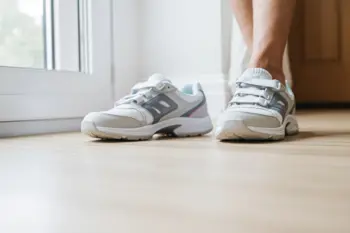
Two technical specifications that significantly affect comfort and safety are stack height and heel-to-toe drop. Stack height refers to total midsole thickness in millimeters. For walking after 50, a range of 28 to 34 mm is generally considered appropriate, providing cushioning without reducing ground feel and stability excessively. 13 Heel-to-toe drop, the height difference between heel and forefoot, affects load distribution across the Achilles tendon and plantar fascia. A lower drop of around 4 mm places greater demand on the calf and Achilles, while a higher drop of 10 to 12 mm offloads those structures and is often more appropriate for older adults with stiffer fascia.
A stable, low-to-the-ground platform is identified as one of the most critical features for fall prevention in senior footwear. 14 Rocker-bottom sole geometry, where the sole curves upward at the forefoot, reduces the effort required at toe-off and is clinically recommended for those with arthritis or limited ankle mobility. Overly thick or highly cushioned maximalist soles above 38 mm may paradoxically reduce stability by distancing the foot too far from the ground. 13
Condition-Specific Footwear Guidance
Different foot conditions require targeted shoe features, and a single model rarely suits all seniors. The table below summarizes condition-specific priorities based on podiatrist and physical therapist guidance.
| Condition | Key Shoe Feature | Commonly Cited Models |
|---|---|---|
| Balance problems | Wide stable base, low drop, deep heel cup | New Balance 928v3, Hoka Bondi SR |
| Plantar fasciitis | Arch support, cushioned midsole, rocker sole | Hoka Bondi 9, Brooks Adrenaline GTS 24 |
| Arthritis / joint pain | Rocker-bottom geometry, shock absorption, wide toe box | Brooks Addiction Walker 2, Vionic Walker Classic |
| Flat feet / overpronation | Medial post, firm midsole, structured heel counter | ASICS Gel-Kayano 31, Skechers Go Walk Arch Fit |
| Swollen feet / edema | Stretch knit upper, wide toe box, adjustable closure | Orthofeet Coral Stretch Knit, Propet Stability Walker |
Removable insoles are a practical feature that allows for the insertion of custom orthotics when specific medical conditions require more precise arch correction than an off-the-shelf insert can provide. 7 Podiatric physical therapists note that insoles with proprioceptive elements can also sharpen sensory feedback from the ground, partially compensating for the reduced sensation that commonly accompanies aging. 9
Practical Shopping and Maintenance Guidance
Several evidence-based practices improve the likelihood of selecting a correctly fitting shoe. The NHS advises wearing supportive shoes that fit well and replacing worn-out pairs that no longer provide adequate support. 15 Shoes should be tried on in the afternoon when feet are at their largest, and shoppers should wear the same type of socks or orthotics they intend to use with the shoe. Walking around the store for several minutes, not just standing, is necessary to evaluate heel stability and toe room under realistic movement conditions. 6
Breathable upper materials such as mesh or lightweight fabric help maintain foot hygiene, prevent blistering during longer walks, and reduce heat-related swelling. 12 Shoe weight also affects gait efficiency; heavier shoes accelerate fatigue and can alter stride mechanics in older adults who already have reduced muscle endurance. Lightweight construction is therefore a meaningful selection criterion alongside cushioning and stability. The National Institute on Aging emphasizes that comfortable, well-fitting shoes are important for staying active with age and may directly support continued participation in physical activity that maintains cardiovascular and musculoskeletal health over time. 16
Sources
- Verywell Fit - The 12 Best Walking Shoes for Seniors of 2026, Tested (verywellfit.com)
- iamcure.com - Elderly Walking Shoes: The Ultimate Guide to Comfort, Safety, and Mobility
- Silverts - 3 Best Walking Shoes for Seniors and Older Adults (silverts.com)
- ShoeFitLab - Best Shoes for Seniors 2026: Stability, Cushioning and Everyday Comfort (shoefitlab.com)
- Fix My Daily Life - Best Walking Shoes for Seniors With Balance Problems (fixmydailylife.com)
- StoryPoint Group - The Ultimate Guide To Choosing The Best Walking Shoes For Seniors (storypoint.com)
- American Podiatric Medical Association - Choose the Right Shoes (apma.org) via General Research Data
- ShoeFitLab - Cushioning and Arch Support Scoring Criteria (shoefitlab.com)
- Michigan Foot Doctors - Best Shoes for Elderly with Balance Problems 2026 (michiganfootdoctors.com)
- The 40 Method - Walking Shoe Comfort Checklist for Women Over 40 (the40method.com)
- Cleveland Clinic - How To Find the Best Walking Shoes (health.clevelandclinic.org)
- Caring Senior Service - Selecting the Best Shoes for Senior Fall Prevention 2026 (caringseniorservice.com)
- The 40 Method - Stack Height and Heel-to-Toe Drop Guidance (the40method.com)
- PAHI USA - Shoes That Prevent Falls: What to Look For and What to Avoid (pahiusa.com)
- NHS - Foot Pain Footwear Guidance (nhs.uk) via General Research Data
- National Institute on Aging - Staying Active (nia.nih.gov) via General Research Data