An Analytical Industry Report on Premium hybrid heat pump water heaters
Introduction to Hybrid Water Heating Mechanics
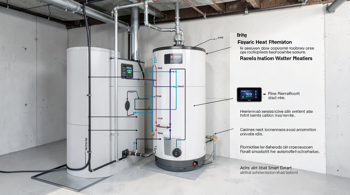
Residential energy management continues to evolve as property owners seek efficient domestic utility solutions, with premium hybrid heat pump water heaters emerging as a leading standard. Unlike conventional electric resistance systems that generate heat directly, these advanced systems utilize heat pump technology to extract warmth from the surrounding ambient air 3. A built-in fan pulls air into the system, allowing a specialized refrigerant to absorb heat 6. This refrigerant is compressed to elevate its temperature, transferring the captured thermal energy directly to the stored water through insulated coils wrapped around the storage tank 6.
This thermodynamic process is the inverse of how air conditioners work, achieving remarkable performance metrics 3. While standard electric storage tanks operate at 100% efficiency, premium hybrid models routinely achieve efficiency ratings up to 400% 11. By moving heat rather than generating it, these systems reduce the overall electrical demand required for water heating by up to 70% in standard installations, establishing a highly sustainable option for modern homes 6.
Technology Integration and Smart Valve Systems
Modern high-end hybrid systems are defined by their sophisticated monitoring systems and integrated smart features. Manufacturers have introduced advanced telemetry, such as premium smart valve technologies, which monitor and regulate municipal flow rates to maximize systemic efficiency 1. These valves are paired with active electronic mixing elements that blend hot and cold water precisely at the point of exit, allowing units to deliver up to 60% more hot water during high-use periods without increasing tank size 13.
Furthermore, standard features in premium models now include integrated leak detection sensors and automatic mechanical water shut-off systems 13. In the event of a system malfunction, these smart leak protection features send immediate notifications via mobile applications, such as the SmartHQ system or iCOMM platform, to alert homeowners before damage occurs 8, 13. Users can toggle between five operating modes: Energy Saver, Heat Pump, Electric, High Demand, and Vacation mode, directly from their smartphones 18.
Performance Metrics and Capacity Scaling
Premium hybrid heat pump systems are engineered across a broad range of volumetric capacities to accommodate diverse household needs. Standard configurations typically include 40, 50, 66, and 80-gallon tank configurations 1, 11. To evaluate the performance of these units, regulatory bodies rely on the Uniform Energy Factor (UEF), where premium hybrid models consistently achieve ratings ranging from 3.0 to over 3.8 6, 8. High recovery rates are maintained through dual backup electric heating elements that assist the primary compressor system during peak hot water demand 7.
| Capacity | UEF Rating | First Hour Delivery |
|---|---|---|
| 40 Gallons 5 | Up to 3.60 14 | 70 Gallons 13 |
| 50 Gallons 4 | Up to 4.07 18 | 89 Gallons 22 |
| 66 Gallons 2 | Up to 3.87 8 | 82 Gallons 14 |
| 80 Gallons 1 | Up to 3.45 7 | 91 Gallons 11 |
Operational Economics and Incentive Frameworks
While the purchase price of high-efficiency hybrid water heaters represents a larger upfront capital expenditure compared to standard electric resistance models, the operational economics present a compelling return. The Department of Energy estimates that a standard household of four spends between $800 and $900 annually on water heating with conventional electric units 6. Upgrading to a premium hybrid model reduces this annual cost to approximately $200 to $300, generating average savings of $600 per year 6. Over a standard 10-year warranty cycle, this equates to thousands of dollars in cumulative savings 6.
These long-term operational savings are supported by federal and local utility incentives designed to offset initial installation costs. In the United States, the Inflation Reduction Act offers a federal tax credit under Section 25C, providing up to 30% of the total installation project cost, capped at $2,000 22. Additionally, regional utility networks frequently provide direct customer rebates that can range from $500 to $1,300, depending on the certified efficiency tier of the installed model 6.
Essential Installation Requirements and Spatial Constraints
Integrating a hybrid heat pump system into an existing residential structure requires careful consideration of mechanical and spatial constraints. Because these water heaters rely on extracting thermal energy from the surrounding air, they must be situated in areas with adequate air volume. Industry standards dictate a minimum of 700 cubic feet of clear ambient space for standard operation 22. If installed in a constrained utility closet, louvered doors or dedicated ducting kits are necessary to maintain adequate airflow and ensure the heat pump operates optimally 18.
Beyond space requirements, these systems demand specific electrical configurations and plumbing integration. Most residential hybrid units require a dedicated 240-volt, 30-amp circuit to power both the compressor and the backup electric resistance elements 22. Furthermore, because the heat pump process dehumidifies the ambient air, the system generates continuous condensate. Installers must route a dedicated condensate drain line to a nearby floor drain, sump pump, or condensate pump to safely manage the collected moisture 7, 18.
Market Variations and Climate Limitations
The performance of hybrid heat pump technology is directly impacted by the climate of the installation zone. These systems achieve peak efficiency in warm, humid environments where ambient air temperatures consistently exceed 50 degrees Fahrenheit. While modern high-end systems can operate in lower temperatures down to 37 degrees Fahrenheit, colder environmental conditions require the system to rely more heavily on its internal electric resistance backup elements, which temporarily lowers overall energy efficiency 6, 8.
Several prominent manufacturers produce qualifying residential systems, each with unique brand configurations. For example, the Rheem ProTerra series is recognized for its high-efficiency metrics and comprehensive leak protection systems 18. The A.O. Smith Voltex line offers rugged construction with maintenance-free powered anodes designed to protect the tank for up to 10 years 7. State Water Heaters features the Premier MAX series, which integrates smart valve technology to optimize water flow dynamically 1.
Sources
- State Water Heaters
- State Water Heaters
- Consumer Reports
- State Water Heaters
- State Water Heaters
- A. O. Smith
- A. O. Smith
- American Water Heaters
- State Water Heaters
- P.C. Richard & Son
- Rinnai
- State Water Heaters
- GE Appliances
- Lochinvar
- State Water Heaters
- State Water Heaters
- The Washington Post
- Rheem
- State Water Heaters
- State Water Heaters
- Rosenberry Rooms
- HomeSystemsGuide
- State Water Heaters
- State Water Heaters
- Heaters to Heat
- State Water Heaters
- AC Direct
- ClimaMarket
- YouTube
- Ad-Hoc News