Used center console boats for coastal fishing: A Technical and Market Analysis
Market Dynamics of Saltwater Center Consoles
Center console vessels serve as a dominant platform in coastal and offshore angling due to their open deck layout, which facilitates full 360-degree casting access 1. The market for pre-owned center consoles is highly active across coastal regions, particularly in areas like Florida, North Carolina, and the Gulf Coast 2 3 4. Pre-owned models offer buyers a practical method to acquire capable saltwater fishing platforms without the high upfront capital depreciation associated with brand-new builds 5 1. This active marketplace provides a diverse selection of models, allowing buyers to select boats specifically optimized for their local waters.
Used inventory generally ranges from 15 to 35 feet, with valuations highly dependent on age, structural condition, brand reputation, and engine hours. Buyers often seek out versatile hybrid models in the 19 to 24-foot range, which successfully balance inshore back-bay maneuverability with nearshore capability 3 6. This active secondary marketplace spans major platforms such as YachtWorld and regional listings, where seasonality plays a large role in availability and price fluctuations. Understanding these market dynamics helps prospective owners navigate historical averages and negotiate realistic acquisition terms.
Structural Inspections and Surveying Protocols
Evaluating a pre-owned vessel requires a meticulous structural assessment prior to purchase. Saltwater environments subject hulls to extreme hydrodynamic stress, making marine surveys critical for identifying hidden structural anomalies. Professional marine surveyors utilize specialized tools to inspect fiberglass laminates for signs of delamination, osmotic blistering, and moisture intrusion within the transom and stringer systems. Decks must be physically tested for soft spots, which often signal rotten core materials beneath the fiberglass, leading to costly repair requirements.
Beyond the hull, hardware and mounting points require detailed inspection. This includes assessing the integrity of the T-top structure, transom support braces, and bow rails. For example, older hulls or heavily utilized vessels may display stress cracks around the engine mounting bracket, indicating potential structural fatigue. Checking self-bailing cockpit scuppers and looking for signs of galvanic corrosion on underwater metals are also vital steps. Securing a complete structural survey ensures long-term safety and protects the buyer's financial investment in the secondary market.
Hull Geometry and Hydrodynamics
The deadrise angle, measured at the transom, is a key metric determining how a center console handles rough coastal chop. Deep-V hulls, typically featuring a deadrise of 20 to 24 degrees, are engineered to slice through heavy ocean swells, providing a smoother and drier ride in offshore conditions 7 5. However, this aggressive angle requires more horsepower to plane and exhibits increased draft and roll when resting or drifting. Buyers must balance the desire for offshore stability with the realities of fuel consumption and operating costs.
Conversely, shallow-draft hulls, such as bay boats or modified-V designs with a 15-degree deadrise, are optimized for shallow inshore waters, flats, and rivers 8 9. Models like the Tidewater 2300 Carolina Bay utilize stepped-hull configurations combined with a pronounced bow flare to achieve a dry running angle in both shallow backwaters and moderate chop 10. Selecting the appropriate hull geometry is a critical decision that depends directly on the buyer's intended fishing environment and target species.
Standard Fishing Equipment and Layouts
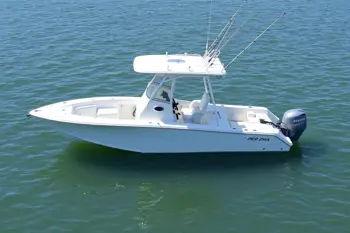
True coastal fishing center consoles are defined by dedicated angling amenities integrated directly into the deck layout. Essential features include aerated livewells to maintain live bait, insulated fish boxes for catch storage, and gunnel rod holders 11 12. Many advanced models, such as the Sea Pro 239 Deluxe, feature built-in prep stations, tackle centers, and rocket launchers mounted on the hardtop frame to maximize utility and declutter the deck 13. These features allow serious anglers to operate efficiently when managing multiple lines in active waters.
In addition to fishing hardware, modern layouts often incorporate family-friendly amenities that do not compromise fishability. These hybrid designs include forward bow seating with removable cushions, console heads with holding tanks, and folding transom bench seats 7 11 5. This dual-purpose design allows the vessel to easily transition from a dedicated offshore angling platform to a recreational cruiser for family sandbar outings. Inspecting the condition of upholstered components and storage hinges is highly recommended during a physical viewing.
Technical Comparison of Selected Used Models
Analyzing specific specifications of available used center consoles highlights the diversity in size, power, and capabilities on the secondary market. Buyers must weigh overall length, beam width, draft constraints, and fuel capacities against their specific operational needs. Below is a comparative overview of several prominent models documented in recent market inventories, showing how manufacturers balance offshore footprint with power requirements.
| Model | Length | Draft | Fuel Capacity | Engine Configuration |
|---|---|---|---|---|
| 2020 Blackfin 242 CC 7 | 24 ft 6 in | 21 in | 140 gal | Single 300 HP Outboard |
| 2023 Sea Hunt Gamefish 25 11 | 25 ft 0 in | N/A | 144 gal | Twin 150 HP Outboards |
| 2021 Tidewater 292 CC Adventure 14 | 29 ft 0 in | N/A | N/A | Twin 300 HP Outboards |
| 2023 Trophy T18 Bay 8 | 18 ft 0 in | Shallow | N/A | Single 115 HP Outboard |
Propulsion Systems and Maintenance Economics
Modern pre-owned center consoles are predominantly powered by four-stroke outboard engines, which have largely replaced older two-stroke technology due to superior fuel efficiency, quieter operation, and lower emissions. Popular configurations include single outboards for vessels under 24 feet, and twin outboards for larger offshore platforms like the Sportsman 261, providing redundancy and enhanced maneuverability 5. Engine hours are a major factor in valuation, with lower-hour engines commanding a premium. Buyers should always verify maintenance logs and confirm that scheduled valve adjustments and gear lube changes were performed.
Ongoing maintenance for used coastal fishing vessels averages between $1,000 and $3,000 annually, covering seasonal oil changes, water pump replacements, and hull detailing. Prior to acquisition, buyers should secure a professional engine diagnostic report to check cylinder compression, download history codes, and verify running hours. Regular service of hydraulic steering systems and trim tabs is also required to maintain optimal ride control and vessel safety in variable marine environments 7 15.
Sources
- United Yacht Sales
- MyBoatsForSale (2023 Tidewater 198cc Adventure)
- Avalanche Motorsports
- Louisiana Sportsman
- Coastal Boat Pros (2025 Sportsman 261 Heritage)
- Ocean Marine Boats (2026 Key West 203FS)
- Rhode River Boat Sales (2020 Blackfin 242 CC)
- Coastal Boat Pros (2023 Trophy T18)
- Premier Boating Centers (2026 Tidewater 2110BMT)
- Ocean Marine Boats (2026 Tidewater 2300CB)
- Coastal Boat Pros (2023 Sea Hunt Gamefish 25)
- DiMillo's Yacht Sales (1999 Pursuit 2470 Center Console)
- MyBoatsForSale (2023 Sea Pro Center Console 239 Deluxe)
- Premier Boating Centers (2021 Tidewater 292 CC Adventure)
- MyBoatsForSale (2023 Key West Center Console 239F)