Commercial Grade Epoxy Flooring Kits on Sale: A Buyer's Analysis of Systems, Specs, and Market Pricing
Commercial grade epoxy flooring kits on sale represent a substantially different product category than the single-layer floor paints commonly found in home improvement centers. Understanding the chemistry, coverage economics, and application realities of these systems allows buyers to make informed comparisons rather than selecting a kit based on price alone. The market spans entry-level two-part kits covering under 500 square feet to industrial bulk systems designed for warehouses exceeding 5,000 square feet, with pricing structures and performance claims that vary significantly across suppliers.
What Separates Commercial-Grade Epoxy Kits from Standard Floor Paint
The defining characteristic of a commercial-grade epoxy kit is solids content. True commercial systems use 100% solids formulas, meaning no solvents evaporate during curing and the full applied thickness remains as dry film. A typical big-box-store DIY garage kit lays down a total dry film thickness of approximately 3 to 5 mils, which is thinner than a credit card. 1 A reputable commercial system using 100% solids epoxy achieves 12 to 20 mils with a flake broadcast, and premium multi-layer systems like the ArmorUltra Kit with Topcoat reach 25 to 30 mils, described as at least 5 to 6 times thicker than standard floor paint. 2
The structural difference is not cosmetic. Commercial systems use a primer layer that chemically bonds to mechanically prepared concrete, a high-build body coat, and a protective topcoat that resists UV, chemicals, and abrasion. Primer prevents the 100% solids epoxy from absorbing unevenly into the slab, adds overall thickness, and dramatically improves chip resistance. 3 Single-layer products that skip this architecture tend to delaminate under thermal cycling, forklift traffic, or chemical exposure far sooner than multi-layer commercial systems.
Documented Pricing Benchmarks Across Coverage Ranges
Pricing for commercial grade epoxy flooring kits spans a wide range depending on square footage, layer count, and included components. Based on current market data, DIY-oriented commercial kits cost approximately $1.16 to $2.66 per square foot for material. 4 A 500-square-foot two-car garage system from ArmorGarage runs $699 to $899 in kit form, compared to $2,000 to $3,600 for the same area installed by a contractor. 4 Small commercial spaces of 550 to 1,500 square feet average around $1.42 per square foot at the kit level, with mid-commercial projects from 1,500 to 5,000 square feet dropping to approximately $1.32 per square foot. 4
Specialized system kits reflect higher per-unit costs. The Dymond Coatings 600-square-foot commercial kitchen epoxy system with antimicrobial and non-slip properties is listed from $484.98, while a 3-layer restaurant epoxy flooring kit covering the same area starts from $734.47. 5 Full flake systems from One Stop Epoxy scale from $899 for areas up to 400 square feet to $5,979 for spaces up to 3,000 square feet, reflecting the raw material volume required for broadcast applications. 6 Industrial polyaspartic solid color systems from Concrete Floor Supply are available at approximately $1.75 per square foot with a $400 minimum purchase. 7
Kit Contents and Coverage Rate Comparisons
Understanding exactly what a kit includes is critical for accurate cost-per-square-foot analysis. The Rockhard USA 3-gallon kit from Xtreme Polishing Systems, priced at $185, covers 450 square feet as a flake floor base coat at 150 square feet per gallon, or 300 square feet as a solid color floor requiring two coats at 100 square feet per gallon. 8 The 14-gallon bulk version of the same system, priced at $895, extends coverage to 2,100 square feet for a flake base coat or 1,400 square feet for a solid color two-coat application. 9 A 1,000-square-foot professional garage kit from PowerCOAT Canada includes 100% solids pigmented epoxy with polyaspartic topcoat and is listed at $1,999 CAD. 10
| System | Coverage | Approximate Price | Layers |
|---|---|---|---|
| Rockhard USA 3-Gal Kit (XPS) | 300-450 sq ft | $185 | Base coat only |
| Dymond Kitchen Epoxy Kit | 600 sq ft | From $484.98 | Multi-layer, antimicrobial |
| One Stop Epoxy Full Flake System | Up to 400 sq ft | $899 | Epoxy + polyaspartic topcoat |
| ArmorGarage DIY Kit | 440 sq ft (2-car) | $699-$899 | Primer, epoxy, topcoat |
| Rockhard USA 14-Gal Bulk Kit | 1,400-2,100 sq ft | $895 | Base coat only |
Application Environments and Industry Use Cases
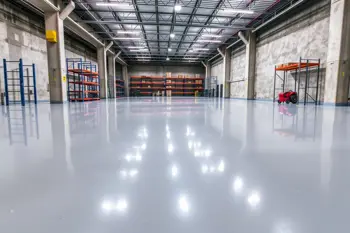
Commercial grade epoxy flooring kits are engineered for environments where surface failure carries operational and safety consequences. The ArmorUltra system documents use in car dealerships, aircraft maintenance facilities, airplane hangars, restaurants, and kennels, citing its 3-layer primer, epoxy, and topcoat architecture as the enabling feature for these demanding environments. 2 The Rockhard USA clear epoxy system is specifically formulated for commercial kitchens, industrial warehouses, and high-traffic garages. 8 The Bond Craftor clear floor epoxy, which achieves Shore D 82 hardness and a heat deflection threshold of 70 degrees Celsius, is positioned for garages, workshops, showrooms, and industrial floors. 11
Specialized commercial applications require system-specific chemistries. The ResuShield Deco Quartz DB23 system, a nominal 1/8-inch thick four-layer epoxy with double broadcast decorative quartz, is engineered for food processing plants, laboratories, pharmaceutical clean rooms, and healthcare facilities where hygiene standards and chemical resistance are non-negotiable. 12 The Sikafloor-2002 topcoat binder meets CFIA and USDA requirements for food processing areas and supports LEED v4 low-emitting material credits, highlighting the regulatory compliance dimension of commercial system selection. 13
Surface Preparation: The Most Overlooked Cost Factor
Surface preparation consistently emerges as the determining factor between a commercial epoxy system that lasts years and one that fails within months. Industry data from a comparative video analysis of DIY versus professional systems found that 33% of viewers reported their DIY kit failed within the first year, with inadequate surface preparation identified as the primary cause. 14 Mechanical grinding using a dual-disc grinder reduces prep time from approximately 30 minutes per 25 square feet when hand-grinding to just 7 minutes for the same area, representing a four-times improvement in efficiency. 14
Previously coated floors, porous or damaged concrete, and mechanically ground surfaces must be primed before applying 100% solids epoxy to prevent uneven sheen and premature delamination. 3 For environments with moisture vapor transmission concerns, moisture vapor barrier primers are available as kit add-ons, with products like the Kretus OMG Blocker providing up to 25 pounds MVER moisture vapor retention. 15 Skipping this step in high-humidity climates or on slabs with elevated moisture readings is cited as a leading cause of coating failure in commercial installations.
Performance Tradeoffs, Topcoat Options, and Risk Factors
Topcoat selection significantly affects both performance and installation complexity. Standard single-component topcoats offer basic protection and are simple to apply. Two-part military-grade polyurethane topcoats provide very high durability and excellent chemical resistance but carry higher VOC levels and require approximately three days for full cure. Polyaspartic topcoats achieve foot-traffic readiness in 2 to 4 hours and full vehicle readiness within 24 hours, but their short working time makes them challenging for inexperienced applicators. 3 The FloorEx 110 industrial epoxy from SolarExsys, a solvent-free 2-part system, claims a service life of up to 20 years in garages, warehouses, factories, and parking structures when properly installed, though longevity depends heavily on traffic type and maintenance practices. 16
Commercial epoxy systems carry genuine risk factors that buyers should evaluate honestly. Typical cure time before moderate foot traffic is 24 to 72 hours, with full chemical resistance often requiring up to 7 days. 13 Systems with higher VOC content require proper ventilation during and after application. Epoxy does not perform well when applied to damp concrete or in temperatures outside manufacturer-specified ranges. Commercial grade epoxy typically provides 5 to 10 years of effective durability under appropriate traffic conditions, but this range assumes correct surface preparation, complete primer application, and adherence to mixing ratios and cure schedules. Any shortcut in the installation process compresses that lifespan significantly, turning a cost-efficient kit purchase into an expensive remediation project.
Sources
- Apex Epoxy Flooring - Commercial vs Residential Epoxy Flooring (apexflooringllc.com)
- FlooringInc - ArmorUltra Commercial Epoxy Kit w/ Topcoat (flooringinc.com)
- ArmorPoxy - ArmorClad Epoxy Kit (armorpoxy.com)
- ArmorGarage - Epoxy Flooring Cost Per Square Foot 2026 (armorgarage.com)
- Dymond Coatings - Epoxy Flooring Kits (dymondcoatings.com)
- One Stop Epoxy - Full Flake Epoxy Flooring System (onestopepoxy.com)
- Concrete Floor Supply - Polyaspartic Floor Coating Kit (concretefloorsupply.com)
- Xtreme Polishing Systems - Rockhard USA 3 Gallon Kit (xtremepolishingsystems.com)
- Xtreme Polishing Systems - Rockhard USA 14 Gallon Bulk Kit (xtremepolishingsystems.com)
- PowerCOAT Canada - 1000 Sq Ft Professional DIY Epoxy Garage Floor Kit (powercoatcanada.com)
- Bond Craftor - Clear Epoxy Floor Coating Kit (bondcraftor.com)
- KAIDA PAINT - ResuShield Deco Quartz DB23 Epoxy Flooring System (jinyupaint.com)
- Topline Distribution - Sikafloor-2002 (toplinedistribution.ca)
- Everyday Home Repairs Help - Pro Epoxy Garage Floor: Why Prep Beats DIY Kits (youtube.com)
- GrindLine - 2 Car Garage Epoxy Floor Kit Full Broadcast 500 sq ft (grindline.net)
- SolarExsys - FloorEx 110 Heavy-Duty 2-Part Industrial Floor Paint (solarexsys.com)