Retired military communication gear for sale in the United States: A Technical Evaluation of Surplus Inventory and Acquisition Protocols
The market for retired military communication gear for sale in the United States encompasses a broad range of technology, from mid-century vacuum tube receivers to sophisticated contemporary digital transceivers. These assets are typically released into the public domain through structured liquidation processes when government agencies or military branches upgrade their technological infrastructure. The acquisition of such equipment allows researchers, historians, and technical enthusiasts to examine the engineering standards and operational capabilities of hardware designed for mission-critical environments.
Federal Liquidation Channels for Communication Assets
The primary avenue for the public to acquire surplus federal equipment is through the General Services Administration (GSA). GSA Auctions serves as a centralized platform where the general public can electronically bid on assets that the government no longer requires 2. The inventory on this platform is diverse, featuring categories such as communication equipment, electrical components, and lab supplies 2. Items are often sold in lots or as individual units, and the site manages the transition of thousands of assets annually from various federal agencies to the secondary market.
Acquisition protocols at the federal level are governed by strict financial and legal terms. Standardized payment methods for successful bidders include wire transfers via Fedwire or ACH, as well as government checks 9. Credit card transactions are also permitted for amounts up to $24,999.99 per single transaction 9. Bidders must adhere to the U.S. Government Standard Form 114C, which outlines the general sale terms and conditions for personal property 9. This structured approach ensures transparency and accountability throughout the liquidation of high-specification defense and administrative hardware.
Technical Profile of Handheld and Portable Radio Sets
Handheld communication units represent some of the most sought-after items in the surplus market due to their portability and historical significance. A notable example is the AN/PRC-90-2 Radio Set, which was primarily utilized as an emergency survival radio 1. This unit often appears in working condition with an extendable antenna and earpiece, frequently categorized under National Stock Number (NSN) 5820-01-238-6603LS 1. These devices were manufactured by specialized contractors such as OAI, Inc. or ACR Electronics to meet stringent military performance criteria.
Earlier generations of handheld technology include the SCR-536, commonly referred to as the BC-611-F radio set. Nicknamed the Handie-Talkie, it was one of the first true handheld radios issued for military use during World War II and the Korean War 8. Many units remaining today have undergone postwar refurbishment for secondary service or have been surplussed to civilian agencies like the U.S. Forest Service 8. Due to their age, these units are often identified as candidates for full restoration rather than immediate operational use, serving primarily as tactical collectibles or living history displays.
Evolution of Manpack Tactical Radio Systems
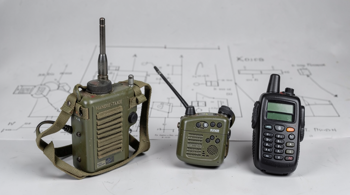
Manpack radios have served as the backbone of tactical ground communications for decades, with several models now appearing in the surplus inventory. The AN/PRC-77, which entered service in 1968, represented a significant technological shift from its predecessor, the AN/PRC-25 3. The PRC-77 utilized solid-state components for its power amplifier stage rather than the vacuum tubes found in the earlier PRC-25 3. This model was also compatible with voice encryption devices like the TSEC/KY-57 VINSON, providing secure short-range VHF FM communication 3.
Prior to the PRC-77 era, the AN/PRC-10 was widely deployed during the Korean and early Vietnam Wars. This 16-tube FM radio functioned as a squad-level communication tool and was part of a family that included the PRC-8 and PRC-9 5. These units were often paired with the AT-271/PRC antenna, a 10-foot long seven-section whip designed for maximum range 5. The frequency coverage for tactical radios of this era typically spanned from 30 to 75.95 MHz, divided into distinct bands for operational flexibility 4.
Field Telephony and Manual Switching Infrastructures
Beyond wireless radio systems, retired military gear often includes wired field communication sets designed for durable, localized networks. The SB-22A/PT Field Telephone switchboard is a portable manual unit capable of interconnecting up to 12 separate voice frequency circuits 6. It was engineered for all-weather use in fixed-base or mobile military shelters and could be combined with additional units to expand the network to 29 circuits 6. Its rugged design includes a tightly-fitting front cover to protect internal components from environmental elements.
Complementary to the switchboard is the TA-312/PT field telephone, an analog two-wire battery-operated device 6. The TA-312 was designed to replace the World War II era EE-8 field phone and remains compatible with legacy systems 9. These units are frequently found in secondary markets as part of complete communication sets that include accessory kits like the MX-2915/PT, which contains trunk jacks and spare signal lamps 6. Such equipment illustrates the reliance on robust, hardwired systems for secure point-to-point communication in the field.
Contemporary Digital and P25-Compliant Infrastructure
Modern surplus listings frequently feature high-performance digital systems that have transitioned from public safety and federal use. The Motorola APX 8000 is a prominent all-band P25 portable radio that offers interoperability across multiple RF bands 10. These units are often equipped with advanced features such as Adaptive Audio Engines and integrated Wi-Fi for software updates 10. Many of these transceivers available in the surplus market are trade-ins from agencies that have upgraded their fleets, often retaining multi-key encryption modules like AES256 or DES-XL 10.
Mobile and base station equipment such as the Motorola XTL5000 and the XPR 5550e are also common in the secondary market. The XTL5000 is often configured as a consolette for base station use, operating in the UHF 450-520 MHz range with 40-watt power output 11. Similarly, the XPR 5550e offers GPS and Bluetooth capabilities, serving as a high-power mobile radio with up to 1000 channels 12. These contemporary units represent a shift toward wideband communication and integrated data services, moving away from the purely analog designs of the mid-20th century.
Regulatory Constraints and Historical Preservation
Acquiring and operating retired military communication equipment involves navigating various regulatory and technical hurdles. Many tactical radios are liquidated by the Defense Logistics Agency (DLA) through specific marketplaces like GovPlanet 13. However, sensitive hardware is often subject to demilitarization requirements, which may involve the removal of cryptographic modules or specialized security components prior to public release 13. Furthermore, the Federal Communications Commission (FCC) regulates the frequencies on which these devices can transmit, often requiring an amateur radio license for legal operation on civilian-accessible bands.
Technical maintenance is another consideration for those managing retired gear, as functional military-grade hardware often requires proprietary power sources. For instance, many legacy radios like the PRC-25 or PRC-77 are sold without batteries, as the original BA-279/U or similar units are no longer in production 4, 5. Collectors frequently seek rare components such as the TBY-6 radio used by Navajo Code Talkers during World War II, though pristine examples are exceptionally rare due to the corrosive effects of tropical environments on non-moisture-proofed hardware 12. This preservation of history requires a deep understanding of both the mechanical and electronic specifications of each unit.
| Model Category | Specific Equipment | Operational Era | Primary Function |
|---|---|---|---|
| Handheld | AN/PRC-90-2 | Late 20th Century | Emergency/Survival |
| Manpack | AN/PRC-77 | Vietnam/Cold War | Tactical VHF FM |
| Field Phone | TA-312/PT | Korea/Vietnam | Point-to-Point Voice |
| Digital Portables | Motorola APX 8000 | Modern | P25 Interoperability |
| Switchboard | SB-22A/PT | Korea/Vietnam | Network Management |
Sources
- toughmilitaryitems.com
- gsaauctions.gov
- backcountryhuntshop.com
- coltwinchestershop.com
- ww2originalsshop.com
- backcountryhuntshop.com
- usadroneshop.com
- kruschiki.com
- gsa.gov
- northgeorgiacommunications.com
- haloidsolutions.com
- precisiongunpro.com
- trueprepper.com
- vintageradioparts.com