Generator Financing Options: A Complete Consumer and Business Guide
Generator financing options have expanded considerably as backup power has shifted from a luxury item to an operational necessity for both homeowners and businesses. A whole-home standby generator typically costs between $5,000 and $15,000 before installation, while commercial and industrial units can reach $118,000 or more, making upfront cash purchases impractical for many buyers. 1 Understanding the full spectrum of available financing structures, from deferred-interest credit cards to SBA loans and international trade finance, helps buyers avoid costly missteps and select terms that align with their actual financial situation.
Residential Generator Financing: Manufacturer and Retailer Programs
The most widely available residential financing routes flow through manufacturer-affiliated credit programs. Generac, one of the largest standby generator brands in the United States, operates an exclusive financing partnership with Synchrony Financial, allowing qualified homeowners to access promotional credit lines. 2 Under the Synchrony structure, payment calculations are based on a percentage of the highest balance rather than a declining principal, which means monthly payments remain fixed rather than decreasing over time. For example, under a 132-month plan, a borrower with a $12,000 generator pays approximately 1.25% of the original balance monthly, or roughly $150. 3
Multiple installer networks, including Premier Generators, Bo's Generators, and Vermont Generator Systems, offer the Synchrony Project Card with three standard plan structures on a $15,000 purchase: a deferred-interest option at 0% if paid within 12 to 18 months with a 2.1% payment factor, a mid-term plan at approximately $300 per month over 79 months, and a long-term plan at approximately $180 per month over 15 years. 4 Kubota Engine America also publishes retail finance rates through Kubota Credit Corporation, including 0% APR for 12 months, 0.9% APR for 24 months, and 2.5% APR for 36 months on select generator models such as the GL7000 (list price $8,292) and GL11000 (list price $10,624). 5
Critical Risk: Deferred Interest vs. True 0% APR
A significant compliance and financial literacy point for any generator financing consumer is distinguishing between a genuine 0% APR fixed loan and a deferred-interest promotional plan. Under deferred-interest structures, if the promotional balance is not paid in full before the promotional window closes, interest accrues retroactively from the original purchase date at the standard APR. At Brite Generators, for instance, the standard APR reverts to 34.99% if promotional terms are not met. 6 This creates a substantial hidden liability for borrowers who carry even a small remaining balance at the end of the promotional period.
Some programs charge an upfront account activation fee regardless of the promotional structure. Generator One's Plan 924 and Plan 980 each carry a $59 account activation fee, while Brite Generators charges a $69 activation fee on its 18-month same-as-cash product. 7 Brite's 88-month fixed option carries a disclosed 7.99% APR with no promotional fee, which in many long-term scenarios represents a lower total cost than a deferred-interest plan where the payoff deadline is missed. Borrowers should calculate the total dollar cost of interest over the entire loan term, not just the monthly payment amount.
Personal Loans, HELOCs, and Unsecured Credit Alternatives
Homeowners who prefer not to use manufacturer-affiliated credit cards have several independent financing alternatives. Personal loans from banks, credit unions, and online lenders offer fixed interest rates and defined repayment terms with no collateral requirement. According to NerdWallet, personal loans are a common mechanism for home improvement projects including generator installation precisely because they do not require home equity as a pledge. 8 Financing terms for generators typically range from 12 to 84 months depending on the borrower's credit profile and total project cost.
Home equity loans and home equity lines of credit (HELOCs) are frequently used for large-scale whole-home generator installations due to their typically lower interest rates compared to unsecured personal debt. Bankrate notes that interest on home equity products used for qualified home improvements may carry tax deduction benefits, though borrowers should verify eligibility with a tax professional. 9 The primary risk of HELOC-based generator financing is that the home serves as collateral, meaning a default could jeopardize the property. Most residential generator financing plans can also incorporate the cost of the unit, professional installation, transfer switches, and an extended warranty into a single financed amount.
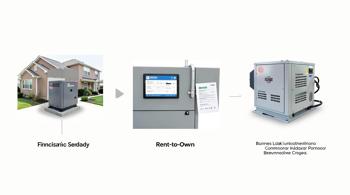
Buy Now Pay Later and Rent-to-Own Programs
Buy Now Pay Later (BNPL) platforms and rent-to-own programs represent an accessible, though often more expensive, tier of generator financing. Major BNPL providers including Affirm, Klarna, Afterpay, PayPal Pay in 4, and Zip appear at checkout for generators on national retail websites. Short pay-in-4 plans are frequently interest-free if paid on time, while longer installment plans of 3 to 36 months may carry interest or a flat finance fee. 10 Absolute Generators lists Bread Pay as a consumer checkout financing option, while also recommending local banks and credit unions as supplementary sources. 11
Rent-to-own (RTO) and lease-to-own (LTO) models allow customers with thin or challenged credit files to take possession of a generator immediately and make fixed periodic payments over time. Ownership only transfers after completing the full payment term, and the equipment can typically be returned to halt future payments. The structural tradeoff is meaningful: RTO arrangements generally carry a significantly higher total cost compared to outright cash purchase or a conventional personal loan, and consumers should calculate the total obligation before signing an agreement.
Commercial and Industrial Generator Financing
Commercial generator financing operates under different structures and approval criteria than residential programs. Brilliance Funding Partners notes that most generator purchases in the $15,000 to $250,000 range fall into the app-only financing category, meaning full financial statements are generally not required. Absolute Generators offers commercial equipment financing through First Citizens Bank (Direct Capital), which accepts online applications and allows qualification up to $250,000, with a minimum FICO score of 640 (Experian) and at least two years in business. 12 Vista Pacific Capital specializes in industrial and commercial generator financing for systems typically 90kW and above, with application-only approvals up to $500,000, same-day decisions, and terms from 24 to 84 months covering both new and used equipment. 13
Commercial lenders frequently allow borrowers to bundle soft costs into the financed amount, including installation and electrical work, transfer switches, concrete pads, delivery, extended warranties, fuel tanks, and sound attenuation enclosures. For food trailer operators, commercial generators range from $3,000 to $8,000 for portable inverter units up to $40,000 or more for large trailer-mounted systems, with installation adding $2,000 to $10,000. 14 SBA 7(a) loans can be used for working capital and equipment, while the SBA 504 program finances major fixed assets through a certified development company structure. SBA Microloans provide smaller-dollar access for eligible small businesses and certain non-profits. 15
Equipment Leasing, Chattel Mortgage, and Tax Considerations
Equipment leasing is a structurally distinct alternative to purchase-based financing. Under an operating lease, the borrower pays periodic lease payments and does not own the equipment, which may qualify those payments as fully tax-deductible operational expenses. This preserves existing bank credit lines and avoids a large capital expenditure on the balance sheet. Standard lease programs sometimes require only one advance payment and a documentation fee before the term begins. For Australian commercial buyers, a chattel mortgage secures the loan against the generator itself, with the borrower owning the asset from day one and claiming depreciation and interest deductions. A civil contractor purchasing a 120kVA diesel generator might structure the loan over four years with a 20% balloon payment to reduce monthly cost while claiming the full GST input credit at purchase. 16
Comfort Connect's Premier Program represents a subscription-style alternative, bundling a new standby generator, professional installation, factory-recommended maintenance, and priority repair service into a single predictable monthly payment with no large upfront cost. The program reportedly improves contractor close rates by 5 to 10%, reflecting that the combined financial and operational burden of generator ownership is a primary consumer hesitation point. 17 Regardless of financing structure, borrowers should factor in ongoing fuel, maintenance, and annual inspection costs that are not captured in the generator purchase price when evaluating total affordability across the loan term.
Sources
- zccpower.com - Generator Financing: Rates, Loans and Leases (2026)
- generac.com - Generac Financing via Synchrony Financial
- invertergenerator.net - Generac Generator Financing Options 2026
- premiergenerators.com - Generator Financing and Monthly Payments
- kubotaengine.com - Generator Promotion KTC Retail Finance Rates
- britegenerators.com - Financing Options for Brite Generators
- generatorone.com - Financing via Synchrony Bank Plan Details
- nerdwallet.com - Home Improvement Personal Loans
- bankrate.com - What Is a Home Equity Loan?
- learn.updateblast.com - Portable Generator Rent to Own and Buy Now Pay Later Guide
- absolutegeneratorsllc.com - Financing Available via Bread Pay and First Citizens Bank
- brilliancefundingpartners.com - Financing a Generator for Your Business
- vistapacificcapital.com - Industrial and Commercial Generator Financing
- equinox-funding.com - Commercial Generator Financing for Food Trailers and Trucks
- sba.gov - SBA 7(a), 504, and Microloan Programs
- treadgoldfinance.com.au - When to Finance vs Buy Generators Outright
- comfortconnect.com - Stand-by Generator Financing for Contractors