Affordable places to retire in Arizona with low-cost real estate
Arizona rivals Florida as a top retirement destination, and the financial case is grounded in measurable data. The state carries a flat 2.5% income tax rate, fully exempts Social Security from state taxation, and maintains an effective property tax rate of approximately 0.62%, which sits below the national average and below rates in Florida and North Carolina. 1 Yet statewide averages obscure dramatic city-level variation: a median home in Scottsdale is reported at roughly $709,900, while Douglas lists at approximately $138,200, representing a price gap of more than $570,000 within the same state. 2 For retirees operating on fixed incomes, city selection is therefore as consequential as state selection.
Arizona's Retirement Tax Framework
The foundational tax appeal of Arizona for retirees rests on three pillars. First, Social Security income is fully exempt from state taxation. Second, the flat 2.5% income tax rate, established by Proposition 132 passed by voters in 2022, replaced a graduated structure that previously topped out at 4.5%. 1 Third, IRA and 401(k) withdrawals are taxed, but only at that same 2.5% flat rate. For a couple drawing $80,000 annually, with $35,000 from Social Security and $45,000 from IRA distributions, the state tax liability totals approximately $1,125, since only the $45,000 in IRA income is taxable. 1 The combined average sales tax across state and local jurisdictions runs approximately 8.30%, which is a meaningful offset that retirees on tight budgets should factor into monthly expense planning.
Homeowners aged 65 and older may qualify for Arizona's property valuation protection program, which can freeze the assessed value of a primary residence for tax purposes, limiting future increases in annual tax bills. 3 Arizona's statewide effective property tax rate of 0.62% means a home valued at $275,000 carries an annual property tax bill of roughly $1,705, substantially lower than many comparable retirement states. These structural advantages are consistent regardless of which city a retiree selects within Arizona.
Most Affordable Cities by Median Home Price
Cost-of-living data compiled across Arizona's 467 incorporated places reveals a wide affordability spectrum. The most deeply affordable markets are concentrated in border communities and smaller inland towns, while major metro suburbs carry prices well above the national median. The table below summarizes key markets using verified 2025 and 2026 data.
| City | Median Home Value | Average Rent (2BR) | Notable Factor |
|---|---|---|---|
| Douglas | ~$138,200–$205,000 | ~$850–$900 | Groceries and transport 15% below national avg |
| Nogales | ~$172,800 | ~$890 | Border town; grocery prices match low housing cost |
| Kearny | ~$170,000 | ~$1,046 | Housing 35% below national avg; property tax ~$68/mo |
| Coolidge | ~$277,495 | ~$1,695 | Cost of living 21% below national avg; Pinal County |
| Kingman | ~$200,000–$250,000 | Market rate | Historic Route 66; cooler than Phoenix |
| Tucson | ~$242,200–$295,000 | Market rate | Major medical center; University of Arizona |
| Green Valley | ~$275,000 | Market rate | Active adult communities; 20 miles south of Tucson |
| Casa Grande | Below Phoenix metro avg | Market rate | Between Phoenix and Tucson; Social Security-livable |
Douglas, located in Cochise County near the Mexican border, records a median home value around $138,200 according to cost-of-living data, with overall costs running approximately 15% below the national average and 20% below the Arizona state average. 2 Average rent for a two-bedroom unit hovers near $850 to $900 per month, making it one of the lowest-cost rental markets in the state. 4 Kearny, a small community of under 2,000 residents in Gila County, lists median home prices around $170,000, with housing expenses roughly 35% below the national average and a median monthly property tax of approximately $68. 5
Tucson: The Large-City Affordability Case
Among Arizona's major population centers, Tucson consistently registers as the most affordable. Its cost-of-living index sits at approximately 93, below the national baseline of 100, while Scottsdale's index approaches 138. 6 Median home values in Tucson are reported between $242,200 and $295,000 depending on the data source and vintage, compared to the $381,900 recorded for Phoenix and $709,900 for Scottsdale. 2 A couple relying on two average Social Security checks, supplemented by a mid-six-figure savings portfolio, is estimated to need only $310,000 to $350,000 in total savings to sustain a $62,000 annual retirement budget in Tucson. 3
Tucson's practical infrastructure advantages include the University of Arizona's academic medical center, which provides access to specialty healthcare that smaller Arizona towns often lack. The city sits at a higher elevation than Phoenix, producing meaningfully cooler summer temperatures. For comparison, Phoenix regularly records July highs near 115°F, while Tucson's elevation moderates that figure. 1 Green Valley, located 20 miles south of Tucson with a median home price near $275,000, functions as a satellite retirement corridor offering active adult communities, golf, and proximity to Tucson's healthcare network while maintaining lower price points than the city itself. 7
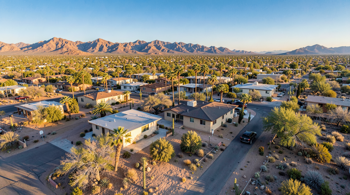
Mid-Range Affordable Options: Prescott, Show Low, and Kingman
Prescott, situated in central Arizona at roughly 5,400 feet elevation, delivers a four-season climate with July average highs near 88°F, a significant contrast to Phoenix's triple-digit summers. 1 Median home prices in Prescott run around $400,000 to $430,000, placing it above the border communities but well below Scottsdale. One-bedroom rental apartments are generally reported between $900 and $1,300 per month. 8 The city carries an established retiree demographic, an active downtown Courthouse Plaza, and reasonable access to healthcare infrastructure. The primary financial trade-off is that Prescott's housing costs are notably higher than smaller alternatives in the same state.
Show Low, positioned at 6,345 feet on the Mogollon Rim in eastern Arizona, offers a cooler climate that counters Arizona's desert heat reputation. One- and two-bedroom apartments are frequently available for under $900 per month, and manufactured housing communities in the area provide lower-cost homeownership alternatives. 9 Kingman, along historic Route 66 in northwestern Arizona, carries median home prices between $200,000 and $250,000, with a higher elevation than Phoenix producing cooler temperatures and proximity to Lake Mead for outdoor recreation. 10 Springerville in eastern Arizona reports a cost of living approximately 15% below the national average, with median home values around $158,997 in certain neighborhoods and average monthly rent near $900. 11
Practical Risks and Budget Considerations
Several cost factors are systematically underestimated in retirement planning for Arizona. Wildfire insurance in Northern Arizona's wildland-urban interface, which includes communities near Prescott, Flagstaff, and Payson, is reported to run between $2,000 and $5,000 annually, a recurring expense absent from most standard retirement calculators. 12 Summer cooling costs in lower-elevation desert communities such as Yuma, Bullhead City, and the Phoenix metro area can add meaningfully to monthly utility budgets during the May-through-September period. Arizona's combined average sales tax of approximately 8.30% represents an above-average consumption tax burden relative to other retirement states. 1
Healthcare access varies substantially across the affordability spectrum. The most deeply affordable markets, including Douglas, Kearny, and Springerville, are geographically remote from major hospital systems. Sunsites, a residential retirement community 85 miles southeast of Tucson in Cochise County, is car-dependent with very limited public transportation options. 13 Retirees with significant or complex medical needs should weigh proximity to tertiary care facilities as a primary location variable, not a secondary one. Arizona's statewide cost-of-living index of 103 places it 3% above the national average overall, driven primarily by housing in metro areas, meaning the affordability case rests almost entirely on city-level selection rather than the state brand. 6
Comparing the Broader Affordability Landscape
Yuma, located at the state's southwestern corner, receives approximately 91% of possible annual daylight hours as sunshine, more than any other American city according to meteorological records. 14 Its cost-of-living index and median home prices fall below $300,000, and it has historically served as a primary destination for seasonal retirees from colder northern states. Summer temperatures regularly exceed 100°F, which deters year-round residents, though retirees with flexibility to travel during peak summer months report the seasonal rhythm as manageable. Bullhead City, on the Colorado River bordering Nevada, offers waterfront access with median home prices in the $250,000 to $300,000 range, while Sierra Vista, near Fort Huachuca in southeastern Arizona, carries median prices around $280,000 to $320,000 with a mild climate driven by its 4,600-foot elevation. 15
Coolidge, in Pinal County between Phoenix and Tucson, maintains a cost of living estimated at 21% below the national average while remaining in the fastest-growing county in Arizona, a combination that is analytically uncommon. 16 Youngtown, the historically documented predecessor to Sun City established in the 1950s, carries a cost of living approximately 2% below the national average, with housing as the primary affordability driver, while nearby Sun City West registers 9.4% higher costs than Youngtown and 7% above the national average. 17 Across all markets, the consistent pattern in the research data is that affordability in Arizona is a city-level variable, not a state-level guarantee, and retirees who conduct market-specific analysis before relocating are more likely to align actual expenses with retirement income projections.
Sources
- wealthvieu.com – Retiring in Arizona 2026: Taxes, Costs, Healthcare, and Best Cities
- costoflivingdata.com – Arizona Cost of Living 2026, 467 Cities, Median Home $359K
- 247wallst.com – For Most Retirees, Only One Arizona City Actually Makes Sense
- aol.com – 9 Arizona Cities Where You Can Retire on $1,750 a Month Or Less
- everafterinthewoods.com – Tiny Town in Arizona Where Social Security Is More Than Enough (Kearny)
- myrelocationsavings.com – Cost of Living in Arizona 2026: City-by-City Breakdown
- courtneyseely.com – Moving to Green Valley AZ: Complete Relocation Guide for Retirees
- fastfoodclub.com – This Charming Arizona Town Is So Affordable, Retirees Say Social Security Is All They Need (Prescott)
- fastfoodclub.com – Retirees Are Thriving in This Affordable Arizona Town: Show Low
- familydestinationsguide.com – 8 Arizona Cities Where $1,500 A Month Is All You Need To Retire (Kingman)
- everafterinthewoods.com – Retirees Say This Affordable Arizona Town Made Them Wish They Moved Sooner (Springerville)
- 247wallst.com – Could You Afford To Retire Near The Grand Canyon? (Williams/Flagstaff)
- islands.com – Arizona's Affordable Retirement Community Southeast of Tucson: Sunsites
- cityvibecheck.com – Yuma AZ Neighborhood Guide and Cost of Living
- Realtor.com – Sierra Vista AZ Real Estate and Retirement Data
- familydestinationsguide.com – This Small Arizona Town Has Living Costs 21% Lower Than Most of America (Coolidge)
- aol.com – America's First Planned Retirement Community Is Still Surprisingly Low-Cost Today (Youngtown)