Impounded Heavy Equipment and Bulldozers on Sale: A Buyer's Guide to Seized Machinery Auctions
Impounded heavy equipment and bulldozers on sale through public auction channels attract contractors, fleet operators, and equipment investors seeking machinery that has been legally seized, repossessed, or declared government surplus. These assets move through structured liquidation pipelines managed by federal agencies, county sheriff departments, creditor-appointed auctioneers, and specialized online platforms. Understanding the mechanics of these channels is essential before committing to any bid.
How Heavy Equipment Becomes Impounded or Surplus
Heavy machinery enters the impounded or surplus pipeline through several legally distinct pathways. Law enforcement agencies seize equipment connected to criminal activity, such as illegal mining operations. In a documented 2025 enforcement action in Ghana, government authorities seized 425 pieces of machinery involved in illegal mining, including 177 excavators, four bulldozers, 12 vehicles, 43 motorcycles, 155 pumping machines, and 10 heavy-duty generators, with an additional 1,200 excavators impounded pending validation at the Tema Port. 1 This scale illustrates how enforcement-driven seizures can introduce large equipment volumes into disposal pipelines simultaneously.
Beyond law enforcement, equipment also enters surplus or liquidation auctions following business closures, equipment financing defaults, tax liens, or secured creditor actions. A creditor-ordered liquidation, for example, may involve the complete disposal of a contractor's fleet across excavators, crawler tractors, and support vehicles, all sold under court or lender authority. 2 These repossession-driven events regularly supply bulldozers and related construction machinery to both live and timed online auction formats.
Federal Government Channels: GSA Auctions and Treasury Sales
The U.S. General Services Administration manages surplus and seized federal government property through its official GSA Auctions platform, where the general public can bid electronically on federal assets. 3 Personal property categories on the platform range from office furniture to heavy machinery, airplanes, and vessels. Payment methods accepted through GSA Auctions include wire transfers via Fedwire or ACH, government-issued checks, and major credit cards processed through the Department of Treasury's electronic payment service, though credit card purchases are capped at $24,999.99 per transaction. 3
The U.S. Treasury Department's Debt Management Services also auctions seized assets and impounded equipment through authorized auction houses nationwide, providing an additional federal-level channel for construction machinery disposal. 4 Separately, GovDeals, a Liquidity Services brand, operates as a major online marketplace where municipal and state government agencies list heavy equipment including bulldozers, excavators, and motor graders from fleet replacements and surplus declarations. 5 These platforms are publicly accessible and require electronic registration before participation.
Specialist Auction Houses and Online Platforms
Beyond direct government channels, several specialized auctioneers regularly handle impounded and repossessed construction equipment. Ritchie Bros. Auctioneers conducts regular live and online auctions of heavy equipment including impounded and repossessed bulldozers across North America. 6 IronPlanet provides an online marketplace specifically for heavy construction equipment sourced from government and corporate liquidations, offering detailed machine specifications to remote bidders. 7 GovPlanet further specializes in military and government surplus and impounded equipment. 8
Timed online auction formats have become the dominant delivery mechanism for this category. Alex Lyon and Son Auctions, for instance, conducted a secured creditor liquidation in Richmond, Virginia covering 10 hydraulic excavators from manufacturers including Volvo, John Deere, Caterpillar, and Case, alongside crawler loaders, tractor loader backhoes, rubber-tracked skid steers, and service trucks. 9 Police seizure and equipment auctions, such as those organized by Powell Auction and Realty in Knoxville, Tennessee, include farm equipment, construction equipment, tractors, skid steers, trailers, and heavy equipment of all kinds, with a standard 15% buyer's premium added to final hammer prices. 10
What Types of Machinery Typically Appear
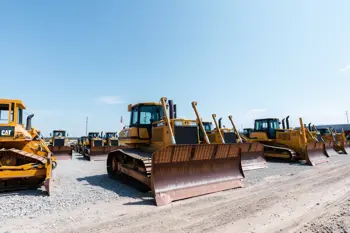
The range of equipment found across impounded and surplus heavy equipment auctions is broad. Government surplus sales through platforms like BidProwl, which aggregates GSA, GovDeals, and GovPlanet listings, show that heavy equipment has historically generated more than 32,155 sold government auction transactions, with a recorded median starting price point of approximately $275 per listing across that category. 11 Bulldozer models commonly appearing in these auctions include Caterpillar D-series machines such as the D5, D6, and D8T, as well as John Deere and Komatsu equivalents.
A Houston, Texas live auction held by Alex Lyon and Son featured 37 crawler tractors from the Caterpillar rental fleet, including multiple Cat D8T, D6T, D6N, D5, D3, D2, and D1 series units alongside John Deere 950 and 750 series dozers and a 2018 Komatsu D61PX. 12 Refurbished impounded bulldozers also appear internationally; a 2018 Shantui SD22, considered a Caterpillar D7 equivalent with 6,097 recorded hours and described as fully refurbished, was listed through Machinery for Africa at an approximate market value of USD 110,500. 13
Buyer Requirements, Fees, and Registration Realities
Participation in impounded heavy equipment auctions involves meeting specific registration and financial requirements. International bidders at some auctions, such as those managed by KD Auctions in Sacramento, California, are required to submit a refundable deposit of $3,000 via bank wire before being approved to bid. 14 Buyer's premiums are a standard cost layer applied on top of the winning bid. These premiums commonly range from 10% to 18%, depending on the auction house and event type. The Floyd County Equipment Online Auction administered by Harritt Group applied a 10% buyer's premium, while KD Auctions applied an 18% buyer's premium to all purchases. 15
Payment timelines are also strict. Many auction terms require full payment within 24 hours of lot closing, with no exceptions. 14 Equipment removal after payment must typically occur within a defined window, ranging from 48 hours to two weeks post-auction depending on the event. Sales tax is frequently added, and buyers are responsible for arranging specialized heavy transport at their own cost. Repossession and commercial asset recovery firms such as PRG Asset Recovery confirm that impounded equipment often involves complex logistics including GPS coordination, specialized trailers, rigging, and licensed storage before it reaches the auction floor. 16
Key Risks and Due Diligence Considerations
Impounded and surplus heavy equipment is almost universally sold on an as-is, where-is basis, meaning the buyer assumes all responsibility for mechanical condition, transport, and post-purchase repairs without warranty protection. 2 Inspection windows are limited; some auctions offer pre-auction preview days lasting only a few hours, while others require appointments. Buyers without direct mechanical expertise or access to a qualified technician face significant risk in evaluating whether hydraulic systems, undercarriage wear, engine hours, and structural integrity meet their operational needs.
Title documentation is another area requiring close scrutiny. Equipment sold from police seizures or secured creditor actions may have title encumbrances, outstanding liens, or bill-of-sale-only transfers that restrict registration or resale. The RTI Auctions Webster Equipment NetAuction, for example, listed a 1986 International Hough forklift explicitly as bill-of-sale only. 17 Buyers should verify lien status through applicable state registries and consult legal counsel when purchasing through law enforcement or creditor-ordered channels to ensure clean title transfer before taking possession of any machinery.
Sources
- CediRates / MyJoyOnline - Galamsey fight: Government seizes 425 excavators, other machinery (cedirates.com)
- PRG Asset Recovery - Commercial Equipment Recovery San Antonio TX (prgassetrecovery.com)
- GSA.gov - How to Purchase Surplus Property (gsa.gov)
- U.S. Department of the Treasury - Fiscal Service Debt Management (fiscal.treasury.gov)
- GovDeals - Heavy Equipment and Construction for Auction (govdeals.com)
- Ritchie Bros. Auctioneers - rbauction.com
- IronPlanet - ironplanet.com
- GovPlanet - govplanet.com
- Alex Lyon and Son Auctions - Richmond, Virginia Timed Auction (lyonauction.com)
- Powell Auction and Realty - Police Seizure and Equipment Auction (powellauction.com)
- BidProwl - Recently Sold at Government Auctions (bidprowl.com)
- Alex Lyon and Son Auctions - Houston, Texas Onsite Live Auction (lyonauction.com)
- Machinery For Africa - 2018 Shantui SD22 (machineryforafrica.com)
- KD Auctions - Surplus Equipment for a Large Heavy Equipment Replacement Parts Company, Sacramento CA (kdauctions.com)
- Harritt Group - Floyd County Equipment Online Auction (harrittgroup.com)
- PRG Asset Recovery and Holdings LLC - prgassetrecovery.com
- RTI Auctions - Webster Equipment Industrial Surplus NetAuction 2026 (rtiauctions.com)