Affordable real estate options for retirees in Arizona
Arizona's Tax Framework and Why It Draws Retirement Migration
Arizona's financial environment has become a structural draw for retirees relocating from higher-tax states. The state imposes zero income tax on Social Security benefits, a meaningful distinction from neighboring states that do tax those payments. 1 Arizona's flat income tax rate stands at 2.5%, and the state also provides a full exemption on military pension income, broadening its appeal to veterans. 2 Real estate expert Sain Rhodes of Clever Offers noted that since 2019, retirement migrants have been able to stretch their retirement dollars further in Arizona compared with alternatives in California or Nevada, citing lower healthcare costs alongside the Social Security tax exemption as key factors. 3
Property tax rates add another layer of financial relief. Arizona's effective property tax rate averages approximately 0.62% of assessed home value, ranking among the lowest in the nation. 4 For homeowners aged 65 and above, Arizona also provides a property value freeze mechanism that prevents reassessment increases, further stabilizing long-term housing costs on a fixed income. 5 These stacked fiscal advantages explain why markets like Tucson, Bullhead City, and small mountain towns have collectively seen sustained retiree in-migration even as coastal markets remain cost-prohibitive.
Market-By-Market Housing Price Benchmarks
Housing costs across Arizona vary considerably by geography, and retirees must weigh price against climate, amenity access, and healthcare proximity. The table below summarizes median home prices and average monthly rents for key retirement markets identified in current research data.
| Location | Median Home Price | Avg. Monthly Rent (1BR) | Notable Factor |
|---|---|---|---|
| Kearny | ~$170,000 | $1,046 | Housing 35% below national avg. |
| Youngtown | ~$180,000 | N/A | America's first retiree-planned community |
| Bullhead City | $296,117 | $1,324 | Colorado River location |
| Yuma | Under $200,000 | $907 | One of lowest rents in state |
| Casa Grande | $250,000–$280,000 | $800–$1,100 | Midpoint between Phoenix and Tucson |
| Show Low | ~$275,000–$340,000 | $1,055–$1,080 | High-elevation mountain climate |
| Tucson | $365,000 | $1,029 | Major university medical center |
At the lower end, Kearny stands out with a median home listing price around $170,000, with most active listings described as 3-bedroom, single-story houses between 1,200 and 1,700 square feet priced between $135,000 and $185,000. 6 Youngtown, historically the first community in the United States specifically designed for retirees (founded in 1954), maintains a median home cost near $180,000, well below the Arizona state average of approximately $275,000. 7
Established 55+ Active Adult Communities Near Phoenix
Arizona is home to roughly 140 active adult communities, with the Phoenix metro area serving as the primary concentration zone. Sun City, established in 1960 as the nation's first age-restricted development, and its neighboring Sun City West represent the most recognized options. 8 Real estate options across these communities span a wide range, from entry-level manufactured and single-family homes in the low $200,000s to luxury estates exceeding $1 million in premier enclaves such as Scottsdale. Sun City West's cost of living sits approximately 9.4% higher than Youngtown and 7% above the national average, illustrating how community prestige influences pricing tiers. 9
Apache Junction hosts multiple 55+ manufactured home communities, including Desert Harbor, La Casa Blanca, and Rancho Mirage, all positioned against the backdrop of the Superstition Mountains. 10 These communities offer amenities such as pools, recreation centers, and organized social activities at price points well below site-built home markets. Victory at Verrado in Buckeye, a master-planned community approximately 30 miles west of downtown Phoenix, targets downsizing empty nesters with a different profile: homes emphasizing energy efficiency rated around 58 on the HERS index, which developers cite as yielding lower utility costs compared to older builds typically rated in the mid-100s. 11
Tucson and Southern Arizona: Practical Retirement Math
Tucson's $365,000 median home price positions it as one of the few major Arizona cities where middle-income retirees can realistically budget long-term. Analysis published by 24/7 Wall St. calculated that a couple drawing two average Social Security checks would need approximately $310,000 to $350,000 in savings to cover Tucson's estimated $62,000 annual retirement budget. 12 The presence of the University of Arizona medical center adds a healthcare stability factor that smaller rural towns cannot match. The city also sits at a higher elevation than Phoenix, producing cooler summer temperatures that reduce the climate trade-off that affects purely desert-based retirement markets.
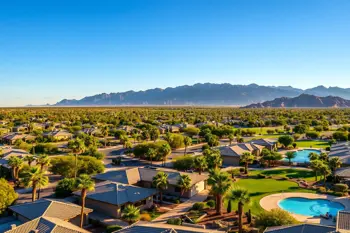
Green Valley, located just 20 miles south of Tucson, earned a place on Forbes' analysis of nearly 1,000 U.S. locations as one of the best retirement destinations in 2026. 13 The community is composed largely of active adult developments offering affordable townhomes and single-family residences, and its proximity to Tucson's medical infrastructure addresses a practical concern that purely rural retirement markets cannot fully resolve. Del Webb at Rocking K in Vail, east of Tucson, represents a newer 55+ community in the metro with floor plans starting in the mid-$400,000s, appealing to retirees seeking new construction with modern energy standards. 14
Mountain and Rural Markets: Show Low, Prescott, and Border Towns
Show Low, situated at 6,345 feet on the Mogollon Rim in eastern Arizona, carries a cost-of-living index of 77 against a national baseline of 100, making it significantly more affordable than the national average. 15 Median home values sit around $275,000 with a rent-to-income ratio of 20%, well below the 30% threshold HUD uses to define cost-burdened households. Property taxes in Navajo County remain low, and the mountain climate provides four mild seasons in contrast to the heat experienced in lower-elevation Arizona markets. One-bedroom apartments in the area average approximately $1,055 to $1,080 monthly. 16
Prescott, in central Arizona, carries a median home price of approximately $400,000, though retirees report finding condos and smaller homes for under that figure, with one-bedroom rentals typically ranging from $900 to $1,300 monthly. 17 Southern border communities present the lowest absolute rent figures in the state: Bisbee averages $840 per month, Douglas averages $850, and Nogales averages $890 for two-bedroom units. 18 These towns offer small-town character but present trade-offs in the form of limited healthcare infrastructure and reduced access to major transportation networks.
Risk Factors, Trade-Offs, and Eligibility Considerations
Retirees evaluating Arizona markets should account for several structural cost risks that are frequently omitted from simplified affordability analyses. In Northern Arizona communities near forested terrain, wildfire insurance in the wildland-urban interface typically runs between $2,000 and $5,000 annually, a recurring expense that most standard retirement budget calculators do not incorporate. 19 HOA fees in 55+ communities vary significantly: Sun City West carries a higher cost-of-living profile than Youngtown partly due to community fee structures. Retirees in manufactured home communities should also evaluate whether they own the land beneath their home or pay lot rent, as the latter introduces ongoing variable costs independent of the home purchase price.
Healthcare access disparities between urban and rural Arizona markets represent a material planning consideration. Tucson's University of Arizona medical infrastructure and Phoenix's concentration of hospital networks contrast sharply with the limited specialist access in rural markets like Kearny (population under 2,000) or border towns like Douglas. 20 Medicare Advantage and Supplemental insurance plans are widely available in Arizona's urban corridors, but plan networks thin considerably in rural counties. Additionally, the Betterment at Work Retirement Readiness Report noted that 90% of full-time workers report being stressed about their financial situation, and 48% believe they will need at least $1 million to retire comfortably, underscoring that even in affordable markets, realistic savings targets remain a prerequisite to sustainable retirement budgeting. 21
Sources
- Kiplinger – States with No State Income Tax on Social Security (kiplinger.com)
- Arizona Department of Revenue – Military Pension Subtraction (azdor.gov)
- GOBankingRates via Yahoo Finance – 7 Cheapest Places To Retire in Arizona (finance.yahoo.com)
- Tax Foundation – Property Taxes by State 2024 (taxfoundation.org)
- 24/7 Wall St. – For Most Retirees, Only One Arizona City Actually Makes Sense (247wallst.com)
- Ever After in the Woods – Tiny Town in Arizona Where Social Security Is More Than Enough (everafterinthewoods.com)
- Islands.com – America's First Community Designed For Retirees: Youngtown Arizona (islands.com)
- 55places.com – Arizona 55+ Retirement Communities and Homes for Sale (55places.com)
- AOL Finance – America's First Planned Retirement Community Is Still Surprisingly Low-Cost Today (aol.com)
- Sun Communities – Desert Harbor, La Casa Blanca, Rancho Mirage Apache Junction AZ (suncommunities.com)
- Renee Watkins Realtor – Victory at Verrado in Buckeye AZ Complete 55+ Community Guide (reneewatkinsrealtor.com)
- 24/7 Wall St. – For Most Retirees, Only One Arizona City Actually Makes Sense: Tucson (247wallst.com)
- Courtney Seely / Realty ONE Group Integrity – Green Valley Best Places to Retire 2026 (courtneyseely.com)
- Tucson Arizona Living – Inside Tucson's Newest 55+ Community: Del Webb at Rocking K (tucsonarizonaliving.com)
- CostToLive – Cost of Living in Show Low AZ 2026 (costtolive.com)
- Decor Hint – The Arizona Mountain Town So Affordable Retirees Are Quietly Flocking There (decorhint.com)
- Fast Food Club – This Charming Arizona Town Is So Affordable Retirees Say Social Security Is All They Need: Prescott (fastfoodclub.com)
- AOL – 9 Arizona Cities Where You Can Retire on $1,750 a Month Or Less (aol.com)
- 24/7 Wall St. – Could You Afford To Retire Near The Grand Canyon (247wallst.com)
- AARP – Retirement Communities Directory and Senior Housing Resources (aarp.org)
- Betterment at Work via GOBankingRates – Retirement Readiness Report (finance.yahoo.com)