Best Custom Cabinet Makers: A Regional Industry Guide to Craftsmanship, Cost, and Credentials
Homeowners and contractors searching for the best custom cabinet makers will find a landscape defined by regional specialization, wide variation in production methods, and meaningful differences in quality tiers. Unlike stock cabinetry, custom work is built around the specific dimensions, material choices, and functional needs of a single project. Understanding where shops operate, what credentials to verify, and what realistic costs and lead times look like is foundational to making an informed decision.
How the Custom Cabinet Market Is Structured
The cabinet industry divides production into three recognized categories: stock, semi-custom, and fully custom. Stock cabinets are pre-manufactured in fixed dimensions and pulled from warehouse inventory. Semi-custom options offer modular components with a limited range of finish and size adjustments. Fully custom cabinetry is engineered from scratch, meaning dimensions, wood species, hardware, and interior layout are determined by the specific project. 1 This distinction matters because pricing, lead times, and installer relationships differ substantially across all three tiers.
Many premium custom cabinet manufacturers in the United States operate through authorized dealer or regional contractor networks rather than selling directly to end consumers. 2 Brands such as Wood-Mode and Plain and Fancy are frequently cited within professional design circles for their extensive customization libraries and luxury joinery standards. Local and regional independent shops, by contrast, typically fabricate entirely in-house, which allows for tighter quality control and direct project management throughout the build cycle.
Regional Shops: A Cross-Market Overview
The research data captures active custom cabinet makers across multiple markets in the United States, Australia, New Zealand, Canada, and the Philippines. In Los Angeles, ATA Custom Cabinets has operated from its Canoga Park facility since 1989, completing over 1,000 projects under California License No. 955754, with all fabrication and installation performed by an in-house crew using CNC machining and hand finishing. 3 On the East Coast, Finest Woodwork in Malden, Massachusetts, operates with a team of seven master artisans and focuses on luxury residential and builder-facing millwork, drawing on more than a decade of hands-on industry experience. 4
In the Pacific Northwest, Keystone Kitchens in Woodinville, Washington, offers premium wood species including maple, cherry, rift-cut white oak, and walnut, with dovetail joinery and soft-close hardware as standard construction features. 5 Spencer LLC, also serving the Washington state market from Monroe, describes itself as an award-winning cabinet manufacturer covering new construction and remodeling projects. In the Southeast, Neptune Custom Cabinetry serves Jacksonville, Florida, using hardwoods such as walnut, cherry, and white oak paired with advanced finishing techniques, while Palmetto Custom Cabinets covers the Daniel Island, South Carolina area with a process that combines artisan woodworking and CNC technology. 6
Pricing Benchmarks and Cost Expectations
Pricing for high-end custom cabinetry typically ranges from $500 to $1,200 per linear foot, with the final figure driven by wood species selection, finish complexity, and interior hardware specifications. 7 Shops using solid hardwood fronts over plywood box construction generally command higher rates than mass-market producers using particleboard carcasses. Consumers should request itemized written estimates that separately identify material costs, labor, lead times, and warranty terms before comparing competing proposals. 8
In the Australian market, Melbourne-based operations such as Perfect Fit Interior, Sagar Cabinets, and Magri Cabinets each position their work in the premium segment, emphasizing precision manufacturing, in-house joinery, and extended service warranties. Cambridge Cabinets in Geelong notes that project timelines vary by scope and complexity, advising that homeowners be informed at each stage once a design is approved. 9 In all markets, transparency around lead times is a recognized differentiator between high-performing shops and those with structural delivery problems.
Lead Times, Process Standards, and Production Methods
Custom projects across the industry typically carry lead times of 8 to 20 weeks from design finalization to installation, depending on shop capacity, project complexity, and material sourcing. 10 Some operations have engineered faster cycles. Three Creeks Custom Cabinets, serving Denver and Colorado mountain towns including Vail, operates a documented process that moves from concept to installation within four weeks by combining design efficiency with tightly scheduled fabrication. 11 Highline Custom Cabinets and Millwork in the Vail Valley similarly promotes shortened lead times as a direct result of local fabrication rather than outsourced production.
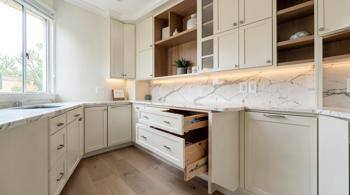
Standard quality indicators in the production process include full 3D rendering before fabrication begins, CNC-cut panels, hand-applied finishing, and single-crew installation by the same team that built the work. ATA Custom Cabinets, T.L. King Cabinetmakers in Chester County, Pennsylvania (operating since 1981), and Stellar Craft Cabinetry in Kelowna, British Columbia (with over 30 years in operation), each apply some version of this integrated model. 12 Stellar Craft specifically notes that its evolution from entirely hand-built production to CNC-assisted manufacturing has improved precision without reducing attention to traditional craftsmanship standards.
Credentials, Certification, and Vetting Criteria
Before commissioning any custom cabinet project, several verification steps reduce the risk of a poor outcome. The Kitchen Cabinet Manufacturers Association (KCMA) administers the ANSI/KCMA A161.1 certification, which sets industry benchmarks for structural integrity through rigorous testing of load capacity, door and drawer cycling, and finish durability. 13 Certification by this body represents an objective, third-party measure that is separate from a manufacturer's own marketing claims. In the United States, state-level contractor licensing requirements vary significantly, and checking a local licensing board is a standard due-diligence step. ATA Custom Cabinets, for example, publishes its California contractor license number publicly as a verification reference.
The National Kitchen and Bath Association (NKBA) operates a searchable member directory that can help locate kitchen and bath professionals, including those specializing in custom cabinetry, in specific geographic areas. 14 Consumer-facing platforms including Google Maps, Angi, and the Better Business Bureau each maintain business profiles and user-generated review records that can be used to assess reputation, complaint history, and average customer ratings by location. 15 Houzz also functions as a portfolio and review aggregator specifically oriented to home design and renovation professionals, where past project photography can be evaluated alongside client commentary.
Materials, Construction Quality Markers, and Risk Factors
Material selection is one of the most reliable proxies for long-term cabinet quality. High-performing shops consistently use plywood box construction with solid wood face frames and doors, whereas lower-tier producers and mass-market operations frequently substitute medium-density fiberboard or particleboard for structural components. 16 Neptune Custom Cabinetry's explicit use of walnut, cherry, and white oak as standard hardwood options, and Keystone Kitchens' menu of maple, cherry, rift-cut white oak, and walnut with dovetail jointing, represent the kind of material transparency that allows direct comparison across proposals.
Hardware quality is equally significant. Soft-close hinges, full-extension drawer glides, and concealed adjustable shelving systems are features that distinguish quality-tier cabinetry from budget production in measurable functional terms. 17 Homeowners should also account for ongoing realities: custom cabinets require proper humidity management in the home environment, as solid wood and plywood respond to seasonal moisture changes. Shops that apply factory-grade conversion varnish or lacquer finishes typically offer better moisture and abrasion resistance compared to those using site-applied brush finishes. Project complexity, permit requirements for structural built-ins, and access constraints in renovation contexts can all extend timelines and affect final costs beyond initial estimates.
How to Evaluate and Compare Cabinet Makers Objectively
A structured comparison framework helps filter candidates beyond surface-level claims. The most useful evaluation criteria include verifiable licensing and insurance, the specific construction method used (box material, jointing technique, finish type), the shop's production model (fully in-house versus outsourced components), demonstrated project history in the relevant application type (residential, commercial, or mixed), and the format of the design deliverable provided before fabrication begins. Shops offering dimensioned shop drawings and 3D renderings as a standard pre-production step indicate a more rigorous process than those working from informal sketches.
Written scopes of work should specify wood species, board thickness, hardware brand and grade, finish product and application method, installation crew composition, and warranty terms covering both material defects and installation workmanship. 18 Comparing multiple proposals on a normalized per-linear-foot basis, while accounting for scope differences, remains the most reliable method for assessing value without relying solely on brand recognition. Independent reviews on platforms such as Google, Angi, and Houzz provide supplementary signal, but detailed project-specific references from completed work in similar applications carry more diagnostic weight than aggregate star ratings alone.
Sources
- Houzz - Kitchen Cabinets: Stock, Semi-Custom, or Custom (houzz.com)
- This Old House - All About Kitchen Cabinets (thisoldhouse.com)
- ATA Custom Cabinets - atacabinets.com
- Finest Woodwork - finestwoodwork.com
- Keystone Kitchens - keystonekitchens.com
- Neptune Custom Cabinetry - neptunecustomcabinetry.com; Palmetto Custom Cabinets - palmettocustomcabinets.net
- Angi - How Much Do Custom Cabinets Cost (angi.com)
- HomeAdvisor - homeadvisor.com
- Cambridge Cabinets - cambridgecabinets.com.au
- Angi - Custom Cabinet Cost and Lead Time Guidance (angi.com)
- The Divine Luxury - Three Creeks Streamlined Cabinet Process (thedivineluxury.com)
- Stellar Craft Cabinetry - stellarcraftcabinetry.ca; T.L. King Cabinetmakers - tlkingcabinetmakers.com
- Kitchen Cabinet Manufacturers Association - ANSI/KCMA A161.1 Certification (kcma.org)
- National Kitchen and Bath Association - Member Search (nkba.org)
- Google Maps (google.com/maps); Angi (angi.com); Better Business Bureau (bbb.org)
- Consumer Reports - Kitchen Cabinets Buying Guide (consumerreports.org)
- Consumer Reports - Kitchen Cabinets Buying Guide (consumerreports.org)
- HomeAdvisor - Contractor Estimate and Scope Guidance (homeadvisor.com)