Heavy-duty workshop storage units on clearance: An Engineering and Procurement Guide for Commercial Spaces
Industrial facilities, commercial repair shops, and organization specialists frequently seek heavy-duty workshop storage units on clearance to optimize workspace efficiency at a reduced cost structure. Organizing heavy tooling, specialized machinery, and delicate diagnostic equipment requires robust storage systems designed to handle substantial weight loads. Understanding the physical engineering of these systems and navigating the surplus marketplace allows procurement managers to identify durable configurations that withstand intense daily operational use.
Structural Engineering and Material Composition
Industrial environments require durable storage solutions to organize high-mass tools safely. Heavy-duty workshop storage units on clearance typically feature heavy-gauge metal construction designed to resist mechanical stress. For example, professional workbenches engineered for heavy tooling utilize 12-gauge stainless steel for work surfaces, supporting up to 2,000 pounds of distributed weight 1. The frame is constructed from high-strength 16-gauge steel, adjustable in precise increments to accommodate ergonomic preferences 1.
In larger storage cabinets, manufacturers deploy 18-gauge galvanized steel for the main chassis to balance structural rigidity with weight distribution 2. These materials are subjected to anti-corrosion treatments, such as chemical degreasing, descaling, phosphating, and electrostatic powder coating finishes 3. This multi-stage finish protects the steel substrate from oxidation, moisture, workshop dust, and chemical exposure, which are common in busy industrial bays 2. Selecting high-grade materials ensures lockable compartments remain secure and structurally integral.
Comprehensive Tool Drawers and Slide Mechanism Classifications
Workspace efficiency relies on systematic tool categorization, leading to the development of multi-drawer storage cabinets. Heavy-duty rolling workstations often integrate between 10 and 30 independent pull-out drawers designed to organize hand tools, fasteners, and diagnostic instruments 2 4. These drawers typically ride on full-extension, three-section ball-bearing slides that prevent binding when loaded to capacity 4. Standard drawers generally support load ratings between 88 and 110 pounds each, preventing rail sag 2 3.
To safeguard delicate instruments, storage models incorporate pre-cut anti-slip drawer liners composed of polyvinyl chloride (PVC), keeping tools firmly in place during transit 3. Full-width aluminum alloy handles are standard across industrial-grade units to ensure quick physical access 3. Furthermore, integrated locking systems are a critical specification, allowing users to secure high-value equipment with a single key turn, reducing loss in shared environments 2. These configurations eliminate clutter, improving speed of retrieval.
Mobility vs. Stationary Structural Systems
Determining whether to deploy stationary or mobile storage units depends largely on operational flow. Stationary storage systems offer the highest load-bearing capacities and are ideal for assembly zones where stability is critical 4. Conversely, mobile utility carts and rolling workbenches introduce heavy-duty polyurethane wheels and dual side-mounted handles, allowing operators to transport tools directly to work areas 2 5. These mobile units utilize locking casters to ensure the cabinet remains stationary once positioned 5.
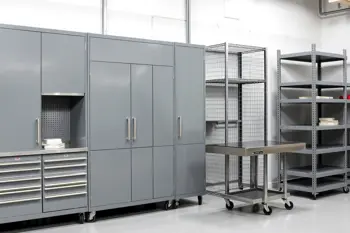
The trade-offs between physical size, storage density, and structural load limits are evident when comparing different industrial cabinet designs. Large-scale rolling systems of 10 feet in length provide extensive horizontal worktop surfaces but require reinforced steel frames to withstand dynamic forces generated during movement 6.
| Unit Classification | Physical Dimensions | Drawer / Cabinet Count | Worktop Load Capacity |
|---|---|---|---|
| 7ft Mobile Storage Workbench | 87.8 x 23.6 x 38.2 inches | 10 Drawers, 2 Cabinets | 1,654 lbs |
| 10ft Rolling Workbench | 113 x 23.6 x 38.2 inches | 15 Drawers, 2 Cabinets | 1,654 lbs |
| 10ft High-Capacity Cabinet | 120 x 24 x 72 inches | 30 Drawers | 750 lbs (Total Limit) |
Secondary Market Classifications: Scratch-and-Dent and Auction Surplus
Procuring heavy-duty workshop storage units on clearance often involves navigating secondary supply channels, such as scratch-and-dent outlets and industrial surplus auctions. Scratch-and-dent inventory typically consists of customer returns, open-box items, floor demonstrations, or units with minor packaging damage 1. These products display cosmetic imperfections, including small dents, scuffs, scratches, or surface smudges, which do not affect the physical strength or operational capacity of the steel frame 1. They offer a viable route to acquire premium gear at reduced costs.
Auction surplus represents another segment of the secondary market, where unused equipment is liquidated due to warehouse overstock, model discontinuations, or business restructuring 4. While these units are structurally identical to retail models, buyers must note that clearance and scratch-and-dent sales are almost universally sold under As-Is terms 1. This classification means transactions are final, with no options for refunds, exchanges, or standard manufacturer warranties 1. It is essential to verify all hardware components are present.
Vertical Storage and Modular Shelving Integration
When floor space is limited, workshops utilize vertical storage solutions to maximize square footage. Industrial metal shelving units and wire storage racks provide open visibility and quick access to inventory, tools, and bulk materials 7. High-capacity metal shelving designs often feature double-walled steel legs and adjustable horizontal beams, enabling a single shelving unit to support total loads exceeding 2,000 pounds 8. Some ultra-heavy-duty configurations utilizing cold-rolled steel frames can manage loads up to 11,000 pounds per unit 9.
For customized layouts, keyhole locking systems facilitate rapid, tool-free assembly of shelving frames 10. These modular systems allow operators to adjust the height of each tier in precise increments or reconfigure upright supports as low-profile workbenches 10. To guarantee safety, vertical storage racks should be secured with tip-over prevention brackets and loaded with the heaviest items on the lowest levels 10. This integration maximizes safe workshop output.
Procurement Realities and Logistical Friction Points
While obtaining high-capacity storage units through clearance channels presents substantial cost advantages, buyers must evaluate the associated logistical challenges. Industrial steel cabinets and heavy-duty workbenches are exceptionally dense, with shipping weights frequently ranging from 500 to over 800 pounds 3. Consequently, these products are classified as freight cargo rather than standard parcel shipments, which incurs separate, variable delivery fees 3. Furthermore, carrier freight policies typically require an adult to be physically present at the delivery location to inspect and sign for cargo 3.
Another logistical friction point is offloading. Standard delivery trucks are rarely equipped to unload heavy palleted steel crates safely, meaning the receiving facility must possess a forklift or equivalent machinery 3. Additionally, while some units arrive pre-assembled, other configurations require considerable assembly and calibration to align drawer slides 11 10. Understanding these requirements prevents costly delivery delays.
Sources
- Borroughs Workbench Outlet
- Pitstop Pro Chery Industrial Storage
- Garage Rebel Storage Solutions
- J&D Auction Heavy Duty Inventory
- VXB Bearings Tool Carts
- Pitstop Pro 10ft Storage
- SmartStorage Australia
- AOL / Men's Journal
- Reibii Heavy-Duty Shelving
- Hercules Store / Harden Equipment
- Pitstop Pro Delivery Information