Move-in ready modular homes for sale in Canada: A Complete Buyer's Guide for 2026
Move-in ready modular homes for sale in Canada have become a central topic in residential real estate discussions as housing affordability pressures intensify across Ontario, Alberta, and British Columbia. Unlike custom-order builds that can extend timelines by years, modular homes arrive factory-assembled with certified finishes, insulation, and mechanical systems already installed, reducing the gap between purchase and occupancy to weeks or months in many documented cases. 1
What Defines a Move-In Ready Modular Home in the Canadian Context
A modular home in Canada is a factory-built residential structure assembled in climate-controlled conditions and transported to a prepared site for installation on a foundation. The term 'move-in ready' specifically refers to units where interior finishes, plumbing, electrical systems, and kitchen and bath components are completed prior to delivery, requiring minimal additional work on-site. 2 According to pricing data from My Own Cottage, modular house prices in Canada range from $100 to $250 per square foot for the factory-built home alone, with all-in turnkey costs of $200 to $450 per square foot in Ontario once foundation, site preparation, delivery, permits, and development charges are included. 3
A completed 1,200 to 1,500 sq ft modular home on a serviced Ontario lot typically runs $300,000 to $525,000 all-in, before land costs. 3 Industry observers note that the factory price represents only 40 to 55 percent of what a buyer will actually spend when all site costs are factored in, making total-cost transparency one of the most important due-diligence steps in any modular purchase. 3 Delivery and installation timelines from confirmed order to occupancy typically range from 4 to 12 months depending on model, region, and site readiness. 2
Certified Construction Standards Across Canadian Provinces
All modular homes sold for residential use in Canada must comply with applicable provincial building codes and national certification programs. In Ontario, the CSA Z240MH standard governs factory-built housing construction, while the CSA A277 standard applies to modular buildings certified through third-party inspection bodies such as Intertek. 4 General Coach Canada's 2026 Parkland Series, a 29-model lineup manufactured for Ontario use, is built uniformly to CSA Z240MH, with insulation specifications of wall R24, floor R32, and roof R40 across every floor plan in the series. 5
Structural framing in these certified builds uses 2x6 wall studding on 16-inch centres and 2x8 transverse floor joists on 16-inch centres, with 3/4-inch tongue-and-groove plywood subfloor that is glued and screwed. 5 In Alberta, companies such as Dynamic Modular Homes and Western Canadian Modular operate out of Red Deer, offering models that carry provincial compliance certifications. Western Canadian Modular's Nova Series includes the NV-245001 model at 24 by 50 feet (1,200 sq ft), featuring 2 bedrooms, 2 bathrooms, and a covered deck. 6 SEED Homes, a CSA-A277 certified builder through Intertek with a patent-pending modular design, markets units as truly move-in ready and provides new home warranty through Travelers. 7
Representative Model Specifications and Price Ranges
The General Coach Canada Parkland Series, distributed through Modular Homes 400 in Ontario, illustrates the breadth of factory pricing currently active in the Canadian market. The table below summarizes a cross-section of documented models from the 2026 price guide. 5
| Model | Type | Bedrooms | Bathrooms | Sq Ft | Reference Price (CAD) |
|---|---|---|---|---|---|
| Portage | Single Wide | 1 | 1 | 580 | $178,262 |
| Parkdale | Single Wide | 1 | 1 | 648 | $181,468 |
| Pinecrest | Single Wide | 2 | 1 | 719 | $184,546 |
| Pitlochry | Single Wide | 2 | 1 | 560 | $189,804 |
| Penetangore | Double Wide | 2 | 2 | 791 | $265,472 |
| Ponoka | Double Wide | 3 | 2 | 1,023 | $283,427 |
| Pineridge | Double Wide | 2 | 2 | 1,004 | $290,480 |
| Paulista | Double Wide | 3 | 2 | 1,235 | $296,252 |
| Prescott | Double Wide | 2 | 2 | 1,213 | $305,229 |
| Pickworth | Double Wide | 3 | 2 | 1,086 | $307,794 |
| Peyton | Double Wide | 2 | 2 | 1,236 | $319,337 |
| Prestige | Double Wide | 3 | 2 | 1,247 | $321,902 |
These figures reflect factory-direct reference pricing and do not include site preparation, foundation work, permits, or development charges, all of which are additional costs that vary significantly by municipality. 5 HST rebates may apply on qualifying new modular homes in Ontario, and as of 2026 legislative changes, the full 13% HST is recoverable on new modular home purchases in certain classifications. 5
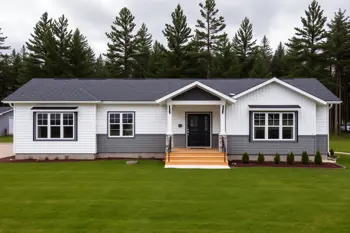
Land-Lease Communities: A Distinct Purchase Structure
A significant portion of move-in ready modular homes in Canada are situated in land-lease communities, where the buyer owns the structure but leases the land from a private operator. This arrangement materially affects long-term costs and resale dynamics. At 26 Hickory Hollow in Norfolk County, Ontario, a 2023-built Biscayne model modular home of 1,600 sq ft with 3 bedrooms and 2 bathrooms carries monthly expenses of approximately $690.71 in lease fees (including maintenance) and $215.33 in property taxes. 8
At Birch Bark Estates in South Huron, Ontario, a 2020-built modular home of approximately 1,000 sq ft with 2 bedrooms and 2 bathrooms was listed at $409,900, with a monthly land-lease fee of $497.50 covering community amenities including an indoor pool, recreation centre, and workout facility. 9 Buyers in land-lease communities should review lease terms carefully, as rent escalation clauses and restrictions on resale can significantly affect the long-term financial profile of the investment. The land itself does not build equity for the homeowner, which is a structural distinction from freehold property ownership. 2
Quebec and Regional Builder Landscape
Quebec's modular market features distinct builders operating under both provincial code and bilingual delivery frameworks. ProFab, serving Quebec and Ontario, offers the Pigna Micro-Home as part of its Unimodular collection, a contemporary 1-bedroom bungalow built on a crawl-space-ready foundation with open-concept living, a central kitchen island, full bathroom with both bathtub and separate shower, and large windows on all sides. 10 Dynamic Modular Homes in Red Deer, Alberta, markets its inventory around a sales operation with 34 years of industry experience, offering custom floor plans, streamlined financing pathways, and after-care support with 5-star service warranties. 11
SEED Homes occupies a niche between tiny homes and conventional modular builds, offering 6 configurations ranging from a 425 sq ft single-bedroom Studio model to a 1,179 sq ft 3-bedroom Haven double-fold unit, all built with fire-resistant materials, sustainably sourced interior finishes, and smart home capabilities included as standard. 7 The Canadian Home Builders' Association maintains member listings for certified modular builders nationwide, and the Canada Mortgage and Housing Corporation publishes housing program details relevant to financing eligibility for factory-built residences. 12
Financing, Eligibility Considerations, and Market Risks
Modular homes in Canada can in principle be financed through standard residential mortgages offered by major Canadian banks, provided the unit is permanently affixed to a freehold foundation and meets provincial building code standards. However, homes situated in land-lease communities often face more restricted financing options, as lenders treat the underlying lease as a complicating factor in security valuation. 2 CMHC mortgage insurance programs may apply to qualifying modular home purchases, but eligibility criteria depend on the nature of the land tenure, the builder's certification status, and the province of installation. 13
Prospective buyers should also account for permit and development charge variability, which can add tens of thousands of dollars to all-in costs depending on the municipality. In Ontario, development charges across the Greater Toronto Area and surrounding regions have risen substantially in recent years, and modular home buyers are not exempt from these fees when placing a unit on a serviced lot. 3 Additional practical considerations include site accessibility for large transport vehicles, local zoning approval for factory-built structures, utility connection costs, and the availability of warranty coverage. In Ontario, builders enrolled with Tarion provide new home warranty protections; buyers should confirm enrollment status independently before proceeding. 3
Sources
- Canadian Home Builders' Association - chba.ca
- CMHC (Canada Mortgage and Housing Corporation) - cmhc-schl.gc.ca
- My Own Cottage - myowncottage.ca/modular-house-prices/
- SEED Homes - seed-homes.com
- General Coach Canada / Modular Homes 400 - modularhomes400.com
- Western Canadian Modular Homes - westerncanadianmodular.com
- SEED Homes - seed-homes.com
- Zillow / Hickory Hollow Norfolk County Listing - zillow.com
- Rock Star Brokerage / Birch Bark Estates Listing - rockstarbrokerage.com
- ProFab - profab.ca
- Dynamic Modular Homes - dynamicmodular.ca
- Canadian Home Builders' Association - chba.ca
- CMHC - cmhc-schl.gc.ca