Specialized centers for ocular reconstructive surgery
What Ocular Reconstructive Surgery Encompasses
Ocular reconstructive surgery, also referred to as oculoplastic or ophthalmic plastic and reconstructive surgery, addresses injuries and diseases affecting the eyelids, the bony eye socket (orbit), the tear drainage system (lacrimal apparatus), and adjacent facial tissues. 1 Conditions driving referrals to specialized centers include ptosis (drooping eyelids), orbital tumors, socket reconstruction after globe removal, traumatic injuries, skin cancers of the periorbital region, Graves eye disease, and complications arising from prior surgical procedures. 2 The field sits at the intersection of ophthalmology and plastic surgery, requiring practitioners to preserve or restore vision while simultaneously achieving functional and aesthetic outcomes for complex anatomical structures.
Amniotic membrane transplantation is used in leading centers for severe ocular surface disease and chemical burns, while custom-designed orbital implants and synthetic materials have significantly improved outcomes in cases involving substantial globe displacement or volume loss. 3 Corneal cross-linking combined with reconstructive strategies is also applied to stabilize corneas following trauma and prevent progressive ectasia in surgical patients. 4 These technical capabilities distinguish dedicated reconstructive units from general ophthalmology practices.
How Major Academic Centers Structure These Services
The Mayo Clinic Oculofacial Plastics Clinic (OFPC) in Rochester, Minnesota, illustrates a model in which patients with complex periorbital reconstructive needs are evaluated by multiple specialists within a single day. 5 High-resolution CT scans are used to create 3D-printed anatomical models that support surgical planning, and a team conference at midday synthesizes all clinical information before a treatment plan is presented to the patient that afternoon. The OFPC team is jointly led by a plastic surgeon and an oculoplastic surgeon, with dermatologists, head and neck surgeons, strabismus surgeons, neurosurgeons, and specialized radiologists available for consultation.
Penn Medicine's oculofacial and orbital surgery program similarly integrates ocular oncology, plastic surgery, dermatology, otolaryngology, neurosurgery, and radiology expertise. 6 Surgeons at Penn are ophthalmologists who have completed advanced fellowship training in both reconstructive and cosmetic eye surgery, addressing orbital fractures, orbital tumors, inflammatory diseases, eyelid malpositions, blocked tear ducts, and eyelid skin cancers within one coordinated program. The University of Michigan's Kellogg Eye Center operates an Oculoplastic Surgery Service that extends care to conditions present from birth through those caused by injury, disease, or aging, supported by ophthalmic ultrasound, ophthalmic photography, and diagnostic visual electrophysiology. 7
Landmark Institutions and Their Specific Capabilities
Several institutions are consistently referenced as benchmark centers in the subspecialty. The Bascom Palmer Eye Institute at the University of Miami maintains fellowship-accredited ocular plastic and reconstructive surgery services. 8 Wills Eye Hospital in Philadelphia provides comprehensive ocular plastic surgery including post-trauma reconstruction and complex periorbital cases through a dedicated Oculoplastic and Orbital Surgery department. 9 Manhattan Eye, Ear and Throat Hospital in New York offers oculofacial reconstructive surgery with microsurgical expertise for complex orbital and eyelid presentations. 10
Mass Eye and Ear, affiliated with Harvard Medical School, provides specialized care for orbital surgery and ocular reconstruction. 11 The Cleveland Clinic Cole Eye Institute delivers ocular plastic and reconstructive surgery with expertise in complex periorbital trauma and chronic conditions. 12 Duke Eye Center, Emory Eye Center in Atlanta, and Northwestern Medicine's Division of Ophthalmology round out a national network of academic programs offering procedures ranging from orbital decompression to eyelid reconstruction and lacrimal surgery. 13 The John A. Moran Eye Center at the University of Utah houses Dr. Robert C. Kersten, MD, FACS, FASOPRS, who has authored more than 200 publications on periorbital disorders, received the American Academy of Ophthalmology Lifetime Achievement Award, and was recognized with the 2025 ASOPRS Foundation Rick Anderson Award for Surgical Innovation. 14
Procedures Commonly Performed at Specialized Centers
The procedural scope at dedicated reconstructive centers is considerably broader than what a general ophthalmology practice typically handles. Common surgical offerings documented across leading programs include the following:
- Orbital fracture repair and orbital tumor surgery
- Custom orbital implant placement and anophthalmic socket reconstruction
- Eyelid retraction repair and ptosis correction
- Skin cancer reconstruction involving periorbital tissues
- Dacryocystorhinostomy (DCR) and other tear drainage system procedures
- Fat grafting and scar revision following trauma or prior surgery
- Correction of eyelid malpositions including entropion and ectropion
- Orbital foreign body removal and canalicular reconstruction using microsurgical techniques
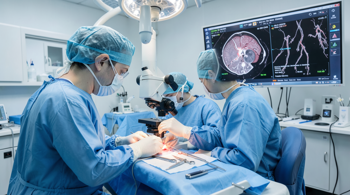
The KIMS Hospitals case in Kurnool, India, documented a nearly three-hour microsurgical eyelid reconstruction in a six-year-old child following a severe domestic accident, requiring loupe magnification, specialized microsurgical instruments, and intracath stent placement to restore canalicular patency. 15 This illustrates that pediatric reconstructive cases present additional complexity due to the extremely small calibre of the lacrimal system and the long-term functional consequences of delayed intervention.
Surgeon Training, Credentials, and Professional Standards
Oculofacial plastic surgeons complete ophthalmology residency training followed by an additional one to two years of fellowship training specifically in ophthalmic plastic and reconstructive surgery. 16 Certification by the American Board of Ophthalmology combined with an accredited fellowship recognized by the American Society of Ophthalmic Plastic and Reconstructive Surgery (ASOPRS) is widely regarded as the standard credential for surgeons practicing in this subspecialty. 17 The ASOPRS fellowship is notably competitive: fewer than 30 fellowships are granted worldwide each year across accredited programs. 18
The ASOPRS maintains a searchable directory of fellowship-trained and verified surgeons across the United States, which physicians and patients can consult when identifying qualified practitioners. 19 Internationally, parallel bodies such as the European Society of Ophthalmic Plastic and Reconstructive Surgery (ESOPRS) and national societies in Brazil, India, Australia, and elsewhere set comparable credentialing frameworks. Dr. Geoff Wilcsek at The Oculoplastics Centre Sydney, for example, holds fellowship status in both the Royal Australian and New Zealand College of Ophthalmology and ASOPRS, and leads the Ocular Plastic Unit at the Prince of Wales Hospital. 20
Risks, Limitations, and Considerations for Patients
Patients considering referral to a specialized ocular reconstructive center should be aware of several clinical and logistical realities. Orbital compartment syndrome, a serious complication that can arise from reconstructive procedures involving the orbit, requires immediate surgical decompression to prevent permanent vision loss, typically within a narrow window of 24 to 48 hours. 21 Complex reconstructive cases involving tumors, prior surgeries, or extensive trauma often require staged procedures across multiple operative sessions rather than a single intervention, meaning total treatment timelines can extend over months.
Eligibility for specific reconstructive techniques depends on the patient's overall medical status, the nature and extent of the tissue defect, prior radiation or chemotherapy history, and the availability of suitable donor tissue or implant materials. Insurance coverage for reconstructive procedures varies substantially depending on whether the case is classified as functionally necessary or cosmetic. Patients seeking second opinions from centers such as Penn Medicine's team are generally encouraged to bring imaging records and prior surgical reports to enable accurate assessment. 22 Geographic access also represents a meaningful barrier: rural and underserved regions frequently lack fellowship-trained oculoplastic specialists, creating disparities in timely access to subspecialty reconstructive care.
Emerging Technologies and Research Frontiers
The Centre for Ocular Regeneration at L.V. Prasad Eye Institute (LVPEI) in India represents an active research frontier in the field, pursuing cell and gene-based approaches to sight restoration. The center's research pipeline includes stem cell therapies using induced pluripotent stem cells (iPSCs) and mesenchymal stem cells (MSCs) for ocular surface reconstruction, biomimetic cornea development, 3D bioprinting of corneal structures, and gene-editing technologies. 23 LVPEI has published more than 100 peer-reviewed papers through this program and has applied for 6 patents while running 3 active clinical trials in ocular regeneration areas.
At the surgical planning level, 3D-printed anatomical models derived from high-resolution CT data have become an established tool at centers such as Mayo Clinic's OFPC, enabling surgeons to simulate complex orbital reconstruction before entering the operating room. 24 The Swisslaser network operating across Warsaw, Krakow, Vienna, and Zurich has documented clinical use of CAIRS (Corneal Allogenic Intrastromal Ring Segments), a biological reconstruction method using natural collagen segments placed with femtosecond laser precision to address advanced keratoconus and reduce the need for corneal transplantation. 25 These developments signal that the boundary between reconstructive surgery and regenerative medicine is narrowing as institutions deepen investment in tissue engineering and precision imaging platforms.
Sources
- American Academy of Ophthalmology - aao.org
- Cleveland Clinic Cole Eye Institute - my.clevelandclinic.org
- American Academy of Ophthalmology (fellowship and scope overview) - aao.org
- Swisslaser - CAIRS Corneal Reconstruction - swisslaser.pl
- Mayo Clinic Oculofacial Plastics Clinic - mayoclinic.org
- Penn Medicine Oculoplastic and Orbital Surgery - pennmedicine.org
- University of Michigan Kellogg Eye Center Oculoplastic Surgery Service - uofmhealth.org
- Bascom Palmer Eye Institute - bascompalmer.org
- Wills Eye Hospital - willseye.org
- Manhattan Eye Ear and Throat Hospital - meeth.org
- Mass Eye and Ear - masseyeandear.org
- Cleveland Clinic Cole Eye Institute - clevelandclinic.org
- Duke Eye Center / Emory Eye Center / Northwestern Medicine - respective institutional sites
- University of Utah Health - John A. Moran Eye Center - healthcare.utah.edu
- ETV Bharat - KIMS Hospitals Kurnool Eyelid Reconstruction Report - etvbharat.com
- American Academy of Ophthalmology Fellowship Training - aao.org
- ASOPRS - American Society of Ophthalmic Plastic and Reconstructive Surgery - asoprs.org
- Siriraj Hospital Mahidol University / Dr. Pimkwan Jaru-ampornpan - drpimkwan.com
- ASOPRS Surgeon Directory - asoprs.org
- The Oculoplastics Centre Sydney / Dr. Geoff Wilcsek - linkedin.com
- General LLM Research Data - Orbital Compartment Syndrome
- Penn Medicine Second Opinions - pennmedicine.org
- LVPEI Centre for Ocular Regeneration - lvpei.org
- Mayo Clinic OFPC 3D Planning - mayoclinic.org
- Swisslaser CAIRS Procedure Detail - swisslaser.pl