Used Military Field Hospital Equipment: A Buyer's Research and Market Intelligence Guide
Used military field hospital equipment represents a specialized segment of the broader medical surplus market, drawing interest from humanitarian organizations, disaster response agencies, civilian hospitals in austere regions, and government contractors alike. These assets range from complete multi-shelter portable hospital systems designed for up to 52 patients to individual ruggedized litters and field-grade ventilators that once served frontline units. Understanding how this equipment enters the secondary market, what it typically includes, and what oversight frameworks govern its transfer is essential before any serious research or procurement evaluation begins.
What Constitutes Military Field Hospital Equipment
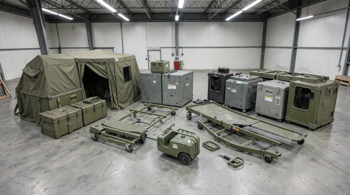
Military field hospital equipment is broadly defined as the collective apparatus, supplies, and structural components required to establish acute medical care in austere or combat environments. The Defense Logistics Agency (DLA) Troop Support Medical supply chain, which supports warfighters and their dependents globally, encompasses surgical items, preventive vaccines, field hospital equipment, and even medical supplies for animals, reflecting the scope of what falls under this classification. 1 Complete portable hospital systems available in this category can provide infrastructure for as many as 52 patients, incorporating multiple shelters with plenums and inner canopies, patient beds and bedding, water systems, electrical systems, and trauma supplies. 2
Modular container-based systems represent one of the more sophisticated product categories in this space. One documented configuration consists of thirteen ISO 20-foot containers, including seven expandable containers that increase interior volume. The total footprint of such a system can reach approximately 28.5 meters in length and 17 meters in width depending on configuration, and may include emergency and operating rooms, dual intensive care units, gender-segregated patient modules, a laboratory and pharmacy unit, an X-ray tomography unit, a blood collection unit, a sterilization unit, and an integrated power and water network. 3
How Military Medical Surplus Enters the Secondary Market
Surplus military medical equipment generally reaches the civilian market through a structured disposition process managed by the Defense Logistics Agency Disposition Services, which oversees the lifecycle and eventual disposal of excess Department of Defense medical property. 4 Once equipment is declared excess, it may be transferred to other federal agencies, donated to eligible organizations, or ultimately auctioned through official government channels. The U.S. Army Medical Materiel Agency (MMA), which provides lifecycle logistics for Army medical materiel, is a key institutional actor in determining what enters these disposal pipelines. 5
GSA Auctions serves as a primary federal portal for the disposal of surplus federal and military medical assets, and occasionally lists complete mobile field hospital kits that include water purification modules, environmental control units (ECUs), and electrical distribution gear. 6 GovPlanet and GovDeals are additional government-affiliated surplus marketplaces where ruggedized medical and field support gear from military inventories has historically appeared. 7 Many used items offered in the U.S. marketplace originate from redeployed units that are later liquidated through dealers or auction sites following official disposition clearance. 8
Common Equipment Categories Found in This Market
The range of assets that appear on the surplus market is broad, but certain categories recur consistently. Transport ventilators represent one class with documented secondary market activity; for example, the Smiths Medical Pneupac compPAC 200, described as a portable transport ventilator used by the U.S. Army and subject to biomedical testing before resale, has appeared through international medical equipment dealers in refurbished condition. 9 Anesthesia workstations, such as the Draeger Fabius GS, appear in refurbished form through specialized medical equipment dealers, with units described as biomed-certified following professional inspection. 10
Other documented categories available in the broader used military medical equipment space include the following:
- Ruggedized patient litters and transport cots
- Field sterilization units and autoclave systems
- Mobile surgical lighting arrays
- Modular hard-walled and soft-walled shelter systems
- Environmental control units (ECUs) and HEPA/UVGI air filtration systems
- Generators (such as 26-kilowatt units documented in portable hospital system specifications) 2
- Portable water pressure pumps and potable water bladder tanks up to 150 gallons
- ICU-grade hospital beds from manufacturers such as LINET, available in used condition through European medical resellers 11
Regulatory, Export, and Compliance Considerations
Acquiring used military medical equipment involves navigating a set of regulatory requirements that vary considerably depending on the equipment type, its technical specifications, and the buyer's location. Buyers must often complete end-use certificates depending on the sensitivity and technical capability of the equipment, and export controls may apply when transferring certain military-origin assets across international borders. 8 Sterilization processing equipment installed at military medical facilities, for instance, may be subject to sole-source maintenance agreements because of proprietary technology, patented designs, and exclusive training requirements, meaning even civilian buyers who acquire the hardware may face restricted service options. A contract awarded to STERIS Corporation for maintenance of its sterilization equipment at Bassett Army Community Hospital in Fort Wainwright, Alaska was structured as a five-year firm-fixed-price agreement estimated between $240,000 and $900,000, illustrating the long-term operational cost dimension of such systems. 12
DLA Troop Support's Medical supply chain has established multiple acquisition methods for purchasing medical materiel, including the Medical Prime Vendor Program (MPVP), Medical Electronic Catalog (ECAT), Contingency Contracts, National Stock Number (NSN) ordering, and the DLA Internet Bid Board System (DIBBS). 1 Civilian and contractor buyers seeking to understand military procurement standards can use these frameworks as reference points when evaluating equipment specifications and origin documentation.
Condition, Refurbishment, and Operational Readiness Risks
Surplus military medical equipment is frequently sold in an as-is condition, and professional refurbishment or biomedical inspection is typically required before such assets can meet civilian health and safety standards. 8 The practical implication is that listed prices for individual units rarely reflect the total cost of bringing the equipment to serviceable condition. Anesthesia machines, ventilators, and imaging systems in particular require detailed inspection by qualified biomedical engineers, and any discrepancy between listed condition and actual functional status represents a significant financial and operational risk. Research published in Trauma Surgery and Acute Care Open found that forward military field hospitals frequently operate in resource-limited environments where access to specialized personnel such as radiologists is constrained, highlighting how military medical configurations are designed for austere conditions that may differ from civilian standards. 13
Military medical readiness training, such as the bilateral exercise Mobility Serpent conducted by U.S. Airmen from the 352nd Special Operations Wing alongside British Army medics from the 16 Medical Support Regiment at Sculthorpe Airfield in July 2025, demonstrates that field hospital equipment is continuously exercised and stressed under demanding conditions. 14 Equipment that has seen extensive field exercise use may show wear patterns not always disclosed in surplus listings. Buyers should seek documentation of the most recent preventive maintenance cycle and request complete service histories wherever available.
Market Channels, Pricing Context, and Due Diligence Framework
The price range for used military field hospital equipment varies by several orders of magnitude depending on completeness, condition, and system type. A complete 52-bed portable hospital system with shelters, electrical, water, and medical supply components has been documented in the commercial marketplace at a reference price point exceeding $749,000 for a complete configured unit. 2 At the individual component level, refurbished transport ventilators have appeared in the range of several hundred to low thousands of dollars, while used ICU-grade hospital beds in European markets have been listed at approximately $2,594 inclusive of applicable charges. 11
| Equipment Category | Condition Context | Approximate Market Reference |
|---|---|---|
| Complete 52-bed portable hospital system | New/surplus configured | ~$749,000+ (reference listing) |
| Transport ventilator (Smiths Medical compPAC 200) | Refurbished, biomed-tested | ~$708 plus shipping/VAT |
| ICU hospital bed (LINET Multicare, 2014) | Used | ~$2,594 plus shipping/VAT |
| STERIS sterilization equipment maintenance | On-site service contract | $240,000 to $900,000 over 5 years |
Due diligence for any acquisition in this category should include verification of the equipment's disposition origin, review of maintenance and biomedical service records, independent inspection by a certified biomedical engineer, and legal review of any export control or end-use certificate requirements. Participation in being a participant in any government procurement channel does not guarantee product availability or price consistency, and buyers are advised to cross-reference multiple sources before drawing conclusions about market averages. 1
Sources
- Defense Logistics Agency - DLA Troop Support Medical Small Business (dla.mil)
- RxPrime Pharmacy - Medical Field Hospital System 52 Bed Product Reference (rxprimepharmacy.com)
- Machineryline / AmbulanceMed - Mobile Field Hospital Container System Specifications (machineryline.pe)
- DLA Disposition Services - Defense Logistics Agency (dla.mil/DispositionServices)
- U.S. Army Medical Materiel Agency (medcoe.army.mil/mma)
- GSA Auctions - U.S. General Services Administration (gsaauctions.gov)
- GovPlanet - Military Surplus Equipment Marketplace (govplanet.com)
- LLM General Research - Military Surplus Market Practices and Regulatory Context
- Bimedis - Smiths Medical Pneupac compPAC 200 Listing, Dr Medica Poland (bimedis.com)
- Loyalty Medical - Draeger Fabius GS Anesthesia Machine Listing (loyaltymed.com)
- Bimedis - LINET Multicare ICU Hospital Bed Listing, Equipmed GmbH Germany (bimedis.com)
- CLEATUS / U.S. Army - STERIS Sterilization Equipment Contract W81K0226PA013, Bassett Army Community Hospital (cleat.ai)
- Trauma Surgery and Acute Care Open - AI-Assisted Chest Radiograph Interpretation in Role 2 Military Field Hospital Settings (tsaco.bmj.com)
- Air Force Medical Service - Mobility Serpent Exercise, Team Mildenhall, July 2025 (airforcemedicine.af.mil)