Senior-friendly home modification costs
For the millions of older adults researching senior-friendly home modification costs, the numbers span an enormous range: from a $100 grab bar to a $120,000 whole-home retrofit. According to AARP survey data, 75% of adults over 50 want to remain in their current homes as they age, yet only about 18% have made the modifications necessary to do so safely. 1 Understanding what each category of work actually costs in 2026, and what factors drive those costs up or down, is the foundation of any sound planning process.
The Three-Tier Budget Framework
Renovation professionals and occupational therapists consistently describe aging-in-place spending in three tiers. A basic safety package covering grab bars, lever door handles, improved lighting, and non-slip mats runs approximately $500 to $2,000. A mid-range package that adds a walk-in shower, comfort-height toilet, wheelchair ramp, and doorway widening runs $10,000 to $25,000. A comprehensive whole-home accessibility retrofit runs $30,000 to $75,000 or more, with coordinated single-project quotes from CAPS-certified contractors reaching $35,000 to $120,000 in higher-cost coastal markets. 2
Financial planning research suggests that most U.S. homeowners who engage in active aging-in-place planning spend $15,000 to $30,000 in capital modifications over the first five to ten years, spread across the highest-priority rooms rather than tackled all at once. 3 Separating the budget into capital modifications, recurring in-home services, and an emergency reserve of $10,000 to $20,000 in liquid savings is the structure most planners recommend. This framework prevents the most common financial surprise: treating home modification as a single lump-sum project rather than a phased, evolving commitment.
Bathroom Modifications: Where Most Budgets Start
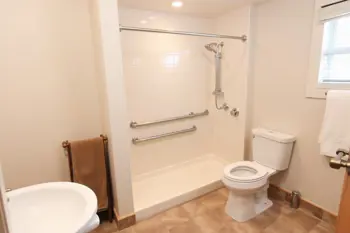
Bathrooms are consistently identified as the highest-risk room in the home for older adults, with slippery floors linked to roughly 80% of home falls among seniors. 4 That statistical reality makes the bathroom the logical starting point for any modification budget. A curbless walk-in shower conversion is the single most requested upgrade, and 2026 contractor data from 47 surveyed contractors places the mid-50% cost range at $6,000 to $22,000, with CAPS-certified contractor quotes for a shower-only conversion running $6,000 to $15,000. 5
A full accessible bathroom remodel, including roll-in shower, grab bars, comfort-height toilet, slip-resistant flooring, and lever faucets, averages $19,000 with a typical range of $12,000 to $28,000 according to 2026 remodeling industry data. 6 Data aggregated from 107 contractors places the broader mid-50% range at $6,100 to $50,000 for a full ADA-compliant bathroom overhaul, reflecting significant variation based on market, home layout, and finish level. Labor typically represents 40% to 60% of the total bathroom remodeling budget. The table below summarizes bathroom-specific modification costs.
| Modification | 2026 Cost Range (USD) |
|---|---|
| Grab bars (set of 3-4, installed) | $150 – $400 |
| Comfort-height toilet (ADA) | $300 – $700 |
| Handheld showerhead with slide bar | $100 – $300 |
| Non-slip bathroom flooring | $800 – $2,500 |
| Built-in shower bench | $300 – $1,200 |
| Walk-in shower conversion (curbless) | $6,000 – $15,000 |
| Walk-in tub (installed) | $20,000 – $34,950 |
| Full accessible bathroom remodel | $15,000 – $45,000+ |
Mobility and Access: Mid-Tier and High-Ticket Items
Mobility equipment represents the middle and upper tier of the modification cost spectrum. A straight stair lift runs $2,800 to $10,000 based on data from 30 contractors, while curved rail or outdoor stair lifts reach $9,000 to $15,000 or more due to the custom fabrication required. 7 Wheelchair ramps show wide variation depending on material and permanence: modular aluminum ramps run $100 to $250 per linear foot installed, while permanent wood or concrete ramps for a typical residential entry run $1,500 to $5,000. 8
Residential elevators represent the top of the cost range, with installed costs typically reaching $30,000 to $60,000 or more. Doorway widening for wheelchair access generally costs $500 to $2,500 per opening, and kitchen accessibility upgrades including lowered cabinets, pull-out shelving, and adjusted countertop heights range from $2,000 to $8,000 for targeted work, rising to $22,000 to $100,000 for a full accessible kitchen remodel. 9 Pathway and motion lighting upgrades, often underestimated in planning discussions, run $400 to $1,200 per room for a layered install and deliver measurable fall-prevention benefit at relatively modest cost.
The Financial Logic of Planning Versus Reacting
One of the most consistent findings across contractor data and occupational therapist guidance is that retrofit costs rise sharply when modifications are made reactively after a health event rather than proactively during a scheduled remodel. Grab-bar blocking, for example, costs approximately $200 to $300 when incorporated during a bathroom gut renovation but $2,000 to $3,000 or more as a standalone retrofit, representing a 7x to 15x cost multiplier. 10 Similarly, a curbless shower planned during a primary bath remodel costs $1,500 to $3,500 as an add-on, versus $8,000 to $15,000 or more when done as a standalone conversion project.
The financial comparison with institutional care is also significant context for budget decisions. National industry cost-of-care data places assisted living at a median of roughly $45,000 to $64,000 annually, and nursing home care at $104,000 to $117,000 per year. 11 Nursing homes averaged $9,945 per month in 2026. A $10,000 to $30,000 whole-home modification budget spread across the highest-priority rooms can represent well under one year's equivalent cost of facility care, though this comparison does not account for care services that facility residents receive beyond the physical environment.
Financial Assistance, Coverage Gaps, and Eligibility Realities
Funding options exist but carry significant limitations that households must understand before building them into a budget. Standard Medicare generally does not cover home structural modifications, though seniors demonstrating medical necessity can qualify for up to 80% coverage of certain durable medical equipment. Some Medicare Advantage plans offer limited support for home modifications. Medicaid programs in many states fund modifications such as lighting adaptations, grab bars, and ramps through Home and Community Based Services (HCBS) waiver programs, though waitlists for these programs can be extended. 12
Veterans may access the VA's Home Improvements and Structural Alterations (HISA) grant program. The USDA Section 504 Home Repair program offers assistance for eligible seniors in qualifying geographic areas. Canada's federal Home Accessibility Tax Credit provides 15% back on qualifying renovation costs, and some municipalities offer forgivable loans up to $25,000 for accessibility retrofits, though eligibility requirements vary significantly by jurisdiction. 13 For homeowners with sufficient equity, a Home Equity Line of Credit (HELOC) or cash-out refinancing represents another mechanism to fund larger projects, though this approach carries its own financial risk relative to borrowing against a primary residence.
Risk Factors, Contractor Selection, and Planning Considerations
Several friction points complicate the actual execution of senior-friendly modifications. Contractors who specialize in accessibility work, particularly those holding the NAHB Certified Aging in Place Specialist (CAPS) designation, command premium pricing relative to general contractors, but general contractors without accessibility training frequently under-specify critical elements like load-bearing grab bar blocking and proper slip-resistance ratings. In NAHB remodeler surveys, 73% of contractors reported that requests for aging-in-place features increased over the past five years, which has expanded the contractor pool but also introduced quality variation. 14
Regional labor and material costs create substantial geographic spread. High-cost coastal metros run at or above the top of published ranges, while rural and lower-cost markets run at or below the midpoint. New tariff-related pressure on steel, aluminum, and lumber pushed material costs 5% to 8% higher relative to late 2025, and contingency budgeting of 15% to 20% above the contractor quote is standard practice given that hidden structural issues, outdated wiring, and plumbing complications emerge in virtually every major renovation. 15 A professional home safety assessment by an occupational therapist, typically costing $150 to $300, is recommended before committing to a modification sequence, as it can identify which rooms and features present the highest actual risk for a specific individual's mobility profile rather than relying on general industry priority lists. 16
Sources
- AARP – Home Modification Survey Data (aarp.org)
- AgeProofPros – Aging-in-Place Modification Costs 2026 (ageproofpros.com)
- HomesImprover – Financial Planning for Aging in Place: Real 2026 Numbers (homesimprover.com)
- PeakGuard Home – Aging in Place Home Modifications: Room-by-Room Cost Guide 2026 (peakguardhome.com)
- ADAHomeFinder – ADA Home Modification Costs 2026: Real Contractor Data (adahomefinder.com)
- Critchfield Construction – Aging in Place Bathrooms Cost $12K to $28K on Average (critchfield-construction.com)
- CostToRenovate – Aging-in-Place Renovation Costs in 2026 (costtorenovate.com)
- AgeProofPros – Wheelchair Ramp Cost Ranges 2026 (ageproofpros.com)
- ADAHomeFinder – Kitchen Remodel Pricing Points 2026 (adahomefinder.com)
- Fedor Fabrication – Aging in Place Bathroom Design: Retrofit vs. Planned Costs (fedorfab.com)
- PeakGuard Home – Assisted Living vs. Home Modification Cost Comparison (peakguardhome.com)
- The Senior List – Medicare Bathroom and Home Modification Coverage 2026 (theseniorlist.com)
- AgePlaceHub – Aging-in-Place Renovations Canada: 2026 Cost and Subsidy Guide (ageplacehub.ca)
- CostToRenovate – NAHB Remodeler Survey Data on Aging-in-Place Demand (costtorenovate.com)
- HammerIO – Home Renovation Cost 2026: Average Prices by Project Type (hammerio.com)
- AARP / Aging in Place at Home – Occupational Therapist Home Safety Assessments (aginginplaceathome.com)