Surplus Military Tactical Equipment and Supplies: A Comprehensive Market and Buyer's Guide
Surplus military tactical equipment and supplies move through a layered ecosystem that includes federal disposal agencies, licensed exporters, public auction platforms, and brick-and-mortar retailers. Whether the end user is a law enforcement agency seeking tactical vests, a civilian collector researching historical optics, or a defense contractor sourcing obsolete aircraft components, each acquisition pathway carries its own regulatory structure, condition variables, and eligibility requirements. Understanding how this market operates is essential before engaging with any channel.
The Defense Logistics Agency and Federal Disposal Frameworks
The Defense Logistics Agency (DLA) manages the Department of Defense's excess property disposal and sales processes, serving as the primary institutional gateway through which surplus military equipment and supplies enter the civilian and secondary defense markets. 1 DLA Disposition Services specifically handles the disposal of excess military property across categories that include scrap metal, electronics, tactical gear, and vehicles. 2 This is not an informal process: items move through structured decommissioning workflows before reaching any buyer.
The General Services Administration (GSA) also administers a federal surplus property program for eligible participants, including military-related excess items, operating under official eligibility rules that govern who may acquire certain categories of government property. 3 Federal regulations under the National Defense Authorization Act further define which types of controlled property can be transferred to state and local agencies, establishing hard legal limits on downstream distribution. 4
The 1033 Program and Law Enforcement Transfers
The U.S. Department of Defense operates the Law Enforcement Support Office (LESO), commonly known as the 1033 Program, to facilitate the transfer of excess DOD property to state and local law enforcement agencies. 5 Under this program, agencies can receive surplus military equipment at no acquisition cost, with the receiving agency responsible for shipping and ongoing maintenance expenses. 6
Commonly transferred items through the 1033 Program include tactical vests, ballistic helmets, night-vision equipment, and High Mobility Multipurpose Wheeled Vehicles (HMMWVs). 7 The practical utility of these transfers is well documented: rural and volunteer fire departments in South Carolina, for example, have acquired Light Medium Tactical Vehicles through a partnership among DLA Disposition Services, the U.S. Forest Service, and state forestry agencies, transforming former military cargo trucks into brush trucks, tankers, and command vehicles. 8 These transfers illustrate that the end use of surplus military assets frequently diverges significantly from original military purpose.
Major Equipment Categories in the Surplus Market
The surplus tactical equipment market encompasses a wide range of product categories, each with distinct grading standards, regulatory overlays, and buyer qualifications. Body armor systems represent one of the most closely tracked categories. The U.S. Army Gen 2 Improved Outer Tactical Vest (IOTV) in Multicam, for instance, carries ITAR restrictions that prohibit export outside the United States and cannot be returned once purchased, reflecting the sensitivity classification applied to releasable body armor platforms. 9 Similarly, the U.S. Army Next Generation Integrated Head Protection System (NG-IHPS) surplus units come complete with issued helmet covers, chin straps, foam pads, NVG shrouds, and side-swappable Picatinny rails, though industry guidance consistently recommends replacing pads and chin straps and conducting a full Kevlar inspection before operational use. 10
Optics represent another high-value surplus category. Wholesale lots in the international defense market can include mixed collections of 29 or more items, spanning brands such as Kahles Wien, Zeiss Jena, Karl Kaps Austria, and Ortek, along with historical military mounts for platforms including the G3, K98, M16, and Dragunov. 11 Buyers sourcing such lots are consistently advised to verify import-export license requirements in their respective national jurisdictions before completing any transaction.
Civilian Retail Channels and Auction Mechanisms
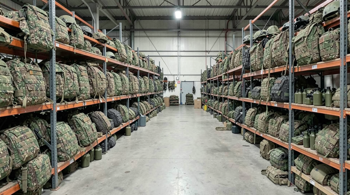
Beyond institutional programs, surplus military tactical equipment and supplies reach civilian consumers through a well-established secondary retail ecosystem. Physical stores such as Armed Forces Supply Military and Tactical Surplus Store in Converse, Texas, rated 4.7 stars across 775 reviews, serve hunters, outdoor enthusiasts, law enforcement personnel, and survivalists with authentic military-grade uniforms, tactical backpacks, canteens, hydration systems, and survival equipment. 12 Gear Up Surplus Inc in Titusville, Florida represents another example of a large-format physical retailer carrying extensive inventories of tactical gear, night vision equipment, and historical military patches and insignia.
Public auction platforms constitute a parallel acquisition channel. Fleet Vehicle Disposal in Boyertown, Pennsylvania has conducted multi-session military surplus auctions featuring over 575 lots per event, covering categories from industrial transit cases and Hypertherm plasma cutters to Nikon optical theodolites, 3M N95 masks, combat boots, and bulk ratchet straps. 13 Digital platforms such as GovPlanet provide additional marketplace infrastructure for auctioning surplus military vehicles and heavy equipment to the public. 14
International Wholesale Sourcing and Compliance Requirements
The global wholesale segment of the surplus military tactical equipment market operates under a distinctly different compliance architecture than domestic civilian retail. Suppliers such as MCT Defense, based in Israel and regulated by the Ministry of Defense, source firearms, optics, and combat gear directly from government reserves, arsenal liquidations, and authorized dealers worldwide for export to licensed international importers and defense contractors. 15 The international market for collectible and surplus firearms has seen sustained growth driven by interest in mechanical history and manufacturing durability, but sourcing in commercial volumes requires navigating complex international trade frameworks and strict export compliance standards. 16
U.S. export controls can restrict overseas transfers of certain military equipment even when sold as surplus, requiring compliance with the International Traffic in Arms Regulations (ITAR) administered by the Directorate of Defense Trade Controls (DDTC). 17 Italy's listing of over 16,000 retired Beretta MAB submachine guns for potential sale in 2026 illustrates how national governments periodically introduce large volumes of decommissioned arms into regulated surplus channels, each transfer requiring adherence to applicable end-user certificate requirements and import regulations in receiving countries.
Condition Grading, Demilitarization, and Buyer Risks
Condition grading is a critical variable in any surplus tactical equipment acquisition. Industry-standard grading systems commonly distinguish between Grade I items (used, structurally and aesthetically sound, with minor defects such as fading, staining, or small holes) and Grade II items (used, fair condition, with possible tears, missing parts, or repairable structural defects). 18 Many surplus items sold to civilians are demilitarized, meaning sensitive components or functional weaponry have been removed or rendered inoperable before entering commercial channels. 19 Buyers should also be aware that lot purchases are common: a pallet or lot sale may contain dozens of mixed items with no option to split quantities, and condition within a single lot can vary significantly between individual pieces.
Specific items carry non-return restrictions that buyers must understand before committing to a purchase. ITAR-controlled items such as tactical vests and certain helmets explicitly cannot be returned or exchanged under any circumstances, and they cannot be transported or shipped outside the United States. 20 Government surplus contracts processed through the Defense Logistics Agency's DIBBS platform require certified documentation of condition, cure dates, data plates, and full origin traceability through CAGE codes, National Stock Numbers (NSNs), and part numbers, reflecting the accountability standards applied even to reconditioned surplus materials flowing back into defense supply chains. 21
Sources
- Defense Logistics Agency (DLA) - dla.mil
- Defense Logistics Agency Disposition Services - dla.mil
- GSA Auctions - gsa.gov
- U.S. Congress - Congressional Research Service (crsreports.congress.gov)
- Defense Logistics Agency - Law Enforcement Support Office (LESO) - dla.mil
- U.S. Congress - Congressional Research Service, 1033 Program - crsreports.congress.gov
- Defense Logistics Agency - dla.mil
- Defense Logistics Agency News - South Carolina Firefighters (dla.mil)
- Venture Surplus - venturesurplus.com
- Venture Surplus - US Army NG-IHPS (venturesurplus.com)
- MCT Defense - Military Surplus and Used Optics Lot (mctdefense.com)
- Armed Forces Supply Military and Tactical Surplus Store - nimrods.ai
- Fleet Vehicle Disposal - fleetvehicledisposal.com
- GovPlanet - govplanet.com
- MCT Defense - Global Importers and Wholesale Military Surplus (mctdefense.com)
- MCT Defense - Sourcing Wholesale Military Surplus and Firearms (mctdefense.com)
- U.S. Department of State, Directorate of Defense Trade Controls (DDTC) - pmddtc.state.gov
- Army Import Italia - armyimportitalia.com
- Surplus Store Finder - surplusstorefinder.com
- Venture Surplus - ITAR Restrictions (venturesurplus.com)
- CLEATUS Government Contracts - Government-Compliant Material Supply (cleat.ai)