Surplus Military Medical Storage Equipment: A Comprehensive Buyer's and Researcher's Guide
Surplus military medical storage equipment represents one of the most technically rigorous categories within the broader government surplus marketplace. These items, ranging from watertight aluminum transport chests and passive thermal blood-transport containers to sterile processing storage systems and RFID-enabled surgical supply vaults, were originally manufactured to meet stringent Department of Defense and military specification (MILSPEC) standards before entering the federal disposal pipeline. Understanding how this equipment is classified, tracked, and ultimately redistributed is essential for anyone researching this sector.
What Qualifies as Surplus Military Medical Storage Equipment
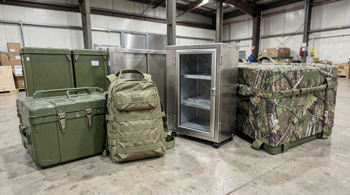
The category spans a wide functional spectrum. At the portable end, authentic U.S. G.I. aluminum medical transport chests have been documented in medium (11.5 in. H x 19.5 in. W x 31.5 in. L), large, and extra-large configurations, secured by 10 snap-lock fasteners and designed to be stackable and watertight for field transport of fragile medical supplies. 1 On the tactical carrier side, the Blackhawk Special Operations Medical Backpack, constructed from 1,000-denier nylon with reinforced stitching, lockable YKK zippers, S.T.R.I.K.E. webbing, and individual medical gear compartments measuring 18 in. x 13 in. x 7.5 in., represents the kind of combat-medic-specific storage originally priced at a retail equivalent of roughly £350 that may appear in surplus channels. 2
At the institutional level, the category includes sterile processing service storage systems featuring mobile, stainless-steel racks with solid bottoms, adjustable open-wire or fine-mesh shelves, color-coded rack locations by service, individually labeled tray positions for instrument scanning, and drawer compartments with adjustable dividers for loose peel-pack instruments. 3 The Defense Logistics Agency has also procured passive thermal transport containers engineered to maintain temperatures between 1 and 10 degrees Celsius for a minimum of 96 hours without ice or external power, with a proprietary phase change material, finished in three-color woodland military camouflage, and weighing approximately 6.8 pounds. 4
Federal Supply Classification and NSN Tracking
Every item in the military supply chain carries a National Stock Number (NSN) under a specific Federal Supply Classification (FSC). Medical storage items fall primarily under FSC 6530 (Hospital Furniture, Equipment, Utensils, and Supplies) and FSC 6545 (Replenishable Field Medical Sets, Kits, and Outfits). For example, NSN 6530-01-615-1759 covers a field operating table with 5 associated manufacturer part numbers and 10 historical government contracts awarded across 3 different suppliers. 5 NSN 6545-01-605-8152, classified as a medical supply set (field), was assigned April 25, 2012 and has not been procured by the U.S. Government in over five years, indicating items under this number may have entered the surplus stream. 6
Specialized shipping and storage containers used in medical logistics fall under FSC 8145. NSN 8145-01-531-4696, for instance, carries 11 historical government contracts awarded to 3 different suppliers, and the item's availability is currently listed as readily available through active qualified suppliers. 7 The Federal Logistics Information System (FLIS) maintains procurement history, cancellation status, and supplier data for every NSN, making it the primary reference for researchers verifying whether a claimed surplus item has a legitimate military procurement background. Genuine surplus items typically carry NSN markings, contract numbers, and manufacturer tags traceable to government contracts. 8
Federal Disposal Channels and Acquisition Pathways
The primary institutional pathway for surplus military property is the Defense Logistics Agency's Disposition Services, formerly operating as DRMS, which manages the redistribution and eventual sale of excess DoD property including medical-grade storage equipment. 9 The process generally flows through redistribution first, where other federal agencies or eligible organizations may acquire items at no cost, before excess property proceeds to donation programs or public auction. The General Services Administration (GSA) facilitates public sales through GSA Auctions (gsaauctions.gov), an online bidding platform open to registered buyers where surplus federal property including medical and related storage equipment is listed. 10
Several other platforms operate in parallel. GovDeals.com hosts online auctions for surplus government equipment including medical storage items from military facilities and is accessible to both public and private buyers. 11 GovPlanet similarly provides an online marketplace where government surplus equipment, potentially including healthcare-related storage systems and containers, is listed for bid. 12 The National Association of State Surplus Property Administrators (NASSPA) coordinates the distribution of federal surplus property, including military medical equipment, to eligible state-level buyers. 13 System for Award Management (SAM.gov) additionally lists federal surplus property notices and relevant procurement opportunities. 14
Compliance Standards and Condition Considerations
Military medical storage equipment must meet overlapping regulatory frameworks during both active service and post-disposal handling. Sterile medical supplies manufactured and packaged for the DoD must comply with FDA regulations, ISO 13485 quality management standards, and specific military medical specifications, with shelf-life control and secure unit sealing required to maintain product integrity through distribution. 15 Packaging and labeling of military medical items in transit must adhere to MIL-STD-129 and ASTM D3951, and active DoD solicitations for such packaging services direct deliveries to Defense Logistics Agency facilities such as the North Charleston, South Carolina site. 16
When evaluating surplus items specifically, condition grading is a critical variable. Surplus military gear is commonly classified as unissued (new old stock), issued but lightly used, or service-worn, and two physically identical units can perform very differently depending on prior use history. 8 Equipment that previously stored controlled substances carries additional documentation obligations and handling requirements. The military PA156 large ammo storage box, frequently repurposed for medical supply storage, demonstrates how MILSPEC storage hardware functions at the construction level: DC01 carbon steel, corrosion-proof zinc phosphate undercoat, powder coating to a minimum 80-micron thickness, a high-density synthetic rubber gasket seal rated ASTM D2000 Grade 4 Class A Type A, and 96-hour salt corrosion test compliance. 17
Institutional Applications: VA and DoD Facility Procurement
Active procurement by Veterans Affairs medical centers and DoD healthcare facilities provides a parallel data stream that illustrates the specifications civilian and institutional buyers would encounter when repurposing surplus items. The Department of Veterans Affairs Pittsburgh Healthcare System issued solicitation 36C24426Q0638 for a DSI Custom Supply Storage Solution to convert an Operating Room from wire track shelving to a high-density basket system, requiring medical-grade corrosion-resistant construction, locking casters, infection-control cleanability, a 10-year service life, and installation without structural modifications. 3 The VA New York Harbor Healthcare System similarly sought a Sterile Processing Service Storage System under solicitation 36C24226Q0756, a total small business set-aside under NAICS code 339113, specifying eleven Elevation A Mobile Starter Bays and twenty-eight Elevation A Mobile Add-on Bays among other modular units. 18
At the technology frontier, institutions are deploying RFID-enabled medical storage cabinets that deliver 600-plus tag reads per second using Impinj R2000 chipsets, bulk item identification completed in approximately 3.8 seconds, AI-driven inventory prediction reported to reduce stockouts by 92 percent in operating room environments, and direct API connectivity with Epic, Cerner, and Meditech EMR systems. 19 As such systems cycle out of service, they enter the surplus stream at significantly different condition and compliance profiles than basic aluminum field chests, underscoring the importance of verifying the specific technical generation of any surplus medical storage equipment under consideration.
Risk Factors and Market Friction Points
Researchers and prospective acquirers should be aware of several material risks. Authenticity verification is a persistent challenge; not all equipment marketed as surplus military medical storage is genuine government-issue. Genuine items carry NSN markings, contract numbers, and manufacturer tags tied to verifiable military contracts, while commercial reproductions or tactical-style civilian gear may lack these identifiers entirely. 8 Condition variability is compounded by the fact that surplus dealers are generally not the original manufacturers and explicitly disclaim responsibility for items stored in used containers, meaning independent inspection before reliance on used units for critical medical storage functions is prudent.
Regulatory and base realignment dynamics also affect supply. Military hospital closures and base realignments regularly generate releases of surplus medical storage equipment into the federal disposal system, but the volume and specific equipment types are unpredictable and tied to policy cycles rather than market schedules. 20 For sterile storage specifically, units like the Air Innovations SSC 4500, deployed across VA hospitals and military healthcare facilities, maintain ISO 4 to ISO 6 cleanliness within minutes of door closure and require approximately 250 air changes per hour with HEPA filtration, temperature maintenance between 66 and 72 degrees Fahrenheit, and humidity between 20 and 60 percent RH. 21 A surplus unit of this type without verified calibration records and maintenance history may not reliably reproduce those specifications, posing patient safety concerns if repurposed for active clinical sterile storage without professional recertification.
Sources
- Coleman's Military Surplus - Medical Transport Chest, U.S. G.I. Aluminum (colemans.com)
- Feltons Army Surplus Stores - Blackhawk Special Ops Medical Backpacks (feltonsarmysurplus.com)
- SweetSpot Gov / Department of Veterans Affairs - DSI Custom Supply Storage Solution, Pittsburgh VA Medical Center, Solicitation 36C24426Q0638 (console.sweetspotgov.com)
- CLEATUS / Department of Defense - Container, Transport, TH; Solicitation SPE2DH-26-T-5427; Peli Biothermal LLC (cleat.ai)
- ISO Group - NSN 6530-01-615-1759, FSC 6530 Hospital Furniture, Equipment, Utensils, and Supplies (iso-group.com)
- ISO Group - NSN 6545-01-605-8152, FSC 6545 Replenishable Field Medical Sets, Kits, and Outfits (iso-group.com)
- ISO Group - NSN 8145-01-531-4696, FSC 8145 Specialized Shipping and Storage Containers (iso-group.com)
- Smiths Surplus and Supply - Military Surplus Gear: 10 Things to Know (smithssurplusandsupply.com)
- Defense Logistics Agency - Disposition Services (dla.mil)
- General Services Administration - GSA Auctions (gsaauctions.gov)
- GovDeals - Government Surplus Auction Platform (govdeals.com)
- GovPlanet - Government Surplus Equipment Marketplace (govplanet.com)
- National Association of State Surplus Property Administrators - NASSPA (nasspa.org)
- System for Award Management - SAM.gov (sam.gov)
- CLEATUS / Defense Logistics Agency - Sterile Medical Supply Manufacturing and Packaging, Solicitation SPE2DS26P2511 (cleat.ai)
- CLEATUS / Department of Defense Medical Supply Chain FSH - Packaging, Labeling, and Shipping Services (cleat.ai)
- Feltons Army Surplus Stores - Brand New Military PA156 Large Ammo Storage Box (feltonsarmysurplus.com)
- CLEATUS / Department of Veterans Affairs - Sterile Processing Service Storage System, Solicitation 36C24226Q0756 (cleat.ai)
- GSRFID - GS-GY2B Medical RFID Storage Cabinet (gsrfid.com)
- Department of Defense - Base Realignment and Surplus Property Releases (defense.gov)
- Aldevra / Air Innovations - Sterile Storage Cabinets for Healthcare, SSC 4500 Features (aldevra.com)