Surplus maritime patrol vessels on sale: Global Trends in Decommissioned Naval Asset Acquisitions
Decommissioned military and coast guard platforms represent an important market for maritime operators globally. Many nations list surplus maritime patrol vessels on sale to modernize fleets, offset budgets, or support allies through defense cooperation agreements. While these vessels offer a cost-effective alternative to commissioning new builds, navigating the acquisition process requires a detailed understanding of state-to-state transfers, public auction channels, and complex regulatory compliance guidelines.
State-to-State Purchases: Uruguay's River-Class Acquisition
Uruguay's recent efforts to update its naval fleet highlight the strategic value of decommissioned hulls. The government submitted a formal proposal to the United Kingdom to acquire three River-class Batch I offshore patrol vessels: HMS Tyne, HMS Mersey, and HMS Severn 1. This direct state-to-state deal is valued at approximately 60 million euros, or 20 million euros per vessel 1. The acquisition was initiated following the termination of Uruguay's prior contract with a Spanish shipyard due to contractual discrepancies 2.
Built between 2001 and 2003, these ships have served in fisheries protection and coastal patrol roles 1 3. They feature a displacement of 1,770 tons, a length of 79.5 meters, and an operational range of 7,800 nautical miles 3. Though legacy hulls, they possess an estimated remaining service life of 20 to 25 years 1, offering Uruguay an immediate solution to secure its exclusive economic zone 2.
Caribbean Security and the Portuguese Tejo-Class Transfer
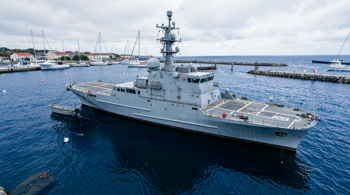
In the Caribbean, the Dominican Republic Navy has boosted its maritime surveillance capabilities through a bilateral agreement with Portugal. The contract, valued at 24 million euros, covers the acquisition of four surplus Tejo-class coastal patrol vessels: NRP Tejo, NRP Douro, NRP Mondego, and NRP Guadiana 4. Each ship is valued at 6 million euros 4. The vessels will strengthen law enforcement and counter-narcotics operations across Dominican maritime zones 5.
Constructed in Denmark, these vessels feature the Standard Flex modular system, allowing mission modules to be swapped in 48 hours to transition between combat, patrol, and pollution control tasks 6. The deal includes logistics support, crew training, and systems modernization, with phased deliveries scheduled over 40 months to ensure a smooth transition of the naval assets 5.
Bilateral Transfers: U.S. and Japanese Fleet Adjustments
The redistribution of patrol vessels is frequently driven by broader strategic partnerships. The United States recently confirmed the transfer of a 210-foot Reliance-class cutter to the Philippine Coast Guard to extend its offshore patrol capabilities 4. Additionally, the U.S. Coast Guard’s international office transferred three decommissioned 110-foot Island-class patrol boats (Liberty, Mustang, and Naushon) to Colombia 7. These moves are facilitated under the Foreign Military Sales program 7.
Concurrently, Japan is leveraging revised defense export guidelines to discuss transferring retired naval combatants. Formal talks are underway with Indonesia concerning retired Asagiri-class destroyers 8. Additionally, Tokyo has engaged in negotiations with Manila regarding retired Abukuma-class destroyers 9. By transferring these capable patrol and anti-submarine warfare platforms, Japan aims to support regional maritime balance and secure critical Indo-Pacific sea lanes 8.
Specialized Vessels: Hydrographic and Mine Warfare Sales
Specialized survey and mine warfare platforms also form a vital component of the surplus vessel market. The Bangladesh Navy acquired the former Royal Navy survey ship HMS Enterprise to enhance its capabilities in the Bay of Bengal 10. The 91-meter Echo-class vessel is configured with advanced sensors for scanning the seabed 10 2. This transaction provides a robust oceanographic platform at a reduced cost compared to new construction 2.
Additionally, the Romanian Navy commissioned a decommissioned Sandown-class minehunter, formerly HMS Pembroke, renamed the Capitan Constantin Dumitrescu 11. This vessel, sold by the UK's Defence Equipment Sales Authority, underwent extensive refurbishment by Babcock prior to transfer 11. The ship is currently deployed to identify and destroy drifting sea mines in the Black Sea, directly contributing to regional security 11.
Primary Sourcing Channels for Surplus Craft
For non-governmental buyers, private security organizations, and marine research institutes, navigating the acquisition of surplus patrol craft involves distinct procurement pathways 12. While major state acquisitions rely on bilateral government programs, smaller vessels are regularly sold through public platforms 12. Below is an outline of the primary channels where decommissioned government maritime assets are formally listed:
| Platform or Agency | Primary Vessel Types Offered | Target Buyers & Markets |
|---|---|---|
| GSA Auctions | Small patrol boats, utility craft, workboats | Domestic public, commercial entities, research groups |
| DLA Disposition Services | Decommissioned auxiliary craft, excess gear | Approved contractors, state agencies, educational programs |
| Specialized Brokers | Ex-government patrol craft, steel trawlers | Private security, commercial fishing, tourism firms |
| Direct Agencies (e.g., DESA UK) | Auxiliary vessels, decommissioned combatants | Foreign sovereign governments, allied defense forces |
Regulatory Compliance and Demilitarization Requirements
Purchasing a decommissioned military vessel is a complex process governed by international trade regulations, such as the International Traffic in Arms Regulations 12. Buyers must recognize that most surplus military vessels are sold on an "as-is, where-is" basis, requiring the purchaser to assume all responsibility for transportation, logistics, and compliance with classification societies 12.
Furthermore, vessels undergo thorough demilitarization prior to transfer, which strips them of military-grade communications, sonar, and weapons systems 12. Re-equipping a vessel for commercial use is a major expense, with refitting costs commonly exceeding the initial purchase price by three to ten times 12. Buyers must also plan for environmental remediation, including hazardous material management, before deployment 12.
Repurposing Retired Hull Designs for Civilian Service
Despite the regulatory hurdles and refitting costs, ex-military hulls remain highly sought after by commercial operators 12. Because patrol craft are engineered to strict military standards, their steel hulls offer superior structural integrity and seaworthiness, making them exceptionally stable platforms for conversion into research vessels, workboats, or exploration yachts 12.
An excellent example of this trend is the 24-meter M/Y Independence, built in 1969 as a Clovelly-class tender for the Royal Navy 13 14. Fully converted into a boutique liveaboard and charter yacht, the steel-hulled vessel now operates in the Caribbean 14. Combining military robustness with modern amenities like solar power systems and generators, it demonstrates the viable second lives available to surplus maritime platforms 13 14.
Sources
- MercoPress (en.mercopress.com)
- Navy Lookout (navylookout.com)
- SSBCrack News (news.ssbcrack.com)
- Army Recognition (armyrecognition.com)
- The Defense Watch (thedefensewatch.com)
- Chuck Hill's CG Blog (chuckhillscgblog.net)
- United States Coast Guard (dcms.uscg.mil)
- Defence Security Asia (defencesecurityasia.com)
- MilitaryLeak (militaryleak.com)
- Bangladesh in Focus (bangladeshinfocus.com)
- Baird Maritime (bairdmaritime.com)
- Seaspension (seaspension.com)
- Elissa Yachting (elissa-yachting.fr)
- Skippern Yachts (skippern.yachts)