Used military surplus tractors available across America: An Analytical Overview of Acquisition Portals and Historical Classifications
Origins and Lifecycle of Used Military Surplus Tractors Available Across America
The market for used military surplus tractors available across America has developed as a structured system for reclaiming retired federal assets 1. When administrative or tactical divisions determine that heavy utility vehicles are no longer required for active operations, these assets are officially classified as surplus 2. If the equipment cannot be transferred to municipal agencies or qualified non-profit organizations, the General Services Administration coordinates its public disposal 2. This process ensures that highly durable, military-specification machinery can transition into civilian agricultural and industrial sectors across the nation.
The lifecycle of these vehicles is strictly regulated under standardized frameworks. Federal property is offered to the public according to Standard Form 114C, which details the general sale terms and conditions of government disposals 2. These items range from compact utility models to massive industrial ballast units, each reflecting the design requirements of their original operational contexts. Because they are engineered to endure severe environments, these tractors retain significant interest from private researchers, historical collectors, and utility operators after decommission.
Primary Online Portals for Federal Surplus Disposal
Private operators seeking to analyze or purchase federal surplus assets primarily use official electronic portals. The General Services Administration hosts GSA Auctions, which serves as a centralized digital platform where the general public can place electronic bids on retired federal assets 2. Users must complete a registration process and verify their accounts to gain bidding privileges 2. Bidding structures are highly regulated, with specific timelines established for single items or grouped lots of equipment.
In addition to federal portals, specialized third-party auction services facilitate the redistribution of Department of Defense assets. Marketplaces such as GovPlanet frequently host dedicated public bidding events featuring heavy engineering machinery and tactical utility equipment 3. These portals require adherence to strict financial terms. For instance, credit card transactions are restricted to a maximum of 24,999.99 dollars 2. For larger acquisitions, buyers must coordinate directly with regional sales offices to arrange wire transfers or certified check payments.
Historical Classifications and Tactical Tractor Lineages
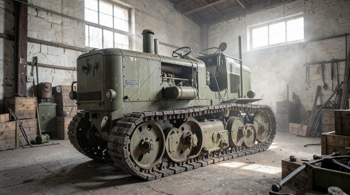
The historical timeline of military tractors in America spans more than a century of mechanical development. During World War I, the Holt Manufacturing Company produced the 5-Ton Artillery Tractor, designed specifically for heavy towing operations 4. Due to high demand, production was expanded through partnerships with companies like the Maxwell Motor Company 4. Similarly, World War II catalyzed the development of the Cletrac M2 High Speed Tractor, built by the Cleveland Tractor Company and John Deere, which featured rubber tracks 5.
Post-war logistics prompted the introduction of even larger ballast tractors and towing vehicles. The Diamond T 980 and 981 models served as 12-ton heavy prime movers, utilizing Hercules DFXE 14.7-liter inline-six engines to haul massive gross weights 6. In the mid-twentieth century, companies like the Mississippi Road Supply Company developed four-wheel-drive towing vehicles like the M.R.S. model I-90, powered by Cummins engines 7. Many of these heavy-duty units eventually entered the civilian market as surplus, establishing a precedent for modern heavy machinery reuse.
| Model | Manufacturer | Engine |
|---|---|---|
| Holt 5-Ton | Holt / Maxwell | Gasoline |
| Cletrac M2 | Cletrac / JD | Hercules WXLC |
| Diamond T 980 | Diamond T | Hercules DFXE |
State and Municipal Level Surplus Infrastructure
Beyond federal channels, individual state administrative offices manage the disposal of local surplus assets. For example, the South Carolina Department of Administration operates a dedicated Surplus Property Office that oversees the distribution of local and federal equipment to public entities and the general public 8. These state-level operations run physical warehouses and digital portals, making inventory accessible to regional buyers 8.
Municipal and regional bids are often aggregated through specialized networks. Platforms like the America Bid Network publish solicitation listings for state and municipal surplus sales, ranging from light utility machinery to heavy industrial tractors 9. For instance, historical bid records document the disposal of local utility tractors, such as a 1984 John Deere 300B loader tractor with associated implements, utilizing minimum bid thresholds to govern public sales 9.
Maintenance Realities and Mechanical Challenges
Potential buyers must acknowledge the significant mechanical risks associated with purchasing decommissioned military equipment. Surplus assets are almost universally sold on an "as-is, where-is" basis, meaning the seller provides no warranty or guarantee of operational readiness 9. Vehicles may have spent years in outdoor storage, exposing hydraulic lines, electrical systems, and structural frames to environmental degradation. In many cases, critical components are missing entirely, requiring extensive diagnostic work and part sourcing.
Historical restoration efforts highlight the complexity of these repairs. When restoring vintage military or agricultural machinery, technicians often have to perform custom engineering. For example, historical records document farmers utilizing surplus Continental diesel engines from bases like Fort McCoy to repower engine-less tractor shells, requiring hand-machined adapter plates 10. Modern surplus buyers face similar hurdles, as military-spec components often differ from standard civilian counterparts, leading to prolonged repair times and limited parts availability.
Logistical Constraints and Transport Considerations
The physical transport of used military surplus tractors represents a significant logistical friction point. Unlike standard passenger vehicles, military utility units are frequently oversized, heavy, and non-operational at the time of sale 11. Buyers are solely responsible for coordinating pickup and transport from secure federal facilities or state warehouses. This process typically requires specialized heavy-haul trailers, flatbeds, and specific loading permits depending on the weight and width of the vehicle.
Furthermore, strict pickup timelines are enforced by surplus agencies, requiring removal of the asset within a designated window after the auction closes. Failure to remove the equipment can result in storage fees or the forfeiture of the purchase. Additionally, out-of-state buyers must account for regional compliance variations, transport permits, and potential bank clearance delays for check payments, which can take up to fourteen days before possession of the vehicle is officially transferred 12.
Sources
- GSAAuctions - Auctions Home (https://www.gsaauctions.gov/)
- How to purchase surplus property | GSA (https://www.gsa.gov/buy-through-us/government-property-for-sale-or-lease/office-of-personal-property-management/for-citizens-seeking-surplus-property/how-to-purchase-surplus-property)
- GovPlanet Government Surplus Auction (https://www.facebook.com/GOVPLANET/videos/the-next-great-deal-could-be-waiting-at-govplanets-government-surplus-auction-on/846145754746926/)
- Collector Rescues, Restores 1918 Holt 5-Ton Artillery Tractor Built for WWI - Machinery Asia (https://machineryasia.org/collector-rescues-restores-1918-holt-5-ton-artillery-tractor-built-for-wwi)
- The Iron Mule: Cletrac's M 2 High Speed Tractor (http://theironmule.blogspot.com/2017/06/cletracs-m-2-high-speed-tractor.html)
- Diamond T Ballast Tractor | Original Hercules Engine | Army Surplus UK (https://www.militarymart.co.uk/products/wwii-diamond-t-980-981-ballast-tractor-original-hercules-engine)
- Made for the US military - Contractor Magazine (https://contractormag.co.nz/contractor/made-for-the-us-military/)
- Surplus Property | Department of Administration - admin.sc.gov (https://admin.sc.gov/services/surplus-property)
- Bid on Surplus Sales | America Bid Network (https://www.americasbiz.net/bid_opportunities/2026/07/25/state/31/14941165-surplus-sales.html)
- Wisconsin Agricultural Historical News (https://wife.ngheanxanh.com/vankok/when-29-year-old-harland-voss-paid-35-for-a-1952-farmall-super-m-with-no-engine-no-starter-no-generator-and-nothing-under-the-hood-but-empty-air-every-man-in-adams-county-laughed-like-he-had-boug/)
- GovPlanet Equipment Disposal Platform (https://www.govplanet.com)
- Harritt Group Equipment Auctions (https://www.harrittgroup.com/gibson-family-kubota-vehicles-tools-household-online-auction/133992/)