Understanding the different types of glaucoma surgery: A Clinical Guide to Procedures, Risks, and Patient Selection
Glaucoma affects an estimated 76 million people worldwide, a figure projected to reach 111.8 million by 2040. 1 Often called the silent thief of sight, this group of eye diseases damages the optic nerve, primarily by elevating intraocular pressure (IOP), and the resulting vision loss is irreversible. 2 Surgery becomes necessary when medications or laser therapies can no longer maintain pressure at a safe target level, making a thorough understanding of the available surgical categories essential for informed patient care.
Why Glaucoma Surgery Becomes Necessary
In a healthy eye, aqueous humor flows through the trabecular meshwork and Schlemm's canal at a rate that keeps IOP stable. In primary open-angle glaucoma, cellular changes within those structures slow drainage gradually, while in acute angle-closure glaucoma, the drainage angle becomes completely blocked. 3 Because optic nerve damage cannot be reversed, the entire focus of treatment, including surgery, centers on preventing further loss by reducing IOP, the only modifiable risk factor currently recognized. 3
Surgery is generally recommended when eye pressure remains above the target despite maximum tolerated medications, when optic nerve damage continues to progress, when medication side effects are difficult to manage, or when advanced disease requires lower target pressures than drops can achieve. 4 Glaucoma is a leading cause of irreversible blindness for people over 60, yet blindness from the condition can often be prevented with timely intervention. 2
Laser Surgery: Selective and Targeted Approaches
Laser procedures are frequently the first surgical step because they are performed in an office setting, require minimal recovery time, and carry a lower risk profile than incisional surgery. Selective laser trabeculoplasty (SLT) uses a focused beam of light to stimulate the trabecular meshwork and improve aqueous outflow without destroying surrounding tissue. Studies referenced by the American Academy of Ophthalmology indicate that SLT is as effective as glaucoma eye drops at controlling eye pressure for many patients with primary open-angle glaucoma, and a newer variant called direct selective laser trabeculoplasty (DSLT) is also now available. 5
A separate laser procedure, laser peripheral iridotomy (LPI), targets angle-closure glaucoma. It creates a small opening in the iris to restore aqueous humor flow through the drainage angle. 6 Cyclophotocoagulation represents a more aggressive laser option reserved for advanced cases; it destroys a portion of the ciliary body that produces aqueous humor, thereby reducing fluid production at its source. 6 Argon laser trabeculoplasty (ALT) is an older variant of the laser approach that has largely been succeeded by SLT in contemporary practice.
Trabeculectomy: The Traditional Filtering Standard
Trabeculectomy has been the benchmark for incisional glaucoma surgery for decades and remains the most preferred procedure among surgeons surveyed in a 2023 Latin American Glaucoma Society study, selected by 48 of 49 responding physicians. 7 The procedure involves creating a small drainage flap in the sclera so that aqueous humor can flow into a reservoir called a bleb under the conjunctiva, bypassing the obstructed natural outflow channels and significantly reducing IOP. 8 It is typically indicated for moderate to advanced glaucoma, cases requiring very low eye pressure, and patients who have not responded to medications or laser therapy.
Despite its efficacy, trabeculectomy carries a higher complication risk compared to newer procedures and requires close post-operative monitoring over an extended period. 8 Complications can include infection, hypotony (excessively low pressure), and bleb failure requiring revision. Recovery is longer than for laser or minimally invasive approaches, and patients should expect frequent follow-up visits to manage wound healing and pressure fluctuations. The procedure's power to achieve very low target pressures makes it the preferred choice when disease severity demands aggressive pressure reduction.
Glaucoma Drainage Implants and Tube Shunt Surgery
When trabeculectomy has failed, when scarring prevents effective bleb formation, or when complex secondary glaucomas such as neovascular glaucoma are present, glaucoma drainage implants, also called tube shunts, are a well-established alternative. These devices place a small silicone tube inside the eye to redirect aqueous humor to an external plate situated beneath the conjunctiva. 9 FDA-approved devices in this category include the Ahmed, Baerveldt, and Molteno shunts, each with distinct plate sizes and valve mechanisms suited to different clinical scenarios. 10
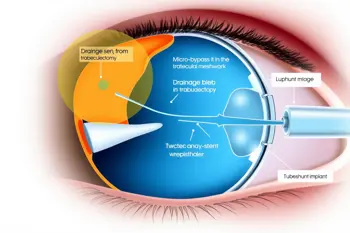
In the same Latin American Glaucoma Society survey, glaucoma drainage devices were selected most frequently across ten diverse clinical scenarios, accumulating 203 individual preferences out of the total responses, compared to 118 for trabeculectomy. 7 Tube shunt surgery carries its own set of risks, including tube erosion, diplopia from restricted eye movement, and the possibility of hypotony or hypertensive phase during the early post-operative period. Careful patient selection and long-term follow-up are integral to managing outcomes.
Minimally Invasive Glaucoma Surgery (MIGS)
MIGS represents a category of procedures defined by an ab interno approach, minimal tissue trauma, and a favorable safety profile compared to traditional filtration surgeries. 11 Research published in the European Society of Medicine's Medical Research Archives estimates that approximately 50 to 70 percent of glaucoma surgical procedures now fall under the MIGS umbrella, generally achieving a slightly lower IOP reduction than conventional filtering surgery but with fewer complications. 12 A 2026 systematic review confirmed that MIGS procedures serve as a safe and effective option, with IOP-lowering outcomes comparable to other proven surgical interventions. 13
MIGS procedures fall into several distinct sub-categories based on their mechanism and anatomical target:
- Trabecular micro-bypass stents: Devices such as the iStent and Hydrus Microstent create a permanent bypass through the meshwork, with 5-year data showing sustained pressure control and reduced medication dependence. 14
- Goniotomy and trabeculotomy-based MIGS: Instruments like the Kahook Dual Blade excise portions of the trabecular meshwork directly, restoring outflow through Schlemm's canal. 14
- Canaloplasty and viscodilation: These canal-based approaches use microcatheters and viscoelastic material to dilate and scaffold Schlemm's canal without implants.
- Subconjunctival filtering devices and gel stents: Devices in this group create a subconjunctival drainage pathway with a lower complication profile than trabeculectomy. 11
- Endoscopic cyclophotocoagulation (ECP): A ciliary body treatment delivered internally, often combined with cataract surgery to reduce medication burden. 15
Candidacy for MIGS typically favors patients with mild to moderate open-angle glaucoma, particularly those already scheduled for cataract surgery or struggling with daily eye drop adherence. Advanced glaucoma cases may still require traditional surgical approaches. 11
Surgical Decision-Making: Risks, Recovery, and Realistic Expectations
No glaucoma surgery restores vision that has already been lost; the sole objective is to halt further optic nerve damage by achieving and sustaining a target IOP. 2 The selection of a procedure depends on disease severity, the angle anatomy observed on gonioscopy, prior surgical history, the surgeon's experience, and the patient's individual tolerance for risk and recovery demands. Ophthalmologists increasingly integrate selective laser trabeculoplasty as a primary option early in the disease course and consider MIGS or drainage implants across the subsequent stages, rather than reserving surgery only for end-stage disease. 16
Recovery timelines vary significantly by procedure. Laser surgery typically allows a return to normal activity within days. MIGS recovery generally spans days to weeks with faster vision stabilization than conventional filtration procedures. Trabeculectomy and tube shunt surgeries require weeks to months of close monitoring, with risks including infection, inflammation, hypotony, and bleb-related complications persisting long after the initial procedure. 8 Post-operative management across all categories demands regular follow-up appointments to monitor pressure, prevent infection, and adjust any residual medication regimens. The expanding toolkit available in 2026 means that individualized therapy, guided by disease stage and anatomy, is now the clinical standard rather than a stepwise escalation through a fixed sequence. 15
Sources
- Liv Hospital - 7 Types of Glaucoma Surgery: A Complete Guide (int.livhospital.com)
- American Academy of Ophthalmology - Understanding Glaucoma: Symptoms, Causes, Diagnosis, Treatment (aao.org)
- Ophthalmology Advisor - Glaucoma Surgery Fact Sheet (ophthalmologyadvisor.com)
- Ubie Health - When is surgery needed for Glaucoma instead of eye drops? (ubiehealth.com)
- American Academy of Ophthalmology - SLT and DSLT Laser Surgeries for Glaucoma (aao.org)
- SASFT - Types of Glaucoma Surgery: What to Know (sasft.org)
- Arquivos Brasileiros de Oftalmologia - Surgical procedures in glaucoma: A preferred practice pattern report by the Latin American Glaucoma Society (doi.org)
- Clarity Eye Surgeons - Glaucoma Surgery Explained: Trabeculectomy, MIGS and Tube Shunts (clarityeyesurgeons.com.au)
- Eye Clinic London - Tube Shunt Surgery for Glaucoma Guide (eyecliniclondon.com)
- Glaucoma Research Foundation - Glaucoma Treatments, Surgeries, And Costs (glaucoma.org)
- Eye Surgery Today - MIGS: Minimally Invasive Glaucoma Surgery Options and Overview (eyesurgerytoday.com)
- European Society of Medicine - Angle-based Minimally Invasive Glaucoma Surgery procedures in glaucoma treatment (esmed.org)
- MDPI Healthcare - The Efficacy and Safety of Minimally Invasive Glaucoma Surgery for Primary Open-Angle Glaucoma: A Systematic Review (mdpi.com)
- Eye Surgery Today - Goniotomy vs Stenting: Which Glaucoma Approach Is Best? (eyesurgerytoday.com)
- Ophthalmology 360 - Interventional Glaucoma in 2026: Patient Selection, Technique, and the Expanding Toolkit (ophthalmology360.com)
- Review of Optometry - Getting in the Glaucoma Groove (reviewofoptometry.com)