Police Impound Offers Musical Instruments for Sale: A Consumer's Guide to How These Auctions Work
When police impound offers musical instruments for sale, the items entering those auctions represent a broad cross-section of seized, abandoned, and unclaimed property recovered through law enforcement operations. These sales are governed by municipal codes, state regulations, and internal departmental policies that mandate transparent public disposition of unclaimed property. Understanding the mechanics behind these events is essential for anyone considering participation.
How Musical Instruments Enter Police Custody
Musical instruments arrive at police impound facilities through several distinct legal pathways. They may be recovered during criminal investigations, discovered as abandoned property, or confiscated as proceeds of crime. In Henderson, Nevada, for example, police property-crimes detective Jameson Harding confirmed the recovery of 15 bass guitars, one amplifier, and effects pedals belonging to Korn bassist Ra Diaz following a storage unit burglary, with the gear located partly through community tip-offs at local music stores. 1 In Belize, the Queen Street Police compound holds annual end-of-year auctions covering items gathered from across the entire country, with ASP Bonifacio Rash noting that the 2025 event included more than 600 accumulated items that had gone unclaimed. 2
In some jurisdictions, instruments can be impounded under municipal ordinance. A documented case in Santa Monica saw city crews take a street performer's upright piano into municipal custody following a scheduled boardwalk enforcement sweep, with a property-retrieval notice posted at the location directing the owner to a designated recovery facility. 3 Once held beyond the statutory waiting period without a verified ownership claim, such items become eligible for public disposal through auction.
Primary Auction Platforms and Agencies
Several established online platforms serve as the primary marketplaces through which law enforcement agencies publicly list impounded instruments and other recovered goods. GovDeals.com functions as a government-focused marketplace where municipal and police departments auction surplus and impounded assets, including guitars and band equipment, to the general public. 4 PropertyRoom.com partners directly with law enforcement agencies across the United States to auction seized and unclaimed personal property, and is among the most prominent third-party sites of this type. 5 Public Surplus provides a similar platform specifically for government entities disposing of confiscated and unclaimed items. 6
In Australia, the ALLBIDS platform handles thousands of police-seized and recovered goods annually on behalf of Australian police departments, with categories spanning electronics, jewellery, computers, and household goods. 7 The Los Angeles Police Department operates a regular auction program that makes impounded property, potentially including musical instruments, available to the public. 8 In Kenya, gazette notices announced the planned auction of over 40 motorcycles and assorted goods held at the Siaya Police Station through Ikimwanya Auctioneers. 9
What Instrument Categories Typically Appear
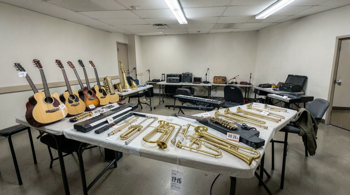
The range of instruments that appear at police impound auctions is broad and largely unpredictable, reflecting the diversity of property recovered in the field. Based on documented auction catalogs, buyers may encounter the following categories:
- Electric, acoustic, and bass guitars from brands such as Fender, Epiphone, Ibanez, Jackson, and Takamine
- Drum sets incorporating components from Pearl, Evans, and Remo
- Keyboards and digital pianos from Casio and Korg
- Synthesizers, violins, and cellos
- Amplifiers, effects pedals, and audio accessories including cables, microphones, and instrument cases
A music store bankruptcy auction catalogued through Maltz Auctions in Levittown, New York, illustrates the scope possible in a single event: the asset list included ukuleles, bass guitars, Korg synthesizers, Meike digital pianos, Howard Core violins, and a full range of accessories, with online bidding spanning a two-day window and a minimum $500 deposit required for registration. 10 While that particular sale arose from insolvency rather than police seizure, impound auctions can carry comparable inventory depth when consolidated from multiple recovery operations.
Buyer Registration, Terms, and Payment Requirements
Participation in police impound auctions is not an open, walk-in process. Regulatory frameworks and platform terms impose clear procedural requirements on all bidders. Buyers must typically register for an account, verify their identity, and agree to binding terms and conditions before placing any bid. At Powell Auction and Realty in Knoxville, Tennessee, police seizure auctions carry a 15% buyer's premium added to the final bid price, sales tax is applied, and payment is accepted only in cash, certified check, or wire transfer. 11 The Kansas City Police Impound Tow Lot Auction, conducted online through OAI Auctions, enforces a strict no-retraction policy on all bids and imposes a permanent bidding ban for non-payment along with forfeiture of a $300 deposit. 12
Items at these auctions are universally sold in their current condition with no warranty offered by the selling agency. Buyers are expected to perform due diligence, including attending in-person preview or inspection windows where offered, before committing to a bid. Shipping is frequently unavailable, with local pickup within a specified window being the standard arrangement.
Legal Framework and Holding Period Obligations
Municipal auctions for impounded property are mandated by state and local laws that require departments to observe a minimum holding period before unclaimed property can be sold. 13 This waiting period exists to provide original owners a legally prescribed window to present documentation and recover their property. In Cyprus, the Limassol Municipality engaged a criminal lawyer and initiated a police report after an internal investigation found only three to four instruments out of approximately 30 belonging to the former Messa Geitonia Municipal Philharmonic, with the missing instruments estimated at a combined value of around 63,000 euros, illustrating how institutional accountability applies to publicly held instrument inventories. 14
Buyers who successfully claim property at auction take title to the item but accept all associated legal risks. If an instrument is later identified as stolen property whose ownership was not properly resolved prior to sale, legal disputes may arise. Prospective buyers are advised to request all available chain-of-custody documentation from the selling agency before completing a purchase. Some departments donate unsold instruments to schools and music nonprofits following failed auction cycles, a practice that reflects the broader community obligation built into these disposal frameworks. 15
Practical Considerations and Risk Factors
Instruments sold through police impound channels typically carry no performance guarantee, and their condition may range from fully functional to requiring professional repair. Buyers should factor potential restoration costs into any bidding decision. Registration deadlines are firm, preview windows are limited, and failure to collect a won item within the designated pickup period typically results in financial penalties or forfeiture. The Bozeman-based band Goners UK reported a theft of instruments valued at approximately $20,000 from a van in Salt Lake City, illustrating how instruments can enter law enforcement recovery pipelines as crime victims' property, adding a layer of provenance complexity to any purchase. 16
Researching the hosting platform's refund and dispute policies before registration is a foundational step. Reviewing the specific lot description, any available photographs, and the stated condition classification provides the best available pre-purchase intelligence. Because these auctions are conducted without recourse, due diligence before bidding is the sole mechanism available to protect a buyer's financial interest.
Sources
- Las Vegas Newsroom – Henderson Police Recover 15 Stolen Guitars Belonging to Korn Bassist Ra Diaz (lasvegasnewsroom.com)
- Greater Belize Media – Big Crowds, Small Bids at Police End-of-Year Auction (greaterbelize.com)
- Santa Monica Close-up – Nathan Raises Funds After City Removes His Pianos from the Boardwalk (santamonicaclose-up.com)
- GovDeals – Government Surplus Auction Marketplace (govdeals.com)
- PropertyRoom – Law Enforcement Auction Partner (propertyroom.com)
- Public Surplus – Government Auction Platform (publicsurplus.com)
- ALLBIDS – Police Auctions Australia (allbids.com.au)
- LAPD Official – Los Angeles Police Department Auction Program (lapdonline.org)
- News Hub Kenya – Police Vehicles, Beer Crates, and Church Chairs to Be Auctioned in Nairobi and Siaya Counties (newshub.co.ke)
- Maltz Auctions – Music Store Bankruptcy Auction, Levittown NY (maltzauctions.com)
- Powell Auction and Realty – Police Seizure Online Only Auction (powellauction.com)
- Woolsey Auction / OAI Auctions – Kansas City Police Tow Lot Auction Terms and Conditions (woolseyauction.com)
- LLM General Research – Municipal Auction Legal Framework and Holding Period Requirements
- Philenews – Limassol Municipality Calls in Criminal Lawyer over Missing Philharmonic Instruments Worth €63,000 (en.philenews.com)
- LLM General Research – Police Department Instrument Donation Practices Post-Auction
- KSL News Radio – At Least $20,000 Worth of Instruments Stolen from Touring Band in Salt Lake City (kslnewsradio.com)