Evaluating Municipal surplus utility trucks for sale: An Analysis of Government Fleet Liquidation Processes
The Lifecycle of Public Fleet Decommissioning
Public sector entities regularly update their operational vehicle fleets to ensure administrative efficiency and adhere to safety regulations. When utility vehicles reach the end of their projected service life or are replaced by newer acquisitions, organizations look to recoup value through specialized public auctions. This process makes municipal surplus utility trucks for sale a frequent option for commercial enterprises and private operators seeking specialized, heavy-duty machinery. Fleet management agencies systematically retire vehicles to maintain fiscal and operational efficacy across statewide highway maintenance networks 1.
Fleet turnover is often driven by annual budgets and contract expirations rather than immediate mechanical failure. For example, large-scale agencies like the California Department of Transportation routinely cycle out thousands of road maintenance and transport assets, transferring older but functional units to specialized auction partners to recover taxpayer-funded value 2. These liquidations feature diverse vehicle categories ranging from motor graders and street sweepers to standard pickup trucks and specialized utility service vehicles 2.
Primary Acquisition Platforms and Methods
Decommissioned government vehicles are distributed through multiple public and electronic auction frameworks depending on the jurisdiction of the selling agency. On the federal level, the General Services Administration coordinates nationwide vehicle sales, providing access to federal surplus through dedicated portals such as GSA Fleet Vehicle Sales and GSA Auctions 3. Local municipal authorities and utility districts, conversely, rely heavily on online third-party bidding platforms. Platforms like Municibid and GovDeals function as major regional clearinghouses, allowing public works departments to list municipal assets directly to regional buyers 4.
Some regional entities prefer localized or sealed-bid processes rather than continuous digital bidding platforms. For instance, the Town of Kimball, Wisconsin, utilizes structured, sealed-bid solicitations for its retired equipment, requiring physical delivery of marked bid envelopes to the municipal garage by specific deadlines 5. Similarly, other regions utilize specialized auction firms like Purple Wave Auction to manage online bidding sequences for local utilities and municipal boards 6.
Classification of Available Surplus Assets
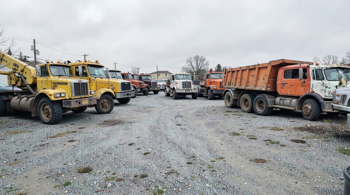
The inventory available through municipal liquidation channels spans multiple utility categories, reflecting the diverse responsibilities of municipal departments. Buyers commonly encounter heavy-duty vocational vehicles such as dump trucks, bucket trucks, and specialized sewer or vacuum trucks alongside standard utility pickups. These vehicles are designed for durability, often featuring specialized steel beds, integrated toolboxes, or hydraulic attachments that would be expensive to install on standard commercial chassis.
| Vehicle Model | Configuration | Key Specifications |
|---|---|---|
| 2010 International 7300 9 | Digger Truck | MaxxForce DT, Altec DM47 9 |
| 2012 International Durastar 4400 6 | Bucket Truck | TL50 Aerial Bucket 6 |
| 2009 Ford F-350 XL 10 | Dump Truck | Dump bed, plow, spreader 10 |
This structural variety allows specialized contractors to acquire highly functional machinery that matches narrow operational needs. Utility districts and municipal agencies, such as Brookings Municipal Utilities or the Surgoinsville Utility District, frequently release heavy-duty platforms including stepsides, dump trucks, and standard service trucks equipped with safety lighting and utility boxes 7 8. These configurations provide robust hauling capabilities and pre-installed safety equipment.
Technical and Operational Friction Points
While municipal utility trucks represent specialized equipment, prospective buyers must navigate substantial operational risks. The vast majority of municipal surplus sales are conducted strictly on an as-is, where-is basis, meaning the selling agency offers no warranties or operational certifications. Vehicles may have spent years in active service under intense environmental conditions, leading to mechanical wear that is not immediately apparent. For instance, some retired municipal dump trucks are auctioned in non-running conditions due to severe engine issues like bad injectors 5.
Similarly, older specialized hardware may suffer from electrical or structural degradation that limits immediate deployment. A historical auction of a 1997 Ford Super Duty bucket truck by Berwick Township revealed a damaged rear fuel tank skid plate and a generator that shuts off after 45 minutes of operation 11. Furthermore, administrative hurdles such as missing vehicle titles are common in municipal liquidation processes. Buyers must carefully inspect auction terms, as vehicles like retired fire trucks or dump trucks are sometimes sold without a legal title 5.
Inspection and Transport Realities
Due to the legal limitations of municipal sales, thorough pre-bid physical inspections are critical. Most agencies establish designated viewing schedules and locations to allow buyers to examine the mechanical state of the vehicles. For example, Lassen Municipal Utility District provides structured inspection windows at its Operations Center, permitting supervised public viewing before bids are finalized 12. These inspections allow mechanical professionals to evaluate critical components, check service histories, and run basic diagnostics on complex hydraulic systems that are costly to repair or replace.
Once a bid is awarded, the logistics of transport and vehicle removal rest solely on the buyer. Public entities do not provide loading, lifting, towing, or hauling services. The Watertown Municipal Utilities board explicitly mandates that any methods of lifting, towing, and hauling are the exclusive responsibility of the purchaser 6. Furthermore, strict removal timelines are typically enforced, often requiring the buyer to pay and remove the asset within five to ten business days of the award notice 5 13.
Regulatory Compliance and Bidding Protocols
Participation in municipal auctions requires strict adherence to institutional protocols and state-specific regulatory structures. Bidding mechanisms vary widely, spanning electronic bidding on certified third-party platforms to sealed bids reviewed during public municipal meetings. Local boards, such as the Town of McMillan, Wisconsin, may employ specific rules, such as accepting the highest responsible offer at a single increment above the next-highest offer 14. These rules are designed to maintain transaction transparency and ensure that local public bodies remain compliant with state procurement statutes.
Payment compliance represents another critical area of friction for prospective buyers. Municipalities do not offer financing, and successful bidders are usually required to settle balances quickly using cash, certified cashier's checks, or approved electronic fund transfers. In addition, local public agencies reserve the right to waive minor bidding irregularities or reject all received bids if they do not meet minimum value expectations 7. Navigating these structured protocols ensures that the final acquisition is legally secure and complies with all localized asset disposal laws.
Sources
- Archynewsy
- Bar None Auction
- USAGov
- Municibid
- Town of Kimball
- Watertown Current
- Brookings Municipal Utilities
- Starbridge
- RTI Auctions
- Starbridge
- Starbridge
- Lassen Municipal Utility District
- The Villagers Voice
- Town of McMillan