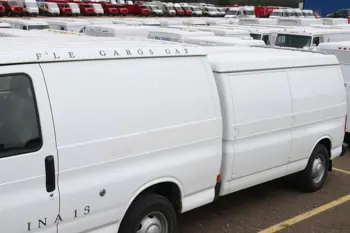
Government surplus work vans on sale
Government surplus work vans on sale through public auction channels represent one of the most structured and transparent secondary markets for commercial fleet vehicles in the United States. Federal agencies, state departments of transportation, county maintenance divisions, and municipal townships all periodically retire cargo vans, passenger vans, and utility vehicles from active service, liquidating them through competitive bidding systems that are open to the general public, businesses, and eligible nonprofit organizations. 1
How the Government Surplus Vehicle Auction System Works
According to USAGov, the federal government auctions thousands of motor vehicles each year through multiple channels. 1 Some are government-owned fleet assets in operational condition, while others were seized from private parties and may require significant mechanical attention. Auctions may take place online, in person, or via mail-in bid, depending on the administering agency. The federal agency that owns the vehicles may conduct the sale directly or contract with a licensed auction company to manage the transaction on its behalf.
At the federal level, four primary channels handle most vehicle disposals: GSA Fleet Vehicle Sales handles government-owned vehicles that are roadworthy and ready to drive; GSA Auctions covers vehicles and other excess government property; the U.S. Marshals Service manages seized asset auctions involving vehicles forfeited in connection with Department of Justice proceedings; and U.S. Treasury auctions cover property forfeited for tax evasion or Treasury law violations. 1 Each channel has distinct eligibility rules, title conditions, and inspection access policies that prospective bidders must review independently.
Key Auction Platforms for Government Work Vans
GovDeals operates as a primary online marketplace where state and local government agencies list surplus equipment and vehicles, including cargo and passenger vans organized by vehicle type and geographic location. 2 The GSA Fleet Marketplace at marketplace.gsafleet.gov maintains dedicated browsable categories for Cargo Vans, Light Cargo Vans (4x2), Medium-Heavy Vans, and Passenger Vans among more than 35 vehicle type classifications. 3 Public Surplus serves local governments, school districts, and university fleet programs as a specialized liquidation platform. 4 The Massachusetts Operational Services Division, for example, allows members of the general public to bid on available surplus property through the state's own online auction portal, with state agencies and municipalities declaring surplus items through OSD's Surplus Property Program. 5
The State of Hawaii's Department of Accounting and General Services operates two distinct programs: a Federal Surplus Property program that offers motor vehicles and heavy equipment to qualified donees including state and local governments, eligible nonprofits, and select small businesses, and a State Surplus Property program where qualified donees receive priority access for 30 business days before items become available to the general public for auction. 6 Illinois operates similarly through the CMS Surplus Property Control Division, which disposes of all surplus personal property generated by state agencies, boards, universities, and constitutional officeholders, as well as excess federal government property through the Law Enforcement Support Office channel. 7
Representative Vehicle Examples and Real-World Auction Data
Published auction records illustrate the range of work van inventory entering the government surplus market. A 2005 Ford Econoline E350 Extended Cargo Van offered on behalf of the Colorado Department of Revenue carried 187,090 miles, a V10 6.8L engine producing 305-310 horsepower, automatic transmission, and rear-wheel drive, with Experian Autocheck records showing 2 calculated owners and 0 calculated accidents. 8 The State of New Jersey listed a 2007 Dodge SE Caravan from a state treasury fleet with 122,852 odometer miles, a 3.3L V6 flex-fuel engine, automatic transmission, and a mechanical note indicating it requires a boost start, with body condition rated fair and rust spots noted. 9
At the township level, Swancreek Township in Ohio accepted sealed bids for a 2005 Chevrolet Astro Van showing 200,674 miles, sold strictly as-is, with bids submitted by mail or in person with a stated deadline of August 3, 2026. 10 The Pennsylvania Department of Transportation routinely liquidates retired trucks, sedans, utility vehicles, and specialized machinery through Municibid, the official online portal for government surplus across the state. 11 These examples collectively demonstrate that surplus inventory spans model years from the early 2000s through relatively recent model years depending on fleet rotation schedules.
Buyer's Premium, Title Types, and Financial Considerations
Buyers must factor costs beyond the winning bid price into any acquisition calculation. Buyer's premiums on government auction platforms commonly range from 10% to 12.5% of the hammer price. 12 The All Surplus platform, which aggregates government seller listings with pricing that has historically ranged from $1 to $2,400,000 depending on asset type, charges a 12.5% buyer's premium. 13 Sales tax and vehicle registration fees apply in the buyer's home jurisdiction and are not typically incorporated into auction pricing. Bidders should also account for transportation costs if the winning vehicle is located in a different state.
Title condition is a critical variable. Some surplus vans carry clean titles, others carry salvage titles, and a portion of seized vehicles may have title complications that require legal resolution before standard registration is possible. The 2009 International 4300 box truck auctioned in Floyd County, Georgia, for example, was listed with a salvage title despite being described as good overall condition. 14 Vehicles listed as exempt from odometer disclosure present additional uncertainty, as the mileage cannot be legally certified and may not reflect actual use.
Condition Realities and Inspection Protocols
Government fleet vehicles generally benefit from scheduled preventive maintenance programs and documented service histories, which distinguishes them from privately owned used vehicles where maintenance records may be incomplete. 15 However, surplus auction terms universally include as-is, where-is conditions with no warranties expressed or implied. The State of New Jersey explicitly states in its surplus vehicle listings that the condition of all surplus vehicles is unknown and that the surplus unit does not receive information or history on vehicles turned in for surplus, strongly advising bidders to inspect in person before placing bids. 9
Inspection windows are typically offered by appointment only and are time-limited. Some platforms like IronPlanet provide third-party inspection reports for heavier commercial inventory. 16 Bidders purchasing vehicles with noted mechanical issues such as cold-weather starting problems, hail damage, or sitting-related fuel system issues should obtain independent pre-purchase mechanical assessments where inspection access is granted. Emissions certification responsibility in applicable states falls entirely on the buyer after the sale is completed.
Eligibility, Access Restrictions, and Program Limitations
Not all government surplus vehicle programs are open to the general public without qualification. Federal surplus property programs administered under Defense Logistics Agency channels and some state-level federal transfer programs are restricted to state and local governments, eligible nonprofit organizations providing health, educational, or homeless services, and certain Small Business Administration-affiliated small businesses. 6 General members of the public typically access the broader inventory through state surplus property programs and municipal auction platforms after priority periods for government entities have elapsed.
State-level programs also impose geographic constraints. Vehicles listed through county or township sealed bid processes, such as the Swancreek Township example, require physical pickup from the selling jurisdiction's maintenance facility. 10 Online-only auction formats administered through platforms like GovDeals and Public Surplus allow remote bidding but still require in-person vehicle collection within specified timeframes after auction close. Failure to retrieve a purchased vehicle within the stated deadline can result in forfeiture of the winning bid and removal fees charged to the buyer's account.
Market Context: Government Surplus vs. Commercial Used Van Pricing
Understanding how government auction prices compare to the broader commercial used van market helps bidders calibrate realistic expectations. In the general used market, a 2025 Chevrolet Express 2500 Work Van with approximately 7,904 miles carried an asking price of $38,922, described as 14% below the average market price of $45,031 for comparable units. 17 A similarly configured 2024 Chevrolet Express 2500 Work Van with 19,215 miles was listed at $27,900, with the dealer noting a rebuilt title due to prior low freshwater damage. 18 Government surplus vans with high mileage and as-is conditions generally attract final auction prices well below these commercial benchmarks, though final hammer prices vary significantly based on local bidder competition, vehicle condition transparency, and title status.
Orange County, Florida surplus auctions have recorded final sale prices as low as $400 for SUVs and $1,000 for dump trucks, illustrating the wide pricing variance possible in competitive government auction environments. 19 Buyers should research comparable recent closed auction results on the relevant platform to develop realistic bidding ranges before participating, rather than relying on retail market comparisons as a proxy for expected government auction outcomes.
Sources
- USAGov - Government vehicle auctions (usa.gov/car-auctions)
- GovDeals - Government Surplus Marketplace (govdeals.com)
- GSA Fleet Marketplace - Browse Vehicles (marketplace.gsafleet.gov)
- Public Surplus - Government Auction Platform (publicsurplus.com)
- Commonwealth of Massachusetts Operational Services Division - Surplus Property Program (LinkedIn, 2026)
- State of Hawaii, Department of Accounting and General Services - Surplus Property Office (LinkedIn, 2025)
- Illinois Department of Central Management Services - Surplus Property Control Division (LinkedIn/exa.ai profile)
- Global Auction Guide - 2005 Ford Econoline E350 Extended Cargo Van, Colorado Dept. of Revenue (globalauctionguide.com)
- Global Auction Guide - 2007 Dodge SE Caravan, State of New Jersey (globalauctionguide.com)
- Swancreek Township - 2005 Chevy Astro Van Sealed Bids Notice (swancreektwp.org)
- Archynewsy - Pennsylvania Surplus Vehicles and Equipment to be Auctioned (archynewsy.com)
- LLM General Research - Buyer premiums and auction cost structures for government surplus vehicles
- Top Consumer Reviews - All Surplus vs US Auction Online, Government Auction Sites 2026 (topconsumerreviews.com)
- Dempsey Auction Company - Surplus Commercial Box Truck Fleet, Floyd County GA (dempseyauction.com)
- LLM General Research - Government fleet preventive maintenance practices
- IronPlanet - Government and commercial surplus marketplace with inspection reports (ironplanet.com)
- AutosToday - 2025 Chevrolet Express 2500 Work Van HD, Federal Way WA (autostoday.com)
- AutosToday - 2024 Chevrolet Express 2500 Work Van HD, London KY (autostoday.com)
- ClickOrlando - Orange County auction vehicle pricing report, January 2026 (clickorlando.com)