Government Seized Heavy Machinery on Sale in Canada: A Complete Buyer's Guide to Surplus Equipment Auctions
Government seized heavy machinery on sale in Canada represents a distinct segment of the country's used equipment market, one that originates from law enforcement actions, tax enforcement, civil forfeiture proceedings, and the routine retirement of publicly owned assets. Understanding the structural difference between these categories, and recognizing the platforms and rules that govern each type of sale, is essential for any buyer researching this market sector.
How Government Agencies Seize and Dispose of Heavy Machinery in Canada
In Canada, multiple government bodies hold the authority to seize heavy equipment. The Canada Revenue Agency (CRA) operates under some of the most aggressive debt-collection powers in the country and, without needing a standard court judgment, can escalate outstanding corporate tax debts to physical asset seizure. 1 When a business in cities such as Edmonton, Winnipeg, or Ottawa fails to resolve substantial GST/HST, corporate income tax, or payroll source deductions, CRA can dispatch a bailiff to physically take equipment and inventory, which is then liquidated through public channels. 1
Law enforcement seizures follow a separate path. Once police complete legal proceedings and courts authorize forfeiture, items are transferred into surplus disposal channels. In Alberta, for instance, a February 2026 operation by Breton/Thorsby RCMP and the Central Alberta District Crime Reduction Unit resulted in the recovery of three semi tractors, seven trailers, a skid steer, two tractors, a shipping container of industrial hosing valued at approximately $175,000, and numerous additional pieces of machinery, all linked to 16 separate theft occurrences. 2 After forfeiture decisions are finalized, assets of this kind typically enter government-authorized auction pipelines.
Primary Federal Platform: GCSurplus
The federal government's primary mechanism for disposing of surplus and seized assets is GCSurplus, operated under Public Services and Procurement Canada. 3 The platform processes substantial volumes annually; in the last reported fiscal year, it completed over 13,927 sales transactions, 209 transfers, and 513 donations. 4 Heavy machinery categories available through GCSurplus have historically included construction equipment, tractors, and industrial machinery derived from public works departments, military surplus, and assets seized during legal proceedings. 3
A critical characteristic of GCSurplus listings is that items are sold on an as-is, where-is basis. The government provides no warranties or guarantees regarding the operational condition of the equipment. 5 Prospective buyers must register for a verified account on the platform and provide valid identification before participating in any auction. 5 Winning bidders are also entirely responsible for all logistics, including loading, transportation, and any export documentation required if the machinery is moved across provincial or international borders. 5
Municipal and Provincial Disposal Channels
Municipalities and provincial governments operate parallel disposal networks. The City of Calgary, for example, no longer manages its own online surplus store; all surplus items, including police seizures, unclaimed lost-and-found property, vehicles, and industrial equipment, are now routed through a contracted local auction service, Michener Allen Auctioneering Ltd. 6 Items that can appear in these sales include industrial equipment and machinery, trailers, vehicles, fire equipment, and court seizures. 6
At the provincial and cross-jurisdictional level, platforms such as GovDeals provide a marketplace where various Canadian government agencies can auction surplus and seized goods to the public. 7 Ritchie Bros. Auctioneers conducts large-scale unreserved public auctions that frequently feature government-owned or seized industrial equipment, often drawing national and international bidders. 8 Municipalities in Ontario have also utilized these third-party platforms to dispose of heavy equipment retired from public service or processed through legal forfeiture. 9
Types of Machinery Commonly Available and Realistic Expectations
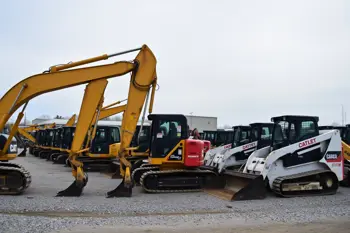
The inventory entering Canadian government surplus auctions through seized or retired channels spans a wide range of equipment classes. Based on historical disposal patterns, categories buyers may encounter include the following:
- Excavators and bulldozers recovered from theft investigations or forfeiture actions
- Semi tractors and commercial trailers seized during criminal proceedings
- Skid steers and compact track loaders retired from municipal public works fleets
- Agricultural tractors processed through provincial surplus systems
- Industrial machinery including manufacturing lines and specialized processing equipment
- Shipping containers and portable storage structures
The Canada.ca government portal describes GCSurplus as the primary channel for bidding on surplus goods including electronics, office equipment, vehicles, and more, and explicitly notes that heavy construction and industrial machinery falls within its scope. 3 Buyers should treat any available inventory as historically variable and subject to the internal re-use needs of government agencies at any given time, as surplus equipment and materials remain subject to re-use within government departments prior to being listed for public sale. 6
Legal Complexities and Buyer Risk Factors
Purchasing seized or forfeited heavy machinery carries notable legal and financial risks that differ significantly from buying through conventional used-equipment dealers. A prominent Nova Scotia case illustrates this clearly: the province's Department of Justice seized a $300,000 Powerscreen Warrior 800 topsoil machine owned by contractor Arni Lively as part of an investigation into an alleged illegal landfill, even though Lively maintained he was unaware of any illegal activity. The forfeiture claim was eventually dropped, but Lively estimated he had lost $250,000 in operating income and a major client, while six employees were left without work for months. 10
This case, along with Quebec Court of Appeal decisions clarifying ownership claims in receivership contexts, underscores that title and ownership history on seized equipment can be legally complex. The 2025 Quebec decision in Séquestre de Bois BSL inc. / BSL Wood Products Inc., 2025 QCCA 993 established, among other points, that late registration of security interests invalidates ownership claims once federal insolvency law applies. 11 Buyers should independently verify that legal proceedings are fully concluded and that no competing ownership or security interest claims remain outstanding on any item before committing to a purchase.
Due Diligence Standards for Auction Participants
Given the as-is sale conditions and the potential for unresolved legal encumbrances, buyers researching government surplus heavy machinery in Canada are generally advised to apply a structured evaluation approach before bidding. Standard industry practices observed across these platforms include in-person equipment inspections during designated viewing periods, independent mechanical assessments, and lien searches appropriate to the province where the equipment was registered.
Payment conditions on government auction platforms typically require settlement within defined timelines, and failure to comply can result in forfeiture of any deposit and exclusion from future sales. 5 Canadian surplus disposal auctions have also been observed to restrict bidding participation to eligible parties in certain categories, particularly when military surplus or specialized industrial equipment is involved. 5 Buyers transporting heavy machinery across provincial borders or internationally must also account for transport permits, oversize-load regulations, and potential customs documentation costs that are not factored into the auction hammer price.
Ongoing Enforcement Activity and Market Context
The supply of seized heavy machinery entering Canadian surplus channels is closely tied to ongoing law enforcement activity levels. Alberta RCMP's auto theft unit executed a search warrant at the Edmonton headquarters of international construction equipment manufacturer XCMG on April 21, 2026 as part of a fraud investigation. 12 XCMG is described as one of the world's largest manufacturers of construction equipment, and a British Columbia court had previously granted an injunction in March 2026 related to a dispute involving more than $32 million. 12 Separately, Ontario Provincial Police, as part of Operation TRACK, seized five complete commercial-sized cigarette manufacturing lines and machinery from a facility on Six Nations of the Grand River territory, with an estimated combined value exceeding $10 million. 13 These enforcement actions demonstrate that significant volumes of industrial and heavy machinery continue to enter the forfeiture and disposal pipeline across Canada, representing an ongoing, if unpredictable, source of assets for the government surplus auction market.
Sources
- lawyerinfo.ca - CRA Corporate Asset Seizure: What Can They Take in Canada?
- rcmp.ca - Alberta RCMP Detachments and Crime Reduction Teams seize over 1 million dollars in stolen equipment
- canada.ca - Buying from government (GCSurplus)
- gcsurplus.ca - Shop now on GCSurplus (fiscal year statistics)
- canada.ca / Public Services and Procurement Canada - GCSurplus terms and buyer conditions
- calgary.ca - Surplus sales and public auctions (City of Calgary)
- govdeals.com - Government Surplus Auctions
- rbauction.com - Ritchie Bros. Auctioneers
- amo.on.ca - Association of Municipalities of Ontario
- stillmancollegebands.com - Nova Scotia Justice Department Drops Forfeiture Claim: Contractor's $300K Machine Returned (2026)
- mondaq.com - Whose Tractor Is It Anyway? Quebec Decision Clarifies Ownership Claims In Receivership (Bennett Jones LLP, 2025)
- edmonton.citynews.ca - Fraud probe: Alberta RCMP search XCMG's Edmonton office
- ottawacitizen.com - Police raid bootleg cigarette factory on Six Nations reserve